

268
17 Earlier Times and Radiation
0.4
1.0
0.0
0.2
0.6
0.8
0.0
0.6
0.4
0.2
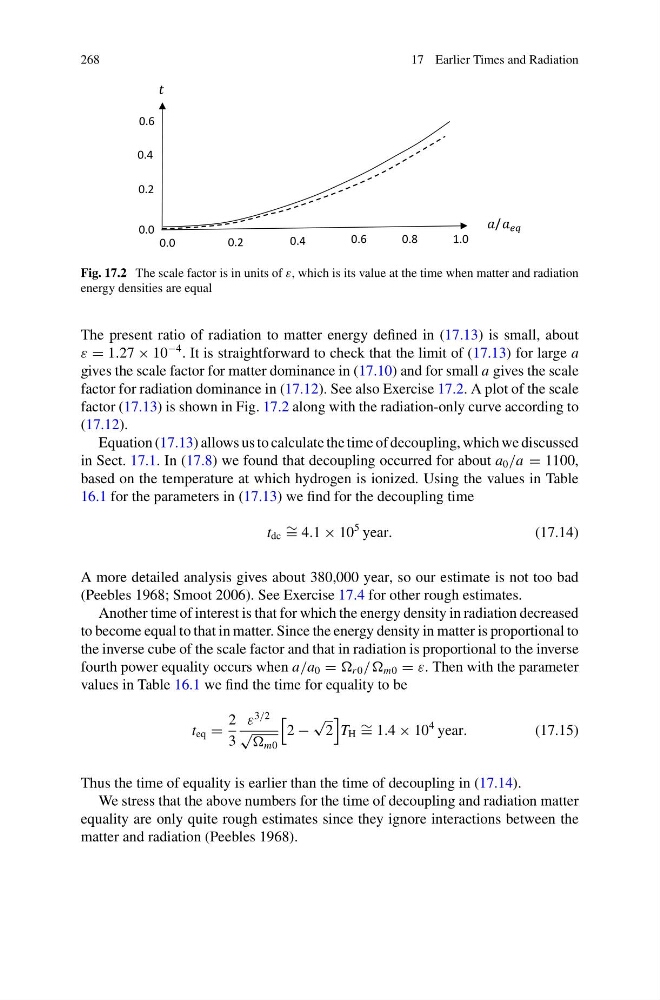
Fig. 17.2 The scale factor is in units of ε, which is its value at the time when matter and radiation
energy densities are equal
The present ratio of radiation to matter energy defined in (17.13) is small, about
ε = 1.27 × 10
−4 . It is straightforward to check that the limit of (17.13) for large a
gives the scale factor for matter dominance in (17.10) and for small a gives the scale
factor for radiation dominance in (17.12). See also Exercise 17.2. A plot of the scale
factor (17.13) is shown in Fig. 17.2 along with the radiation-only curve according to
(17.12).
Equation (17.13) allows us to calculate the time of decoupling, which we discussed
in Sect. 17.1. In (17.8) we found that decoupling occurred for about a 0 /a = 1100,
based on the temperature at which hydrogen is ionized. Using the values in Table
16.1 for the parameters in (17.13) we find for the decoupling time
t dc ∼ = 4.1 × 10
5 year.
(17.14)
A more detailed analysis gives about 380,000 year, so our estimate is not too bad
(Peebles 1968; Smoot 2006). See Exercise 17.4 for other rough estimates.
Another time of interest is that for which the energy density in radiation decreased
to become equal to that in matter. Since the energy density in matter is proportional to
the inverse cube of the scale factor and that in radiation is proportional to the inverse
fourth power equality occurs when a/a 0 = r 0 // m0 = ε. Then with the parameter
values in Table 16.1 we find the time for equality to be
t eq =
2
3
ε
3/2
√ m0
2 −
√
2
T H ∼ = 1.4 × 10
4 year.
(17.15)
Thus the time of equality is earlier than the time of decoupling in (17.14).
We stress that the above numbers for the time of decoupling and radiation matter
equality are only quite rough estimates since they ignore interactions between the
matter and radiation (Peebles 1968).
17 Earlier Times and Radiation
0.4
1.0
0.0
0.2
0.6
0.8
0.0
0.6
0.4
0.2
Fig. 17.2 The scale factor is in units of ε, which is its value at the time when matter and radiation
energy densities are equal
The present ratio of radiation to matter energy defined in (17.13) is small, about
ε = 1.27 × 10
−4 . It is straightforward to check that the limit of (17.13) for large a
gives the scale factor for matter dominance in (17.10) and for small a gives the scale
factor for radiation dominance in (17.12). See also Exercise 17.2. A plot of the scale
factor (17.13) is shown in Fig. 17.2 along with the radiation-only curve according to
(17.12).
Equation (17.13) allows us to calculate the time of decoupling, which we discussed
in Sect. 17.1. In (17.8) we found that decoupling occurred for about a 0 /a = 1100,
based on the temperature at which hydrogen is ionized. Using the values in Table
16.1 for the parameters in (17.13) we find for the decoupling time
t dc ∼ = 4.1 × 10
5 year.
(17.14)
A more detailed analysis gives about 380,000 year, so our estimate is not too bad
(Peebles 1968; Smoot 2006). See Exercise 17.4 for other rough estimates.
Another time of interest is that for which the energy density in radiation decreased
to become equal to that in matter. Since the energy density in matter is proportional to
the inverse cube of the scale factor and that in radiation is proportional to the inverse
fourth power equality occurs when a/a 0 = r 0 // m0 = ε. Then with the parameter
values in Table 16.1 we find the time for equality to be
t eq =
2
3
ε
3/2
√ m0
2 −
√
2
T H ∼ = 1.4 × 10
4 year.
(17.15)
Thus the time of equality is earlier than the time of decoupling in (17.14).
We stress that the above numbers for the time of decoupling and radiation matter
equality are only quite rough estimates since they ignore interactions between the
matter and radiation (Peebles 1968).