

17.2 The Scale Factor and Basic Properties of the Radiation Era
267
17.2 The Scale Factor and Basic Properties
of the Radiation Era
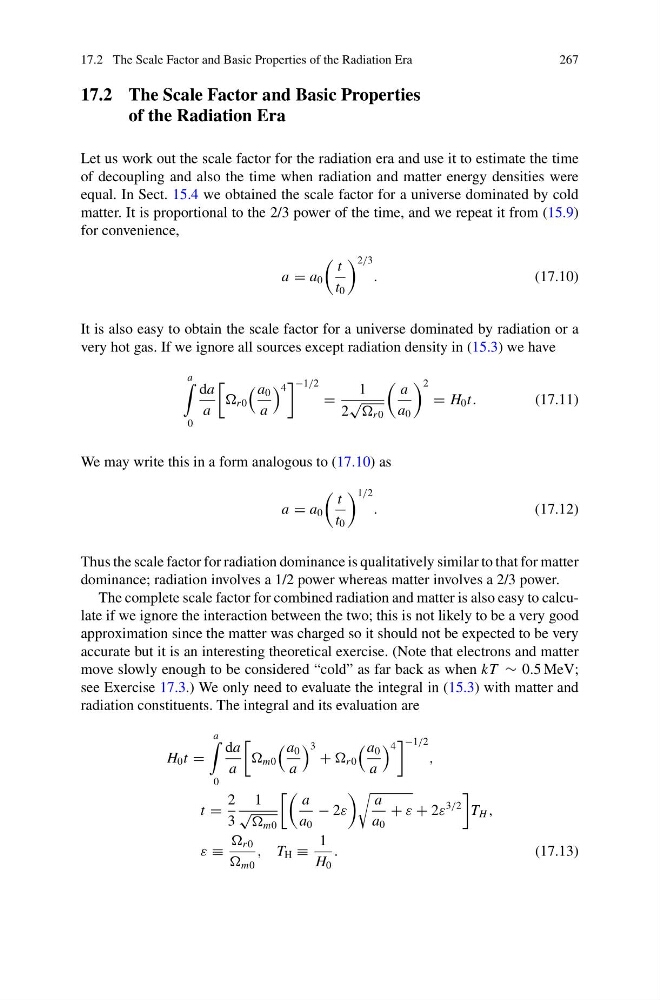
Let us work out the scale factor for the radiation era and use it to estimate the time
of decoupling and also the time when radiation and matter energy densities were
equal. In Sect. 15.4 we obtained the scale factor for a universe dominated by cold
matter. It is proportional to the 2/3 power of the time, and we repeat it from (15.9)
for convenience,
a = a 0
t
t 0
2/3
.
(17.10)
It is also easy to obtain the scale factor for a universe dominated by radiation or a
very hot gas. If we ignore all sources except radiation density in (15.3) we have
a
0
da
a
r 0
a 0
a
4
−1/2
=
1
2
√
r 0
a
a 0
2
= H 0 t.
(17.11)
We may write this in a form analogous to (17.10) as
a = a 0
t
t 0
1/2
.
(17.12)
Thus the scale factor for radiation dominance is qualitatively similar to that for matter
dominance; radiation involves a 1/2 power whereas matter involves a 2/3 power.
The complete scale factor for combined radiation and matter is also easy to calculate if we ignore the interaction between the two; this is not likely to be a very good
approximation since the matter was charged so it should not be expected to be very
accurate but it is an interesting theoretical exercise. (Note that electrons and matter
move slowly enough to be considered “cold” as far back as when kT ∼ 0.5 MeV;
see Exercise 17.3.) We only need to evaluate the integral in (15.3) with matter and
radiation constituents. The integral and its evaluation are
H 0 t =
a
0
da
a
m0
a 0
a
3 + r 0
a 0
a
4
−1/2
,
t =
2
3
1
√
m0
a
a 0
− 2ε
a
a 0
+ ε + 2ε
3/2
T H ,
ε ≡
r 0
m0
, T H ≡
1
H 0
.
(17.13)
267
17.2 The Scale Factor and Basic Properties
of the Radiation Era
Let us work out the scale factor for the radiation era and use it to estimate the time
of decoupling and also the time when radiation and matter energy densities were
equal. In Sect. 15.4 we obtained the scale factor for a universe dominated by cold
matter. It is proportional to the 2/3 power of the time, and we repeat it from (15.9)
for convenience,
a = a 0
t
t 0
2/3
.
(17.10)
It is also easy to obtain the scale factor for a universe dominated by radiation or a
very hot gas. If we ignore all sources except radiation density in (15.3) we have
a
0
da
a
r 0
a 0
a
4
−1/2
=
1
2
√
r 0
a
a 0
2
= H 0 t.
(17.11)
We may write this in a form analogous to (17.10) as
a = a 0
t
t 0
1/2
.
(17.12)
Thus the scale factor for radiation dominance is qualitatively similar to that for matter
dominance; radiation involves a 1/2 power whereas matter involves a 2/3 power.
The complete scale factor for combined radiation and matter is also easy to calculate if we ignore the interaction between the two; this is not likely to be a very good
approximation since the matter was charged so it should not be expected to be very
accurate but it is an interesting theoretical exercise. (Note that electrons and matter
move slowly enough to be considered “cold” as far back as when kT ∼ 0.5 MeV;
see Exercise 17.3.) We only need to evaluate the integral in (15.3) with matter and
radiation constituents. The integral and its evaluation are
H 0 t =
a
0
da
a
m0
a 0
a
3 + r 0
a 0
a
4
−1/2
,
t =
2
3
1
√
m0
a
a 0
− 2ε
a
a 0
+ ε + 2ε
3/2
T H ,
ε ≡
r 0
m0
, T H ≡
1
H 0
.
(17.13)