

16.7 Conformal Time
261
e
−
√
= 1 −
3
cτ,
(16.31)
and thus from (16.27)
b(τ ) = a(t) =
1
1 −
√
/3cτ
.
(16.32)
The conformal metric is then
ds
2
=
1
1 −
√
2
c
2 dτ
2
− d x
2
.
(16.33)
The conformal time τ is given in terms of the FLRW time in (16.30); when the
universe begins at t = 0 the conformal time is also τ = 0. The end of the universe
at t = ∞ corresponds to a finite conformal time
cτ =
3//, end of the universe!
(16.34)
The line element (16.33) is singular at this final time, meaning that physical distances
between comoving objects in the expanding universe are all infinite.
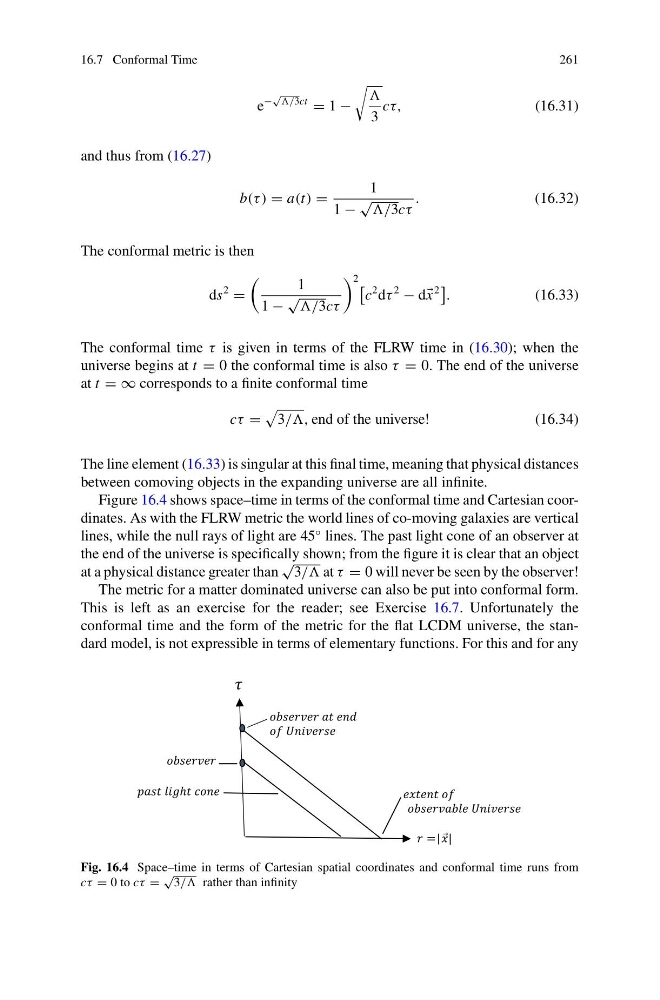
Figure 16.4 shows space–time in terms of the conformal time and Cartesian coordinates. As with the FLRW metric the world lines of co-moving galaxies are vertical
lines, while the null rays of light are 45
◦ lines. The past light cone of an observer at
the end of the universe is specifically shown; from the figure it is clear that an object
at a physical distance greater than
√
3// at τ = 0 will never be seen by the observer!
The metric for a matter dominated universe can also be put into conformal form.
This is left as an exercise for the reader; see Exercise 16.7. Unfortunately the
conformal time and the form of the metric for the flat LCDM universe, the standard model, is not expressible in terms of elementary functions. For this and for any
Fig. 16.4 Space–time in terms of Cartesian spatial coordinates and conformal time runs from
cτ = 0 to cτ =
√
3// rather than infinity
261
e
−
√
= 1 −
3
cτ,
(16.31)
and thus from (16.27)
b(τ ) = a(t) =
1
1 −
√
/3cτ
.
(16.32)
The conformal metric is then
ds
2
=
1
1 −
√
2
c
2 dτ
2
− d x
2
.
(16.33)
The conformal time τ is given in terms of the FLRW time in (16.30); when the
universe begins at t = 0 the conformal time is also τ = 0. The end of the universe
at t = ∞ corresponds to a finite conformal time
cτ =
3//, end of the universe!
(16.34)
The line element (16.33) is singular at this final time, meaning that physical distances
between comoving objects in the expanding universe are all infinite.
Figure 16.4 shows space–time in terms of the conformal time and Cartesian coordinates. As with the FLRW metric the world lines of co-moving galaxies are vertical
lines, while the null rays of light are 45
◦ lines. The past light cone of an observer at
the end of the universe is specifically shown; from the figure it is clear that an object
at a physical distance greater than
√
3// at τ = 0 will never be seen by the observer!
The metric for a matter dominated universe can also be put into conformal form.
This is left as an exercise for the reader; see Exercise 16.7. Unfortunately the
conformal time and the form of the metric for the flat LCDM universe, the standard model, is not expressible in terms of elementary functions. For this and for any
Fig. 16.4 Space–time in terms of Cartesian spatial coordinates and conformal time runs from
cτ = 0 to cτ =
√
3// rather than infinity