

262
16 Some Properties of the LCDM Universe
scale factor (16.28) still serves as a definition of the conformal time in terms of the
function F(t).
Exercises
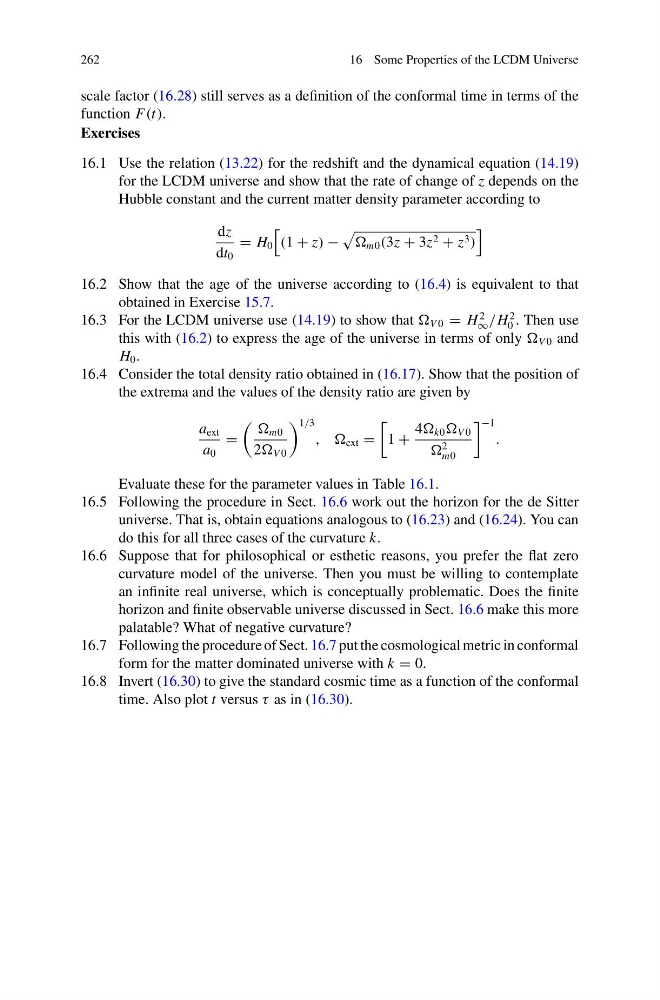
16.1 Use the relation (13.22) for the redshift and the dynamical equation (14.19)
for the LCDM universe and show that the rate of change of z depends on the
Hubble constant and the current matter density parameter according to
dz
dt 0
= H 0
(1 + z) −
m0 (3z + 3z 2 + z 3 )
16.2 Show that the age of the universe according to (16.4) is equivalent to that
obtained in Exercise 15.7.
16.3 For the LCDM universe use (14.19) to show that V 0 = H
2
∞ /H
2
0 . Then use
this with (16.2) to express the age of the universe in terms of only V 0 and
H 0 .
16.4 Consider the total density ratio obtained in (16.17). Show that the position of
the extrema and the values of the density ratio are given by
a ext
a 0
=
m0
2 V 0
1/3
, , ext =
1 +
4 k0 V 0
2
m0
−1
.
Evaluate these for the parameter values in Table 16.1.
16.5 Following the procedure in Sect. 16.6 work out the horizon for the de Sitter
universe. That is, obtain equations analogous to (16.23) and (16.24). You can
do this for all three cases of the curvature k.
16.6 Suppose that for philosophical or esthetic reasons, you prefer the flat zero
curvature model of the universe. Then you must be willing to contemplate
an infinite real universe, which is conceptually problematic. Does the finite
horizon and finite observable universe discussed in Sect. 16.6 make this more
palatable? What of negative curvature?
16.7 Following the procedure of Sect. 16.7 put the cosmological metric in conformal
form for the matter dominated universe with k = 0.
16.8 Invert (16.30) to give the standard cosmic time as a function of the conformal
time. Also plot t versus τ as in (16.30).
16 Some Properties of the LCDM Universe
scale factor (16.28) still serves as a definition of the conformal time in terms of the
function F(t).
Exercises
16.1 Use the relation (13.22) for the redshift and the dynamical equation (14.19)
for the LCDM universe and show that the rate of change of z depends on the
Hubble constant and the current matter density parameter according to
dz
dt 0
= H 0
(1 + z) −
m0 (3z + 3z 2 + z 3 )
16.2 Show that the age of the universe according to (16.4) is equivalent to that
obtained in Exercise 15.7.
16.3 For the LCDM universe use (14.19) to show that V 0 = H
2
∞ /H
2
0 . Then use
this with (16.2) to express the age of the universe in terms of only V 0 and
H 0 .
16.4 Consider the total density ratio obtained in (16.17). Show that the position of
the extrema and the values of the density ratio are given by
a ext
a 0
=
m0
2 V 0
1/3
, , ext =
1 +
4 k0 V 0
2
m0
−1
.
Evaluate these for the parameter values in Table 16.1.
16.5 Following the procedure in Sect. 16.6 work out the horizon for the de Sitter
universe. That is, obtain equations analogous to (16.23) and (16.24). You can
do this for all three cases of the curvature k.
16.6 Suppose that for philosophical or esthetic reasons, you prefer the flat zero
curvature model of the universe. Then you must be willing to contemplate
an infinite real universe, which is conceptually problematic. Does the finite
horizon and finite observable universe discussed in Sect. 16.6 make this more
palatable? What of negative curvature?
16.7 Following the procedure of Sect. 16.7 put the cosmological metric in conformal
form for the matter dominated universe with k = 0.
16.8 Invert (16.30) to give the standard cosmic time as a function of the conformal
time. Also plot t versus τ as in (16.30).