

16.5 Density Ratios and the Shape of the Universe
255
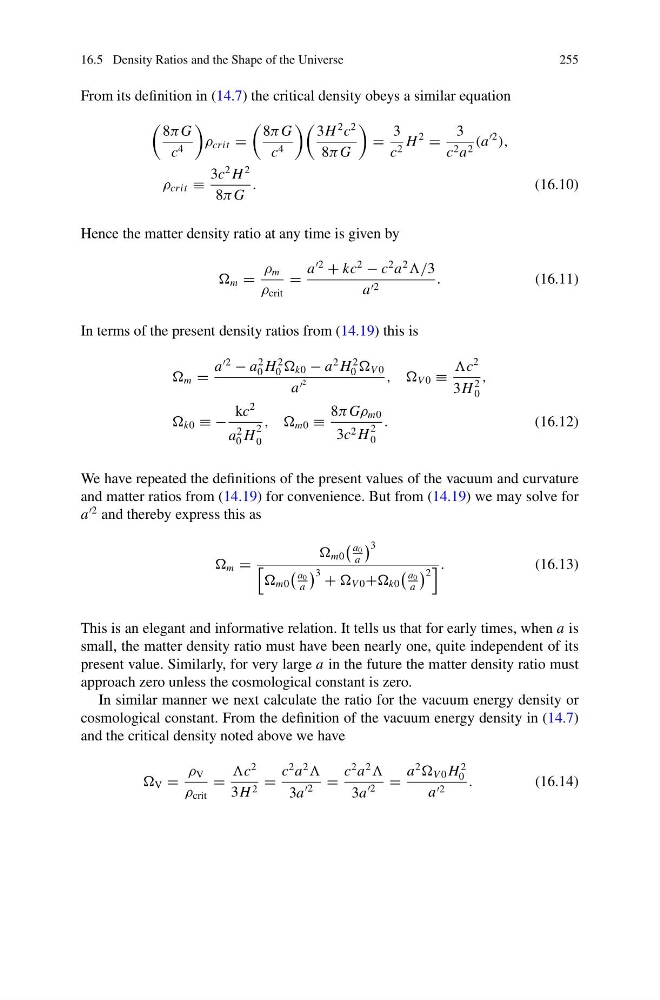
From its definition in (14.7) the critical density obeys a similar equation
8π G
c 4
ρ crit =
8π G
c 4
3H
2 c
2
8π G
=
3
c 2 H
2
=
3
c 2 a 2 (a
2
),
ρ crit ≡
3c
2 H
2
8π G
.
(16.10)
Hence the matter density ratio at any time is given by
m =
ρ m
ρ crit
=
a
2
+ kc
2
− c
2 a
2
/3
a 2
.
(16.11)
In terms of the present density ratios from (14.19) this is
m =
a
2
− a
2
0 H
2
0 k0 − a
2 H
2
0 V 0
a 2
, , V 0 ≡
c
2
3H
2
0
,
k0 ≡ −
kc
2
a
2
0 H
2
0
, , m0 ≡
8π Gρ m0
3c 2 H
2
0
.
(16.12)
We have repeated the definitions of the present values of the vacuum and curvature
and matter ratios from (14.19) for convenience. But from (14.19) we may solve for
a
2 and thereby express this as
m =
m0
a 0
a
3
m0
a 0
a
3 + V 0 + k0
a 0
a
2
.
(16.13)
This is an elegant and informative relation. It tells us that for early times, when a is
small, the matter density ratio must have been nearly one, quite independent of its
present value. Similarly, for very large a in the future the matter density ratio must
approach zero unless the cosmological constant is zero.
In similar manner we next calculate the ratio for the vacuum energy density or
cosmological constant. From the definition of the vacuum energy density in (14.7)
and the critical density noted above we have
V =
ρ V
ρ crit
=
c
2
3H 2 =
c
2 a
2
3a
2
=
c
2 a
2
3a
2
=
a
2
V 0 H
2
0
a 2
.
(16.14)
255
From its definition in (14.7) the critical density obeys a similar equation
8π G
c 4
ρ crit =
8π G
c 4
3H
2 c
2
8π G
=
3
c 2 H
2
=
3
c 2 a 2 (a
2
),
ρ crit ≡
3c
2 H
2
8π G
.
(16.10)
Hence the matter density ratio at any time is given by
m =
ρ m
ρ crit
=
a
2
+ kc
2
− c
2 a
2
/3
a 2
.
(16.11)
In terms of the present density ratios from (14.19) this is
m =
a
2
− a
2
0 H
2
0 k0 − a
2 H
2
0 V 0
a 2
, , V 0 ≡
c
2
3H
2
0
,
k0 ≡ −
kc
2
a
2
0 H
2
0
, , m0 ≡
8π Gρ m0
3c 2 H
2
0
.
(16.12)
We have repeated the definitions of the present values of the vacuum and curvature
and matter ratios from (14.19) for convenience. But from (14.19) we may solve for
a
2 and thereby express this as
m =
m0
a 0
a
3
m0
a 0
a
3 + V 0 + k0
a 0
a
2
.
(16.13)
This is an elegant and informative relation. It tells us that for early times, when a is
small, the matter density ratio must have been nearly one, quite independent of its
present value. Similarly, for very large a in the future the matter density ratio must
approach zero unless the cosmological constant is zero.
In similar manner we next calculate the ratio for the vacuum energy density or
cosmological constant. From the definition of the vacuum energy density in (14.7)
and the critical density noted above we have
V =
ρ V
ρ crit
=
c
2
3H 2 =
c
2 a
2
3a
2
=
c
2 a
2
3a
2
=
a
2
V 0 H
2
0
a 2
.
(16.14)