

256
16 Some Properties of the LCDM Universe
Again we substitute for a
from (14.19) to get
V =
V 0
m0
a 0
a
3 + V 0 + k0
a 0
a
2
.
(16.15)
Notice that this ratio goes to zero at early times and unity for late times.
The ratio of vacuum energy density to matter energy density is, from (16.13) and
(16.15),
V
m
=
V 0
m0
a
a 0
3
.
(16.16)
This of course agrees with the results of Sect. 14.4: as the universe expands the
vacuum energy density becomes more and more dominant.
The total density ratio of matter and vacuum energy is, from (16.13) and (16.15),
= m + V =
m0
a 0
a
3 + V 0
m0
a 0
a
3 + V 0 + k0
a 0
a
2
=
⎡
⎣ 1 +
k0
a 0
a
2
m0
a 0
a
3 + V 0
⎤
⎦
−1
.
(16.17)
It is this ratio which determines whether the universe is open or closed. This total
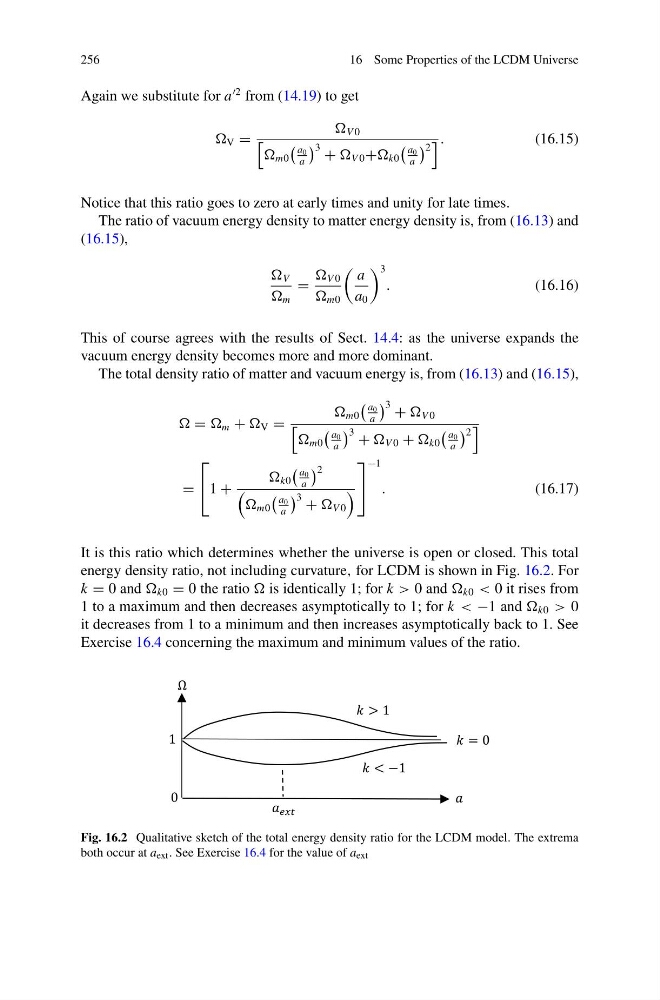
energy density ratio, not including curvature, for LCDM is shown in Fig. 16.2. For
k = 0 and k0 = 0 the ratio is identically 1; for k > 0 and k0 < 0 it rises from
1 to a maximum and then decreases asymptotically to 1; for k < −1 and k0 > 0
it decreases from 1 to a minimum and then increases asymptotically back to 1. See
Exercise 16.4 concerning the maximum and minimum values of the ratio.
Fig. 16.2 Qualitative sketch of the total energy density ratio for the LCDM model. The extrema
both occur at a ext . See Exercise 16.4 for the value of a ext
16 Some Properties of the LCDM Universe
Again we substitute for a
from (14.19) to get
V =
V 0
m0
a 0
a
3 + V 0 + k0
a 0
a
2
.
(16.15)
Notice that this ratio goes to zero at early times and unity for late times.
The ratio of vacuum energy density to matter energy density is, from (16.13) and
(16.15),
V
m
=
V 0
m0
a
a 0
3
.
(16.16)
This of course agrees with the results of Sect. 14.4: as the universe expands the
vacuum energy density becomes more and more dominant.
The total density ratio of matter and vacuum energy is, from (16.13) and (16.15),
= m + V =
m0
a 0
a
3 + V 0
m0
a 0
a
3 + V 0 + k0
a 0
a
2
=
⎡
⎣ 1 +
k0
a 0
a
2
m0
a 0
a
3 + V 0
⎤
⎦
−1
.
(16.17)
It is this ratio which determines whether the universe is open or closed. This total
energy density ratio, not including curvature, for LCDM is shown in Fig. 16.2. For
k = 0 and k0 = 0 the ratio is identically 1; for k > 0 and k0 < 0 it rises from
1 to a maximum and then decreases asymptotically to 1; for k < −1 and k0 > 0
it decreases from 1 to a minimum and then increases asymptotically back to 1. See
Exercise 16.4 concerning the maximum and minimum values of the ratio.
Fig. 16.2 Qualitative sketch of the total energy density ratio for the LCDM model. The extrema
both occur at a ext . See Exercise 16.4 for the value of a ext