

254
16 Some Properties of the LCDM Universe
a(t) =
sinh
3
2
H ∞ t
2/3
sinh
3
2
H ∞ t 0
2/3 .
(16.7)
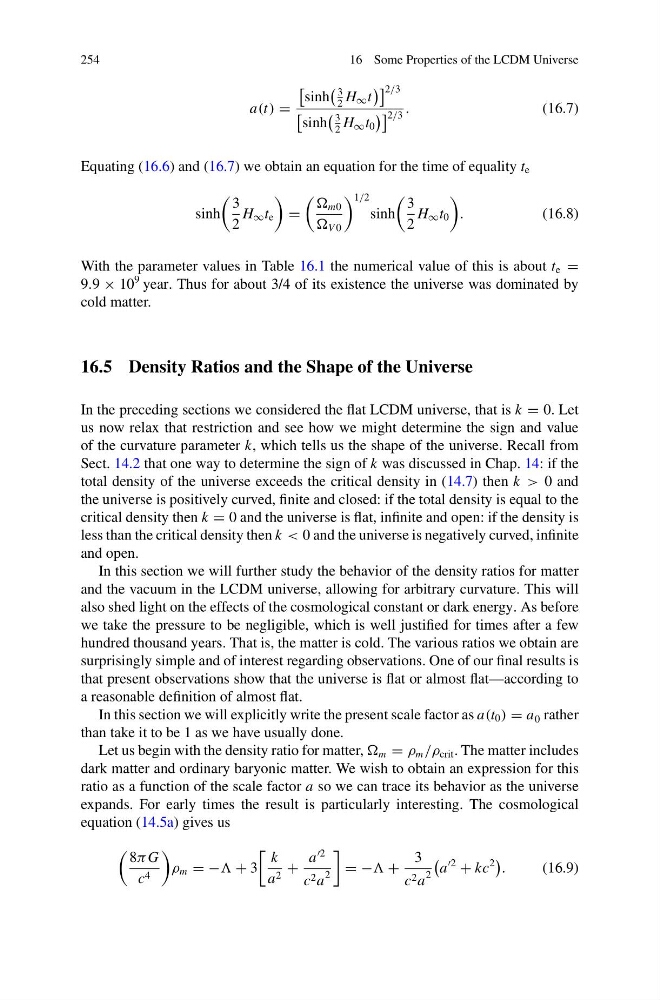
Equating (16.6) and (16.7) we obtain an equation for the time of equality t e
sinh
3
2
H ∞ t e
=
m0
V 0
1/2
sinh
3
2
H ∞ t 0
.
(16.8)
With the parameter values in Table 16.1 the numerical value of this is about t e =
9.9 × 10
9 year. Thus for about 3/4 of its existence the universe was dominated by
cold matter.
16.5 Density Ratios and the Shape of the Universe
In the preceding sections we considered the flat LCDM universe, that is k = 0. Let
us now relax that restriction and see how we might determine the sign and value
of the curvature parameter k, which tells us the shape of the universe. Recall from
Sect. 14.2 that one way to determine the sign of k was discussed in Chap. 14: if the
total density of the universe exceeds the critical density in (14.7) then k > 0 and
the universe is positively curved, finite and closed: if the total density is equal to the
critical density then k = 0 and the universe is flat, infinite and open: if the density is
less than the critical density then k < 0 and the universe is negatively curved, infinite
and open.
In this section we will further study the behavior of the density ratios for matter
and the vacuum in the LCDM universe, allowing for arbitrary curvature. This will
also shed light on the effects of the cosmological constant or dark energy. As before
we take the pressure to be negligible, which is well justified for times after a few
hundred thousand years. That is, the matter is cold. The various ratios we obtain are
surprisingly simple and of interest regarding observations. One of our final results is
that present observations show that the universe is flat or almost flat—according to
a reasonable definition of almost flat.
In this section we will explicitly write the present scale factor as a(t 0 ) = a 0 rather
than take it to be 1 as we have usually done.
Let us begin with the density ratio for matter, m = ρ m /ρ crit . The matter includes
dark matter and ordinary baryonic matter. We wish to obtain an expression for this
ratio as a function of the scale factor a so we can trace its behavior as the universe
expands. For early times the result is particularly interesting. The cosmological
equation (14.5a) gives us
8π G
c 4
ρ m = − + 3
k
a 2 +
a
2
c 2 a
2
= − +
3
c 2 a
2
a
2
+ kc
2
.
(16.9)
16 Some Properties of the LCDM Universe
a(t) =
sinh
3
2
H ∞ t
2/3
sinh
3
2
H ∞ t 0
2/3 .
(16.7)
Equating (16.6) and (16.7) we obtain an equation for the time of equality t e
sinh
3
2
H ∞ t e
=
m0
V 0
1/2
sinh
3
2
H ∞ t 0
.
(16.8)
With the parameter values in Table 16.1 the numerical value of this is about t e =
9.9 × 10
9 year. Thus for about 3/4 of its existence the universe was dominated by
cold matter.
16.5 Density Ratios and the Shape of the Universe
In the preceding sections we considered the flat LCDM universe, that is k = 0. Let
us now relax that restriction and see how we might determine the sign and value
of the curvature parameter k, which tells us the shape of the universe. Recall from
Sect. 14.2 that one way to determine the sign of k was discussed in Chap. 14: if the
total density of the universe exceeds the critical density in (14.7) then k > 0 and
the universe is positively curved, finite and closed: if the total density is equal to the
critical density then k = 0 and the universe is flat, infinite and open: if the density is
less than the critical density then k < 0 and the universe is negatively curved, infinite
and open.
In this section we will further study the behavior of the density ratios for matter
and the vacuum in the LCDM universe, allowing for arbitrary curvature. This will
also shed light on the effects of the cosmological constant or dark energy. As before
we take the pressure to be negligible, which is well justified for times after a few
hundred thousand years. That is, the matter is cold. The various ratios we obtain are
surprisingly simple and of interest regarding observations. One of our final results is
that present observations show that the universe is flat or almost flat—according to
a reasonable definition of almost flat.
In this section we will explicitly write the present scale factor as a(t 0 ) = a 0 rather
than take it to be 1 as we have usually done.
Let us begin with the density ratio for matter, m = ρ m /ρ crit . The matter includes
dark matter and ordinary baryonic matter. We wish to obtain an expression for this
ratio as a function of the scale factor a so we can trace its behavior as the universe
expands. For early times the result is particularly interesting. The cosmological
equation (14.5a) gives us
8π G
c 4
ρ m = − + 3
k
a 2 +
a
2
c 2 a
2
= − +
3
c 2 a
2
a
2
+ kc
2
.
(16.9)