

16.3 The Hubble Function and the Age of the Universe
253
_
_
_
_
_
2.0
1.0
0.5
1.5
0
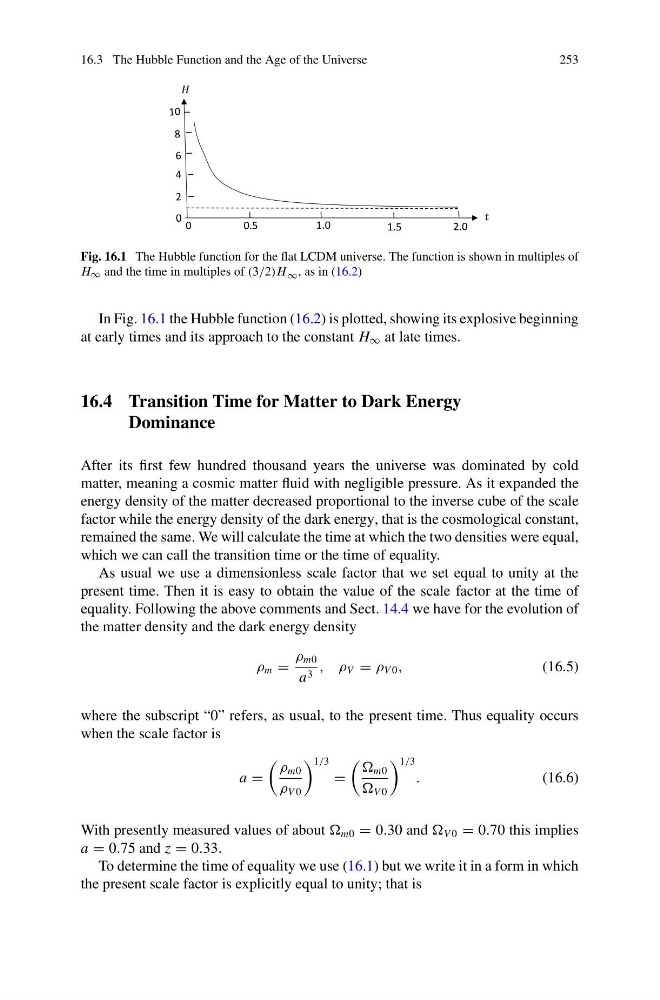
Fig. 16.1 The Hubble function for the flat LCDM universe. The function is shown in multiples of
H ∞ and the time in multiples of (3/2)H ∞ , as in (16.2)
In Fig. 16.1 the Hubble function (16.2) is plotted, showing its explosive beginning
at early times and its approach to the constant H ∞ at late times.
16.4 Transition Time for Matter to Dark Energy
Dominance
After its first few hundred thousand years the universe was dominated by cold
matter, meaning a cosmic matter fluid with negligible pressure. As it expanded the
energy density of the matter decreased proportional to the inverse cube of the scale
factor while the energy density of the dark energy, that is the cosmological constant,
remained the same. We will calculate the time at which the two densities were equal,
which we can call the transition time or the time of equality.
As usual we use a dimensionless scale factor that we set equal to unity at the
present time. Then it is easy to obtain the value of the scale factor at the time of
equality. Following the above comments and Sect. 14.4 we have for the evolution of
the matter density and the dark energy density
ρ m =
ρ m0
a 3 , ρ V = ρ V 0 ,
(16.5)
where the subscript “0” refers, as usual, to the present time. Thus equality occurs
when the scale factor is
a =
ρ m0
ρ V 0
1/3
=
m0
V 0
1/3
.
(16.6)
With presently measured values of about m0 = 0.30 and V 0 = 0.70 this implies
a = 0.75 and z = 0.33.
To determine the time of equality we use (16.1) but we write it in a form in which
the present scale factor is explicitly equal to unity; that is
253
_
_
_
_
_
2.0
1.0
0.5
1.5
0
Fig. 16.1 The Hubble function for the flat LCDM universe. The function is shown in multiples of
H ∞ and the time in multiples of (3/2)H ∞ , as in (16.2)
In Fig. 16.1 the Hubble function (16.2) is plotted, showing its explosive beginning
at early times and its approach to the constant H ∞ at late times.
16.4 Transition Time for Matter to Dark Energy
Dominance
After its first few hundred thousand years the universe was dominated by cold
matter, meaning a cosmic matter fluid with negligible pressure. As it expanded the
energy density of the matter decreased proportional to the inverse cube of the scale
factor while the energy density of the dark energy, that is the cosmological constant,
remained the same. We will calculate the time at which the two densities were equal,
which we can call the transition time or the time of equality.
As usual we use a dimensionless scale factor that we set equal to unity at the
present time. Then it is easy to obtain the value of the scale factor at the time of
equality. Following the above comments and Sect. 14.4 we have for the evolution of
the matter density and the dark energy density
ρ m =
ρ m0
a 3 , ρ V = ρ V 0 ,
(16.5)
where the subscript “0” refers, as usual, to the present time. Thus equality occurs
when the scale factor is
a =
ρ m0
ρ V 0
1/3
=
m0
V 0
1/3
.
(16.6)
With presently measured values of about m0 = 0.30 and V 0 = 0.70 this implies
a = 0.75 and z = 0.33.
To determine the time of equality we use (16.1) but we write it in a form in which
the present scale factor is explicitly equal to unity; that is