

252
16 Some Properties of the LCDM Universe
Notice that we do not give error estimates for most of the parameters: this is
because they are continually being re-evaluated. The reader who is interested in
precise values should consult internet references for up-to-date values with error
estimates; many such references can be found in the NASA website (NASA 2019).
16.3 The Hubble Function and the Age of the Universe
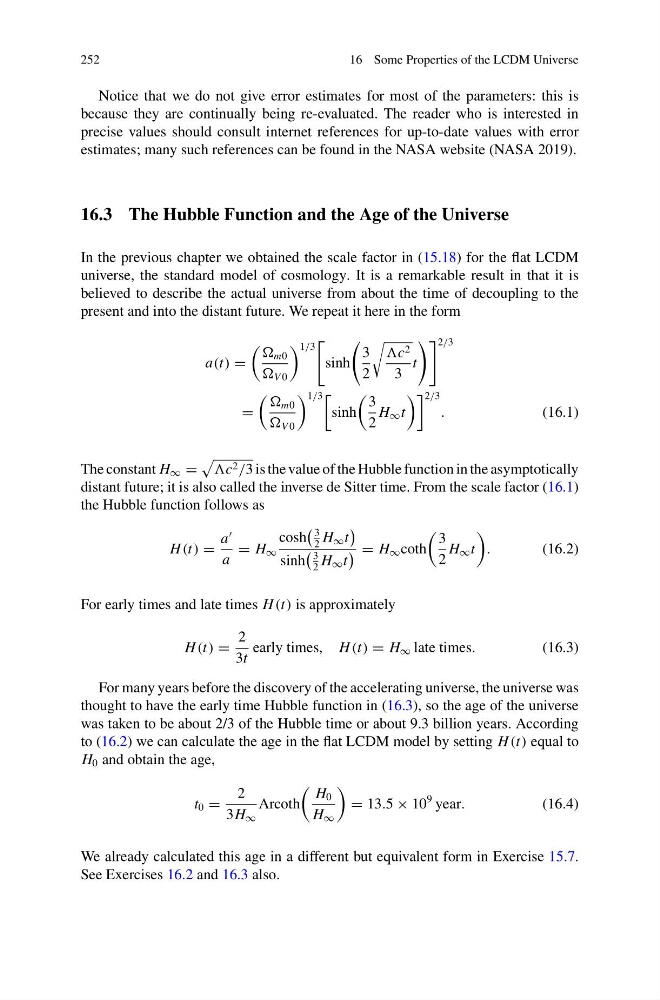
In the previous chapter we obtained the scale factor in (15.18) for the flat LCDM
universe, the standard model of cosmology. It is a remarkable result in that it is
believed to describe the actual universe from about the time of decoupling to the
present and into the distant future. We repeat it here in the form
a(t) =
m0
V 0
1/3
sinh
3
2
c 2
3
t
2/3
=
m0
V 0
1/3
sinh
3
2
H ∞ t
2/3
.
(16.1)
The constant H ∞ =
c 2 /3 is the value of the Hubble function in the asymptotically
distant future; it is also called the inverse de Sitter time. From the scale factor (16.1)
the Hubble function follows as
H (t) =
a
a
= H ∞
cosh
3
2
H ∞ t
sinh
3
2
H ∞ t
= H ∞ coth
3
2
H ∞ t
.
(16.2)
For early times and late times H (t) is approximately
H (t) =
2
3t
early times, H (t) = H ∞ late times.
(16.3)
For many years before the discovery of the accelerating universe, the universe was
thought to have the early time Hubble function in (16.3), so the age of the universe
was taken to be about 2/3 of the Hubble time or about 9.3 billion years. According
to (16.2) we can calculate the age in the flat LCDM model by setting H (t) equal to
H 0 and obtain the age,
t 0 =
2
3H ∞
Arcoth
H 0
H ∞
= 13.5 × 10
9 year.
(16.4)
We already calculated this age in a different but equivalent form in Exercise 15.7.
See Exercises 16.2 and 16.3 also.
16 Some Properties of the LCDM Universe
Notice that we do not give error estimates for most of the parameters: this is
because they are continually being re-evaluated. The reader who is interested in
precise values should consult internet references for up-to-date values with error
estimates; many such references can be found in the NASA website (NASA 2019).
16.3 The Hubble Function and the Age of the Universe
In the previous chapter we obtained the scale factor in (15.18) for the flat LCDM
universe, the standard model of cosmology. It is a remarkable result in that it is
believed to describe the actual universe from about the time of decoupling to the
present and into the distant future. We repeat it here in the form
a(t) =
m0
V 0
1/3
sinh
3
2
c 2
3
t
2/3
=
m0
V 0
1/3
sinh
3
2
H ∞ t
2/3
.
(16.1)
The constant H ∞ =
c 2 /3 is the value of the Hubble function in the asymptotically
distant future; it is also called the inverse de Sitter time. From the scale factor (16.1)
the Hubble function follows as
H (t) =
a
a
= H ∞
cosh
3
2
H ∞ t
sinh
3
2
H ∞ t
= H ∞ coth
3
2
H ∞ t
.
(16.2)
For early times and late times H (t) is approximately
H (t) =
2
3t
early times, H (t) = H ∞ late times.
(16.3)
For many years before the discovery of the accelerating universe, the universe was
thought to have the early time Hubble function in (16.3), so the age of the universe
was taken to be about 2/3 of the Hubble time or about 9.3 billion years. According
to (16.2) we can calculate the age in the flat LCDM model by setting H (t) equal to
H 0 and obtain the age,
t 0 =
2
3H ∞
Arcoth
H 0
H ∞
= 13.5 × 10
9 year.
(16.4)
We already calculated this age in a different but equivalent form in Exercise 15.7.
See Exercises 16.2 and 16.3 also.