

Appendix 1: A Mechanical Analogy
241
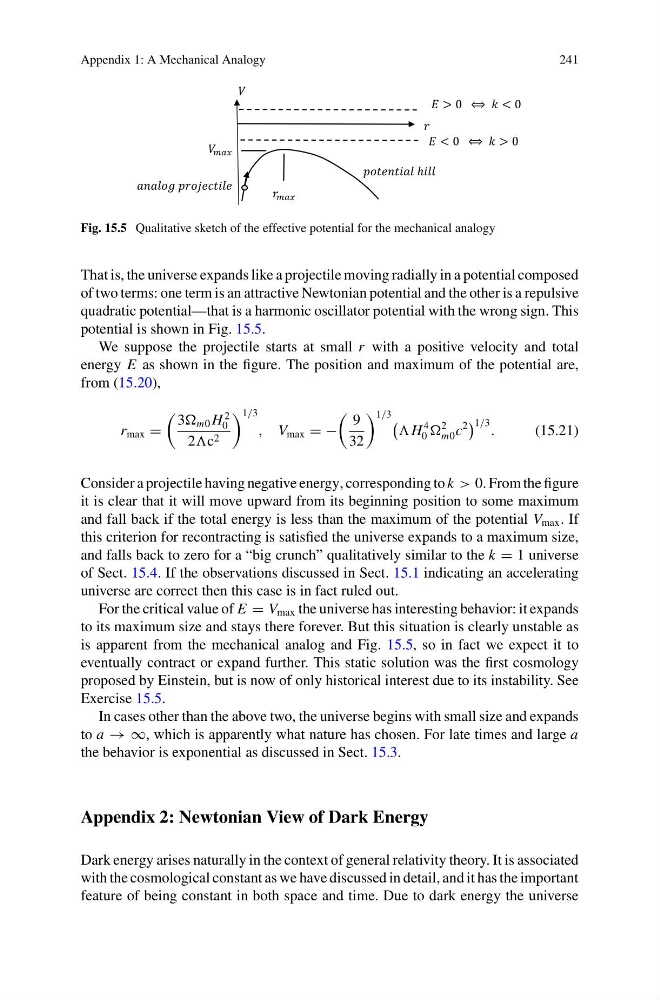
Fig. 15.5 Qualitative sketch of the effective potential for the mechanical analogy
That is, the universe expands like a projectile moving radially in a potential composed
of two terms: one term is an attractive Newtonian potential and the other is a repulsive
quadratic potential—that is a harmonic oscillator potential with the wrong sign. This
potential is shown in Fig. 15.5.
We suppose the projectile starts at small r with a positive velocity and total
energy E as shown in the figure. The position and maximum of the potential are,
from (15.20),
r max =
3 m0 H
2
0
2c 2
1/3
, V max = −
9
32
1/3
4
0
2
m0 c
2
1/3 .
(15.21)
Consider a projectile having negative energy, corresponding to k > 0. From the figure
it is clear that it will move upward from its beginning position to some maximum
and fall back if the total energy is less than the maximum of the potential V max . If
this criterion for recontracting is satisfied the universe expands to a maximum size,
and falls back to zero for a “big crunch” qualitatively similar to the k = 1 universe
of Sect. 15.4. If the observations discussed in Sect. 15.1 indicating an accelerating
universe are correct then this case is in fact ruled out.
For the critical value of E = V max the universe has interesting behavior: it expands
to its maximum size and stays there forever. But this situation is clearly unstable as
is apparent from the mechanical analog and Fig. 15.5, so in fact we expect it to
eventually contract or expand further. This static solution was the first cosmology
proposed by Einstein, but is now of only historical interest due to its instability. See
Exercise 15.5.
In cases other than the above two, the universe begins with small size and expands
to a → ∞, which is apparently what nature has chosen. For late times and large a
the behavior is exponential as discussed in Sect. 15.3.
Appendix 2: Newtonian View of Dark Energy
Dark energy arises naturally in the context of general relativity theory. It is associated
with the cosmological constant as we have discussed in detail, and it has the important
feature of being constant in both space and time. Due to dark energy the universe
241
Fig. 15.5 Qualitative sketch of the effective potential for the mechanical analogy
That is, the universe expands like a projectile moving radially in a potential composed
of two terms: one term is an attractive Newtonian potential and the other is a repulsive
quadratic potential—that is a harmonic oscillator potential with the wrong sign. This
potential is shown in Fig. 15.5.
We suppose the projectile starts at small r with a positive velocity and total
energy E as shown in the figure. The position and maximum of the potential are,
from (15.20),
r max =
3 m0 H
2
0
2c 2
1/3
, V max = −
9
32
1/3
4
0
2
m0 c
2
1/3 .
(15.21)
Consider a projectile having negative energy, corresponding to k > 0. From the figure
it is clear that it will move upward from its beginning position to some maximum
and fall back if the total energy is less than the maximum of the potential V max . If
this criterion for recontracting is satisfied the universe expands to a maximum size,
and falls back to zero for a “big crunch” qualitatively similar to the k = 1 universe
of Sect. 15.4. If the observations discussed in Sect. 15.1 indicating an accelerating
universe are correct then this case is in fact ruled out.
For the critical value of E = V max the universe has interesting behavior: it expands
to its maximum size and stays there forever. But this situation is clearly unstable as
is apparent from the mechanical analog and Fig. 15.5, so in fact we expect it to
eventually contract or expand further. This static solution was the first cosmology
proposed by Einstein, but is now of only historical interest due to its instability. See
Exercise 15.5.
In cases other than the above two, the universe begins with small size and expands
to a → ∞, which is apparently what nature has chosen. For late times and large a
the behavior is exponential as discussed in Sect. 15.3.
Appendix 2: Newtonian View of Dark Energy
Dark energy arises naturally in the context of general relativity theory. It is associated
with the cosmological constant as we have discussed in detail, and it has the important
feature of being constant in both space and time. Due to dark energy the universe