

240
15 Solutions for the Present Universe
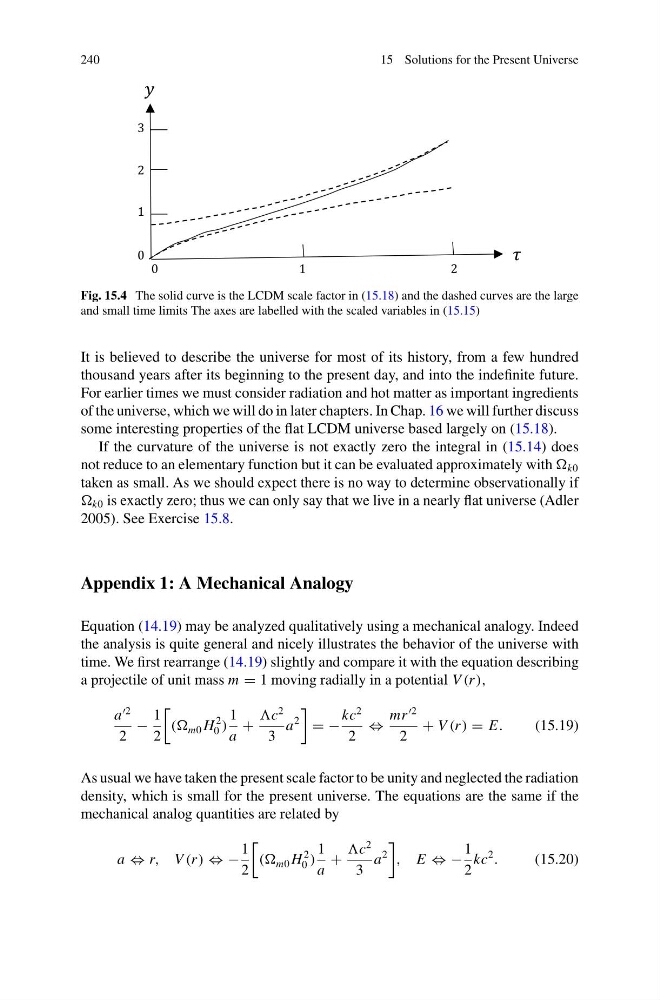
Fig. 15.4 The solid curve is the LCDM scale factor in (15.18) and the dashed curves are the large
and small time limits The axes are labelled with the scaled variables in (15.15)
It is believed to describe the universe for most of its history, from a few hundred
thousand years after its beginning to the present day, and into the indefinite future.
For earlier times we must consider radiation and hot matter as important ingredients
of the universe, which we will do in later chapters. In Chap. 16 we will further discuss
some interesting properties of the flat LCDM universe based largely on (15.18).
If the curvature of the universe is not exactly zero the integral in (15.14) does
not reduce to an elementary function but it can be evaluated approximately with k0
taken as small. As we should expect there is no way to determine observationally if
k0 is exactly zero; thus we can only say that we live in a nearly flat universe (Adler
2005). See Exercise 15.8.
Appendix 1: A Mechanical Analogy
Equation (14.19) may be analyzed qualitatively using a mechanical analogy. Indeed
the analysis is quite general and nicely illustrates the behavior of the universe with
time. We first rearrange (14.19) slightly and compare it with the equation describing
a projectile of unit mass m = 1 moving radially in a potential V (r ),
a
2
−
1
2
(( m0 H
2
0 )
1
a
+
2
3
a
2
= −
kc
2
2
⇔
mr
2
+ V (r ) = E.
(15.19)
As usual we have taken the present scale factor to be unity and neglected the radiation
density, which is small for the present universe. The equations are the same if the
mechanical analog quantities are related by
a ⇔ r, V (r ) ⇔ −
1
2
(( m0 H
2
0 )
1
a
+
2
3
a
2
, E ⇔ −
1
2
kc
2
.
(15.20)
15 Solutions for the Present Universe
Fig. 15.4 The solid curve is the LCDM scale factor in (15.18) and the dashed curves are the large
and small time limits The axes are labelled with the scaled variables in (15.15)
It is believed to describe the universe for most of its history, from a few hundred
thousand years after its beginning to the present day, and into the indefinite future.
For earlier times we must consider radiation and hot matter as important ingredients
of the universe, which we will do in later chapters. In Chap. 16 we will further discuss
some interesting properties of the flat LCDM universe based largely on (15.18).
If the curvature of the universe is not exactly zero the integral in (15.14) does
not reduce to an elementary function but it can be evaluated approximately with k0
taken as small. As we should expect there is no way to determine observationally if
k0 is exactly zero; thus we can only say that we live in a nearly flat universe (Adler
2005). See Exercise 15.8.
Appendix 1: A Mechanical Analogy
Equation (14.19) may be analyzed qualitatively using a mechanical analogy. Indeed
the analysis is quite general and nicely illustrates the behavior of the universe with
time. We first rearrange (14.19) slightly and compare it with the equation describing
a projectile of unit mass m = 1 moving radially in a potential V (r ),
a
2
−
1
2
(( m0 H
2
0 )
1
a
+
2
3
a
2
= −
kc
2
2
⇔
mr
2
+ V (r ) = E.
(15.19)
As usual we have taken the present scale factor to be unity and neglected the radiation
density, which is small for the present universe. The equations are the same if the
mechanical analog quantities are related by
a ⇔ r, V (r ) ⇔ −
1
2
(( m0 H
2
0 )
1
a
+
2
3
a
2
, E ⇔ −
1
2
kc
2
.
(15.20)