

242
15 Solutions for the Present Universe
undergoes accelerated expansion, so there is clearly a repulsive force associated with
it. The repulsive force is perhaps best seen from the Kottler metric, which is also called
the Schwarzschild—de Sitter metric (Adler 1975). The Kottler metric describes the
field of a spherical mass distribution in a universe containing dark energy; it can be
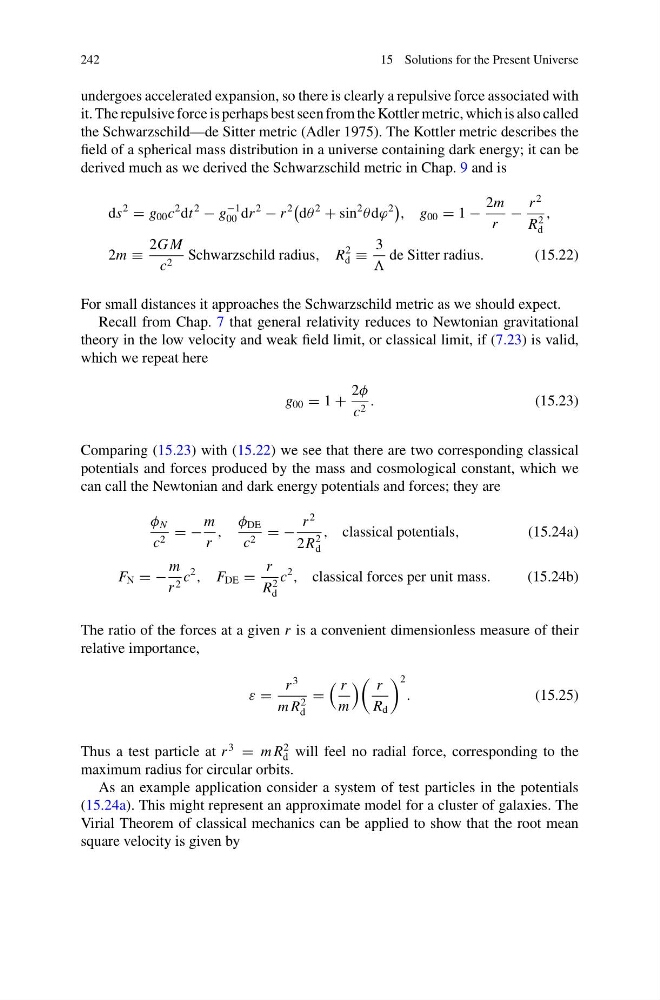
derived much as we derived the Schwarzschild metric in Chap. 9 and is
ds
2
= g 00 c
2 dt
2
− g
−1
00 dr
2
− r
2
dθ
2
+ sin
2
θ dϕ
2
, g 00 = 1 −
2m
r
−
r
2
R
2
d
,
2m ≡
2G M
c 2 Schwarzschild radius, R
2
d ≡
3
de Sitter radius.
(15.22)
For small distances it approaches the Schwarzschild metric as we should expect.
Recall from Chap. 7 that general relativity reduces to Newtonian gravitational
theory in the low velocity and weak field limit, or classical limit, if (7.23) is valid,
which we repeat here
g 00 = 1 +
2φ
c 2 .
(15.23)
Comparing (15.23) with (15.22) we see that there are two corresponding classical
potentials and forces produced by the mass and cosmological constant, which we
can call the Newtonian and dark energy potentials and forces; they are
φ N
c 2 = −
m
r
,
φ DE
c 2 = −
r
2
2R
2
d
, classical potentials,
(15.24a)
F N = −
m
r 2 c
2
, F DE =
r
R
2
d
c
2
, classical forces per unit mass.
(15.24b)
The ratio of the forces at a given r is a convenient dimensionless measure of their
relative importance,
ε =
r
3
m R
2
d
=
r
m
r
R d
2
.
(15.25)
Thus a test particle at r
3
= m R
2
d will feel no radial force, corresponding to the
maximum radius for circular orbits.
As an example application consider a system of test particles in the potentials
(15.24a). This might represent an approximate model for a cluster of galaxies. The
Virial Theorem of classical mechanics can be applied to show that the root mean
square velocity is given by
15 Solutions for the Present Universe
undergoes accelerated expansion, so there is clearly a repulsive force associated with
it. The repulsive force is perhaps best seen from the Kottler metric, which is also called
the Schwarzschild—de Sitter metric (Adler 1975). The Kottler metric describes the
field of a spherical mass distribution in a universe containing dark energy; it can be
derived much as we derived the Schwarzschild metric in Chap. 9 and is
ds
2
= g 00 c
2 dt
2
− g
−1
00 dr
2
− r
2
dθ
2
+ sin
2
θ dϕ
2
, g 00 = 1 −
2m
r
−
r
2
R
2
d
,
2m ≡
2G M
c 2 Schwarzschild radius, R
2
d ≡
3
de Sitter radius.
(15.22)
For small distances it approaches the Schwarzschild metric as we should expect.
Recall from Chap. 7 that general relativity reduces to Newtonian gravitational
theory in the low velocity and weak field limit, or classical limit, if (7.23) is valid,
which we repeat here
g 00 = 1 +
2φ
c 2 .
(15.23)
Comparing (15.23) with (15.22) we see that there are two corresponding classical
potentials and forces produced by the mass and cosmological constant, which we
can call the Newtonian and dark energy potentials and forces; they are
φ N
c 2 = −
m
r
,
φ DE
c 2 = −
r
2
2R
2
d
, classical potentials,
(15.24a)
F N = −
m
r 2 c
2
, F DE =
r
R
2
d
c
2
, classical forces per unit mass.
(15.24b)
The ratio of the forces at a given r is a convenient dimensionless measure of their
relative importance,
ε =
r
3
m R
2
d
=
r
m
r
R d
2
.
(15.25)
Thus a test particle at r
3
= m R
2
d will feel no radial force, corresponding to the
maximum radius for circular orbits.
As an example application consider a system of test particles in the potentials
(15.24a). This might represent an approximate model for a cluster of galaxies. The
Virial Theorem of classical mechanics can be applied to show that the root mean
square velocity is given by