

15.3 Cosmological Constant Dominance
235
a
2
− ((c
2
/3)a
2
= −kc
2
.
(15.4)
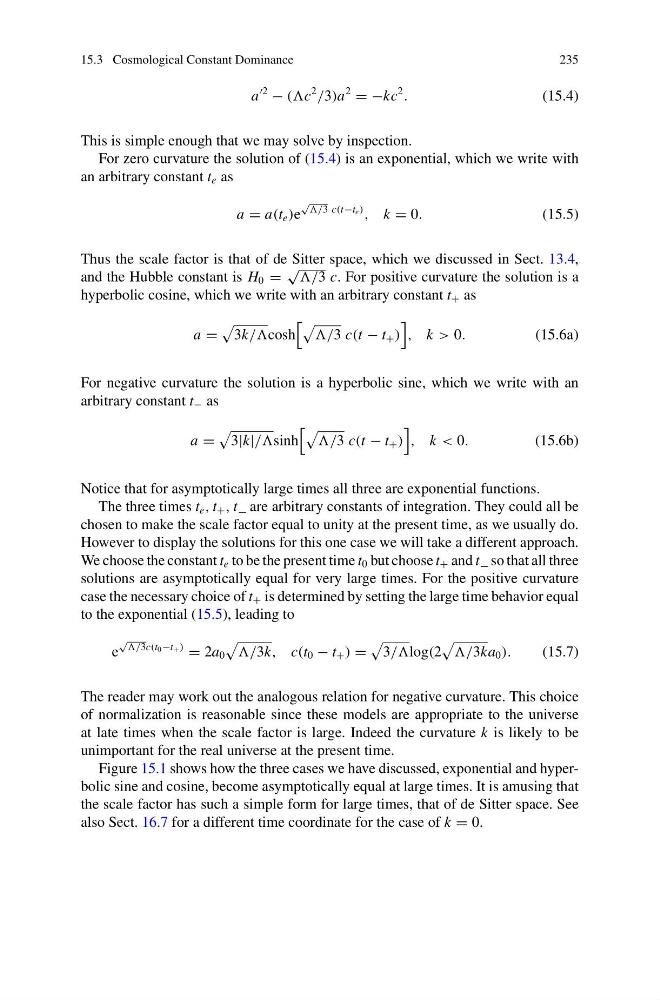
This is simple enough that we may solve by inspection.
For zero curvature the solution of (15.4) is an exponential, which we write with
an arbitrary constant t e as
a = a(t e )e
√ /3 c(t−t e )
, k = 0.
(15.5)
Thus the scale factor is that of de Sitter space, which we discussed in Sect. 13.4,
and the Hubble constant is H 0 =
√
/3 c. For positive curvature the solution is a
hyperbolic cosine, which we write with an arbitrary constant t + as
a =
3k//cosh
/3 c(t − t + )
, k > 0.
(15.6a)
For negative curvature the solution is a hyperbolic sine, which we write with an
arbitrary constant t − as
a =
3|k|//sinh
/3 c(t − t + )
, k < 0.
(15.6b)
Notice that for asymptotically large times all three are exponential functions.
The three times t e , t + , t_ are arbitrary constants of integration. They could all be
chosen to make the scale factor equal to unity at the present time, as we usually do.
However to display the solutions for this one case we will take a different approach.
We choose the constant t e to be the present time t 0 but choose t + and t_ so that all three
solutions are asymptotically equal for very large times. For the positive curvature
case the necessary choice of t + is determined by setting the large time behavior equal
to the exponential (15.5), leading to
e
√
/3c(t 0 −t + )
= 2a 0
/3k, c(t 0 − t + ) =
3//log(2
/3ka 0 ).
(15.7)
The reader may work out the analogous relation for negative curvature. This choice
of normalization is reasonable since these models are appropriate to the universe
at late times when the scale factor is large. Indeed the curvature k is likely to be
unimportant for the real universe at the present time.
Figure 15.1 shows how the three cases we have discussed, exponential and hyperbolic sine and cosine, become asymptotically equal at large times. It is amusing that
the scale factor has such a simple form for large times, that of de Sitter space. See
also Sect. 16.7 for a different time coordinate for the case of k = 0.
235
a
2
− ((c
2
/3)a
2
= −kc
2
.
(15.4)
This is simple enough that we may solve by inspection.
For zero curvature the solution of (15.4) is an exponential, which we write with
an arbitrary constant t e as
a = a(t e )e
√ /3 c(t−t e )
, k = 0.
(15.5)
Thus the scale factor is that of de Sitter space, which we discussed in Sect. 13.4,
and the Hubble constant is H 0 =
√
/3 c. For positive curvature the solution is a
hyperbolic cosine, which we write with an arbitrary constant t + as
a =
3k//cosh
/3 c(t − t + )
, k > 0.
(15.6a)
For negative curvature the solution is a hyperbolic sine, which we write with an
arbitrary constant t − as
a =
3|k|//sinh
/3 c(t − t + )
, k < 0.
(15.6b)
Notice that for asymptotically large times all three are exponential functions.
The three times t e , t + , t_ are arbitrary constants of integration. They could all be
chosen to make the scale factor equal to unity at the present time, as we usually do.
However to display the solutions for this one case we will take a different approach.
We choose the constant t e to be the present time t 0 but choose t + and t_ so that all three
solutions are asymptotically equal for very large times. For the positive curvature
case the necessary choice of t + is determined by setting the large time behavior equal
to the exponential (15.5), leading to
e
√
/3c(t 0 −t + )
= 2a 0
/3k, c(t 0 − t + ) =
3//log(2
/3ka 0 ).
(15.7)
The reader may work out the analogous relation for negative curvature. This choice
of normalization is reasonable since these models are appropriate to the universe
at late times when the scale factor is large. Indeed the curvature k is likely to be
unimportant for the real universe at the present time.
Figure 15.1 shows how the three cases we have discussed, exponential and hyperbolic sine and cosine, become asymptotically equal at large times. It is amusing that
the scale factor has such a simple form for large times, that of de Sitter space. See
also Sect. 16.7 for a different time coordinate for the case of k = 0.