

234
15 Solutions for the Present Universe
This is an important relation between measurable quantities in the real world. It
is consistent with the present values of about q 0 = −0.55, , V 0 = 0.70, , m0 =
0.30, , r 0 = 0.
15.2 Complete Solution of the Friedmann Master Equation
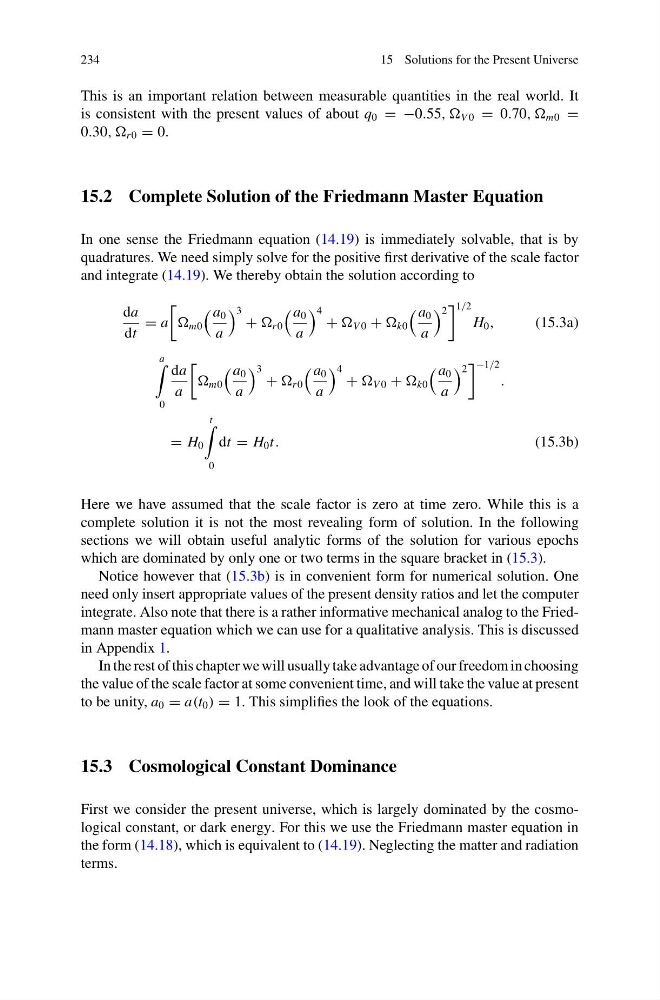
In one sense the Friedmann equation (14.19) is immediately solvable, that is by
quadratures. We need simply solve for the positive first derivative of the scale factor
and integrate (14.19). We thereby obtain the solution according to
da
dt
= a
m0
a 0
a
3 + r 0
a 0
a
4 + V 0 + k0
a 0
a
2
1/2
H 0 ,
(15.3a)
a
0
da
a
m0
a 0
a
3 + r 0
a 0
a
4 + V 0 + k0
a 0
a
2
−1/2
.
= H 0
t
0
dt = H 0 t.
(15.3b)
Here we have assumed that the scale factor is zero at time zero. While this is a
complete solution it is not the most revealing form of solution. In the following
sections we will obtain useful analytic forms of the solution for various epochs
which are dominated by only one or two terms in the square bracket in (15.3).
Notice however that (15.3b) is in convenient form for numerical solution. One
need only insert appropriate values of the present density ratios and let the computer
integrate. Also note that there is a rather informative mechanical analog to the Friedmann master equation which we can use for a qualitative analysis. This is discussed
in Appendix 1.
In the rest of this chapter we will usually take advantage of our freedom in choosing
the value of the scale factor at some convenient time, and will take the value at present
to be unity, a 0 = a(t 0 ) = 1. This simplifies the look of the equations.
15.3 Cosmological Constant Dominance
First we consider the present universe, which is largely dominated by the cosmological constant, or dark energy. For this we use the Friedmann master equation in
the form (14.18), which is equivalent to (14.19). Neglecting the matter and radiation
terms.
15 Solutions for the Present Universe
This is an important relation between measurable quantities in the real world. It
is consistent with the present values of about q 0 = −0.55, , V 0 = 0.70, , m0 =
0.30, , r 0 = 0.
15.2 Complete Solution of the Friedmann Master Equation
In one sense the Friedmann equation (14.19) is immediately solvable, that is by
quadratures. We need simply solve for the positive first derivative of the scale factor
and integrate (14.19). We thereby obtain the solution according to
da
dt
= a
m0
a 0
a
3 + r 0
a 0
a
4 + V 0 + k0
a 0
a
2
1/2
H 0 ,
(15.3a)
a
0
da
a
m0
a 0
a
3 + r 0
a 0
a
4 + V 0 + k0
a 0
a
2
−1/2
.
= H 0
t
0
dt = H 0 t.
(15.3b)
Here we have assumed that the scale factor is zero at time zero. While this is a
complete solution it is not the most revealing form of solution. In the following
sections we will obtain useful analytic forms of the solution for various epochs
which are dominated by only one or two terms in the square bracket in (15.3).
Notice however that (15.3b) is in convenient form for numerical solution. One
need only insert appropriate values of the present density ratios and let the computer
integrate. Also note that there is a rather informative mechanical analog to the Friedmann master equation which we can use for a qualitative analysis. This is discussed
in Appendix 1.
In the rest of this chapter we will usually take advantage of our freedom in choosing
the value of the scale factor at some convenient time, and will take the value at present
to be unity, a 0 = a(t 0 ) = 1. This simplifies the look of the equations.
15.3 Cosmological Constant Dominance
First we consider the present universe, which is largely dominated by the cosmological constant, or dark energy. For this we use the Friedmann master equation in
the form (14.18), which is equivalent to (14.19). Neglecting the matter and radiation
terms.