

236
15 Solutions for the Present Universe
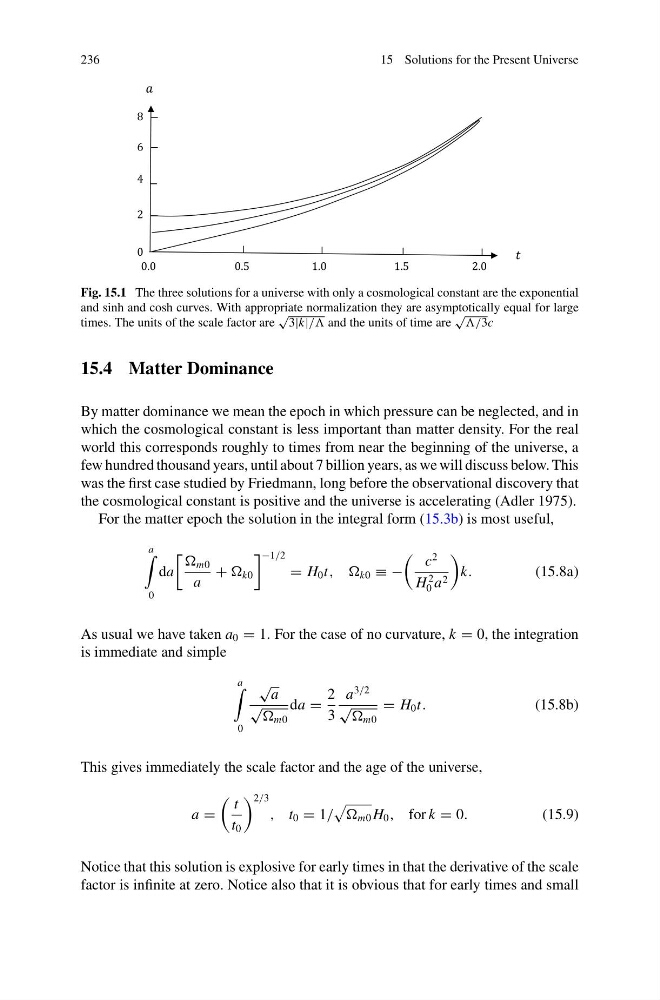
Fig. 15.1 The three solutions for a universe with only a cosmological constant are the exponential
and sinh and cosh curves. With appropriate normalization they are asymptotically equal for large
times. The units of the scale factor are
√
3|k|// and the units of time are
√ /3c
15.4 Matter Dominance
By matter dominance we mean the epoch in which pressure can be neglected, and in
which the cosmological constant is less important than matter density. For the real
world this corresponds roughly to times from near the beginning of the universe, a
few hundred thousand years, until about 7 billion years, as we will discuss below. This
was the first case studied by Friedmann, long before the observational discovery that
the cosmological constant is positive and the universe is accelerating (Adler 1975).
For the matter epoch the solution in the integral form (15.3b) is most useful,
a
0
da
m0
a
+ k0
−1/2
= H 0 t, , k0 ≡ −
c
2
H
2
0 a 2
k.
(15.8a)
As usual we have taken a 0 = 1. For the case of no curvature, k = 0, the integration
is immediate and simple
a
0
√
a
√
m0
da =
2
3
a
3/2
√
m0
= H 0 t.
(15.8b)
This gives immediately the scale factor and the age of the universe,
a =
t
t 0
2/3
, t 0 = 1/
m0 H 0 , for k = 0.
(15.9)
Notice that this solution is explosive for early times in that the derivative of the scale
factor is infinite at zero. Notice also that it is obvious that for early times and small
15 Solutions for the Present Universe
Fig. 15.1 The three solutions for a universe with only a cosmological constant are the exponential
and sinh and cosh curves. With appropriate normalization they are asymptotically equal for large
times. The units of the scale factor are
√
3|k|// and the units of time are
√ /3c
15.4 Matter Dominance
By matter dominance we mean the epoch in which pressure can be neglected, and in
which the cosmological constant is less important than matter density. For the real
world this corresponds roughly to times from near the beginning of the universe, a
few hundred thousand years, until about 7 billion years, as we will discuss below. This
was the first case studied by Friedmann, long before the observational discovery that
the cosmological constant is positive and the universe is accelerating (Adler 1975).
For the matter epoch the solution in the integral form (15.3b) is most useful,
a
0
da
m0
a
+ k0
−1/2
= H 0 t, , k0 ≡ −
c
2
H
2
0 a 2
k.
(15.8a)
As usual we have taken a 0 = 1. For the case of no curvature, k = 0, the integration
is immediate and simple
a
0
√
a
√
m0
da =
2
3
a
3/2
√
m0
= H 0 t.
(15.8b)
This gives immediately the scale factor and the age of the universe,
a =
t
t 0
2/3
, t 0 = 1/
m0 H 0 , for k = 0.
(15.9)
Notice that this solution is explosive for early times in that the derivative of the scale
factor is infinite at zero. Notice also that it is obvious that for early times and small