

214
13 Cosmological Preliminaries
This beautiful result tells us that as the photon travels its wavelength stretches in
proportion to the scale factor of the universe. It is a very easy way to remember the
cosmological redshift relation.
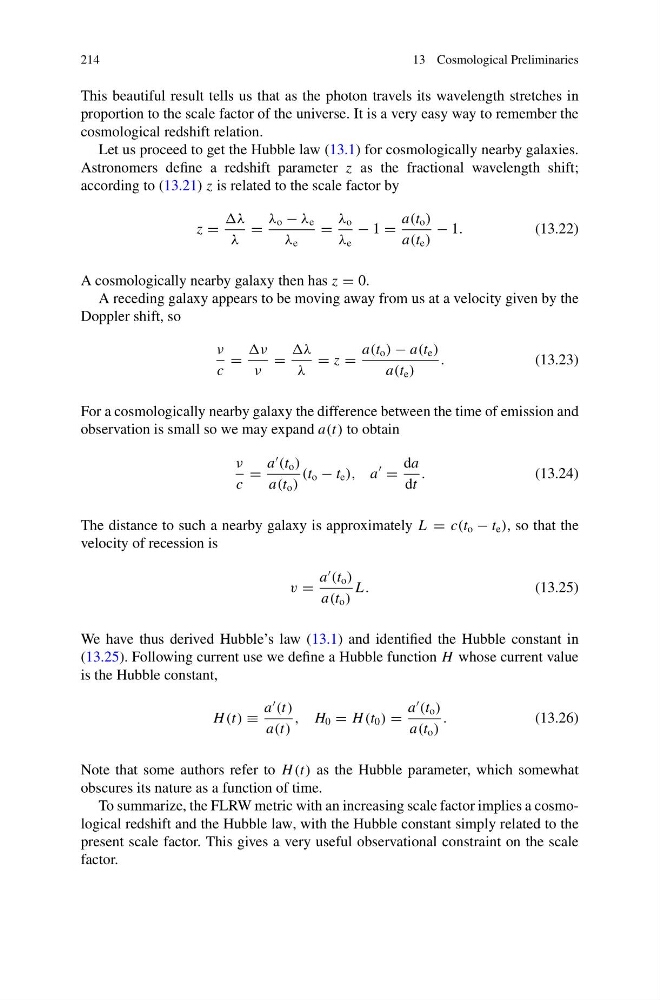
Let us proceed to get the Hubble law (13.1) for cosmologically nearby galaxies.
Astronomers define a redshift parameter z as the fractional wavelength shift;
according to (13.21) z is related to the scale factor by
z =
λ
λ
=
λ o − λ e
λ e
=
λ o
λ e
− 1 =
a(t o )
a(t e )
− 1.
(13.22)
A cosmologically nearby galaxy then has z = 0.
A receding galaxy appears to be moving away from us at a velocity given by the
Doppler shift, so
ν
c
=
ν
ν
=
λ
λ
= z =
a(t o ) − a(t e )
a(t e )
.
(13.23)
For a cosmologically nearby galaxy the difference between the time of emission and
observation is small so we may expand a(t) to obtain
ν
c
=
a
(t o )
a(t o )
(t o − t e ), a
=
da
dt
.
(13.24)
The distance to such a nearby galaxy is approximately L = c(t o − t e ), so that the
velocity of recession is
v =
a
(t o )
a(t o )
L .
(13.25)
We have thus derived Hubble’s law (13.1) and identified the Hubble constant in
(13.25). Following current use we define a Hubble function H whose current value
is the Hubble constant,
H (t) ≡
a
(t)
a(t)
, H 0 = H (t 0 ) =
a
(t o )
a(t o )
.
(13.26)
Note that some authors refer to H (t) as the Hubble parameter, which somewhat
obscures its nature as a function of time.
To summarize, the FLRW metric with an increasing scale factor implies a cosmological redshift and the Hubble law, with the Hubble constant simply related to the
present scale factor. This gives a very useful observational constraint on the scale
factor.
13 Cosmological Preliminaries
This beautiful result tells us that as the photon travels its wavelength stretches in
proportion to the scale factor of the universe. It is a very easy way to remember the
cosmological redshift relation.
Let us proceed to get the Hubble law (13.1) for cosmologically nearby galaxies.
Astronomers define a redshift parameter z as the fractional wavelength shift;
according to (13.21) z is related to the scale factor by
z =
λ
λ
=
λ o − λ e
λ e
=
λ o
λ e
− 1 =
a(t o )
a(t e )
− 1.
(13.22)
A cosmologically nearby galaxy then has z = 0.
A receding galaxy appears to be moving away from us at a velocity given by the
Doppler shift, so
ν
c
=
ν
ν
=
λ
λ
= z =
a(t o ) − a(t e )
a(t e )
.
(13.23)
For a cosmologically nearby galaxy the difference between the time of emission and
observation is small so we may expand a(t) to obtain
ν
c
=
a
(t o )
a(t o )
(t o − t e ), a
=
da
dt
.
(13.24)
The distance to such a nearby galaxy is approximately L = c(t o − t e ), so that the
velocity of recession is
v =
a
(t o )
a(t o )
L .
(13.25)
We have thus derived Hubble’s law (13.1) and identified the Hubble constant in
(13.25). Following current use we define a Hubble function H whose current value
is the Hubble constant,
H (t) ≡
a
(t)
a(t)
, H 0 = H (t 0 ) =
a
(t o )
a(t o )
.
(13.26)
Note that some authors refer to H (t) as the Hubble parameter, which somewhat
obscures its nature as a function of time.
To summarize, the FLRW metric with an increasing scale factor implies a cosmological redshift and the Hubble law, with the Hubble constant simply related to the
present scale factor. This gives a very useful observational constraint on the scale
factor.