

13.3 Consequences of the Metric
213
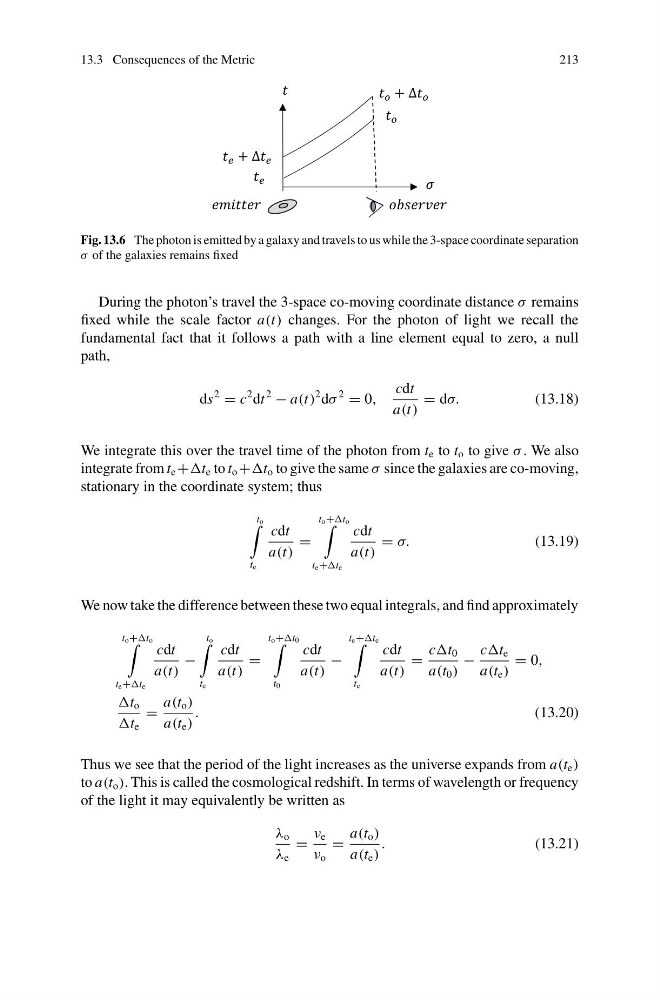
Fig. 13.6 The photon is emitted by a galaxy and travels to us while the 3-space coordinate separation
σ of the galaxies remains fixed
During the photon’s travel the 3-space co-moving coordinate distance σ remains
fixed while the scale factor a(t) changes. For the photon of light we recall the
fundamental fact that it follows a path with a line element equal to zero, a null
path,
ds
2
= c
2 dt
2
− a(t)
2 dσ
2
= 0,
cdt
a(t)
= dσ.
(13.18)
We integrate this over the travel time of the photon from t e to t o to give σ . We also
integrate from t e + e to t o + o to give the same σ since the galaxies are co-moving,
stationary in the coordinate system; thus
t o
t e
cdt
a(t)
=
t o + o
t e + e
cdt
a(t)
= σ.
(13.19)
We now take the difference between these two equal integrals, and find approximately
t o + o
t e + e
cdt
a(t)
−
t o
t e
cdt
a(t)
=
t o + 0
t 0
cdt
a(t)
−
t e + e
t e
cdt
a(t)
=
c 0
a(t 0 )
−
c e
a(t e )
= 0,
o
t e
=
a(t o )
a(t e )
.
(13.20)
Thus we see that the period of the light increases as the universe expands from a(t e )
to a(t o ). This is called the cosmological redshift. In terms of wavelength or frequency
of the light it may equivalently be written as
λ o
λ e
=
ν e
ν o
=
a(t o )
a(t e )
.
(13.21)
213
Fig. 13.6 The photon is emitted by a galaxy and travels to us while the 3-space coordinate separation
σ of the galaxies remains fixed
During the photon’s travel the 3-space co-moving coordinate distance σ remains
fixed while the scale factor a(t) changes. For the photon of light we recall the
fundamental fact that it follows a path with a line element equal to zero, a null
path,
ds
2
= c
2 dt
2
− a(t)
2 dσ
2
= 0,
cdt
a(t)
= dσ.
(13.18)
We integrate this over the travel time of the photon from t e to t o to give σ . We also
integrate from t e + e to t o + o to give the same σ since the galaxies are co-moving,
stationary in the coordinate system; thus
t o
t e
cdt
a(t)
=
t o + o
t e + e
cdt
a(t)
= σ.
(13.19)
We now take the difference between these two equal integrals, and find approximately
t o + o
t e + e
cdt
a(t)
−
t o
t e
cdt
a(t)
=
t o + 0
t 0
cdt
a(t)
−
t e + e
t e
cdt
a(t)
=
c 0
a(t 0 )
−
c e
a(t e )
= 0,
o
t e
=
a(t o )
a(t e )
.
(13.20)
Thus we see that the period of the light increases as the universe expands from a(t e )
to a(t o ). This is called the cosmological redshift. In terms of wavelength or frequency
of the light it may equivalently be written as
λ o
λ e
=
ν e
ν o
=
a(t o )
a(t e )
.
(13.21)