

212
13 Cosmological Preliminaries
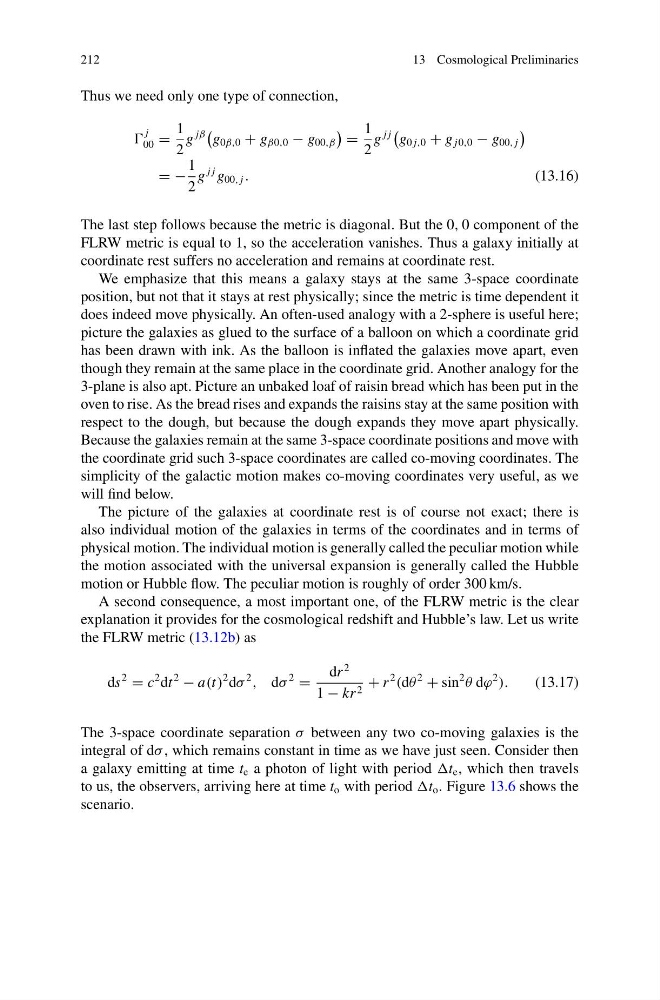
Thus we need only one type of connection,
j
00 =
1
2
g
jβ
g 0β,0 + g β0,0 − g 00,β
=
1
2
g
j j
g 0 j,0 + g j0,0 − g 00, j
= −
1
2
g
j j g 00, j .
(13.16)
The last step follows because the metric is diagonal. But the 0, 0 component of the
FLRW metric is equal to 1, so the acceleration vanishes. Thus a galaxy initially at
coordinate rest suffers no acceleration and remains at coordinate rest.
We emphasize that this means a galaxy stays at the same 3-space coordinate
position, but not that it stays at rest physically; since the metric is time dependent it
does indeed move physically. An often-used analogy with a 2-sphere is useful here;
picture the galaxies as glued to the surface of a balloon on which a coordinate grid
has been drawn with ink. As the balloon is inflated the galaxies move apart, even
though they remain at the same place in the coordinate grid. Another analogy for the
3-plane is also apt. Picture an unbaked loaf of raisin bread which has been put in the
oven to rise. As the bread rises and expands the raisins stay at the same position with
respect to the dough, but because the dough expands they move apart physically.
Because the galaxies remain at the same 3-space coordinate positions and move with
the coordinate grid such 3-space coordinates are called co-moving coordinates. The
simplicity of the galactic motion makes co-moving coordinates very useful, as we
will find below.
The picture of the galaxies at coordinate rest is of course not exact; there is
also individual motion of the galaxies in terms of the coordinates and in terms of
physical motion. The individual motion is generally called the peculiar motion while
the motion associated with the universal expansion is generally called the Hubble
motion or Hubble flow. The peculiar motion is roughly of order 300 km/s.
A second consequence, a most important one, of the FLRW metric is the clear
explanation it provides for the cosmological redshift and Hubble’s law. Let us write
the FLRW metric (13.12b) as
ds
2
= c
2 dt
2
− a(t)
2 dσ
2
, dσ
2
=
dr
2
1 − kr 2 + r
2
(dθ
2
+ sin
2
θ dϕ
2
).
(13.17)
The 3-space coordinate separation σ between any two co-moving galaxies is the
integral of dσ , which remains constant in time as we have just seen. Consider then
a galaxy emitting at time t e a photon of light with period t e , which then travels
to us, the observers, arriving here at time t o with period t o . Figure 13.6 shows the
scenario.
13 Cosmological Preliminaries
Thus we need only one type of connection,
j
00 =
1
2
g
jβ
g 0β,0 + g β0,0 − g 00,β
=
1
2
g
j j
g 0 j,0 + g j0,0 − g 00, j
= −
1
2
g
j j g 00, j .
(13.16)
The last step follows because the metric is diagonal. But the 0, 0 component of the
FLRW metric is equal to 1, so the acceleration vanishes. Thus a galaxy initially at
coordinate rest suffers no acceleration and remains at coordinate rest.
We emphasize that this means a galaxy stays at the same 3-space coordinate
position, but not that it stays at rest physically; since the metric is time dependent it
does indeed move physically. An often-used analogy with a 2-sphere is useful here;
picture the galaxies as glued to the surface of a balloon on which a coordinate grid
has been drawn with ink. As the balloon is inflated the galaxies move apart, even
though they remain at the same place in the coordinate grid. Another analogy for the
3-plane is also apt. Picture an unbaked loaf of raisin bread which has been put in the
oven to rise. As the bread rises and expands the raisins stay at the same position with
respect to the dough, but because the dough expands they move apart physically.
Because the galaxies remain at the same 3-space coordinate positions and move with
the coordinate grid such 3-space coordinates are called co-moving coordinates. The
simplicity of the galactic motion makes co-moving coordinates very useful, as we
will find below.
The picture of the galaxies at coordinate rest is of course not exact; there is
also individual motion of the galaxies in terms of the coordinates and in terms of
physical motion. The individual motion is generally called the peculiar motion while
the motion associated with the universal expansion is generally called the Hubble
motion or Hubble flow. The peculiar motion is roughly of order 300 km/s.
A second consequence, a most important one, of the FLRW metric is the clear
explanation it provides for the cosmological redshift and Hubble’s law. Let us write
the FLRW metric (13.12b) as
ds
2
= c
2 dt
2
− a(t)
2 dσ
2
, dσ
2
=
dr
2
1 − kr 2 + r
2
(dθ
2
+ sin
2
θ dϕ
2
).
(13.17)
The 3-space coordinate separation σ between any two co-moving galaxies is the
integral of dσ , which remains constant in time as we have just seen. Consider then
a galaxy emitting at time t e a photon of light with period t e , which then travels
to us, the observers, arriving here at time t o with period t o . Figure 13.6 shows the
scenario.