

13.2 The Cosmological FLRW Metric
209
R s =
ρ
0
√ g 11 dρ =
ρ
0
dρ
1 − kρ 2 /R 2
∼ = ρ
1 + k
ρ
2
6R 2
.
(13.5b)
Thus the ratio of circumference to radius is
C s
R s
∼ = 2π
1 − k
ρ
2
6R 2
s
.
(13.6)
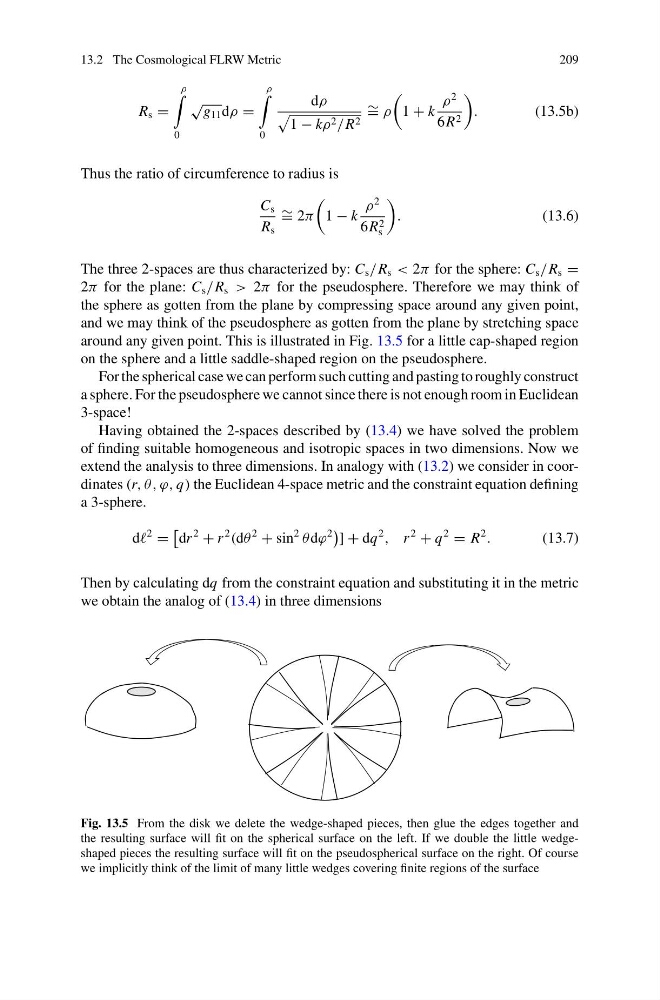
The three 2-spaces are thus characterized by: C s /R s < 2π for the sphere: C s /R s =
2π for the plane: C s /R s > 2π for the pseudosphere. Therefore we may think of
the sphere as gotten from the plane by compressing space around any given point,
and we may think of the pseudosphere as gotten from the plane by stretching space
around any given point. This is illustrated in Fig. 13.5 for a little cap-shaped region
on the sphere and a little saddle-shaped region on the pseudosphere.
For the spherical case we can perform such cutting and pasting to roughly construct
a sphere. For the pseudosphere we cannot since there is not enough room in Euclidean
3-space!
Having obtained the 2-spaces described by (13.4) we have solved the problem
of finding suitable homogeneous and isotropic spaces in two dimensions. Now we
extend the analysis to three dimensions. In analogy with (13.2) we consider in coordinates (r, θ, ϕ, q) the Euclidean 4-space metric and the constraint equation defining
a 3-sphere.
d
2
=
dr
2
+ r
2
(dθ
2
+ sin
2
θ dϕ
2
] + dq
2
, r
2
+ q
2
= R
2
.
(13.7)
Then by calculating dq from the constraint equation and substituting it in the metric
we obtain the analog of (13.4) in three dimensions
Fig. 13.5 From the disk we delete the wedge-shaped pieces, then glue the edges together and
the resulting surface will fit on the spherical surface on the left. If we double the little wedgeshaped pieces the resulting surface will fit on the pseudospherical surface on the right. Of course
we implicitly think of the limit of many little wedges covering finite regions of the surface
209
R s =
ρ
0
√ g 11 dρ =
ρ
0
dρ
1 − kρ 2 /R 2
∼ = ρ
1 + k
ρ
2
6R 2
.
(13.5b)
Thus the ratio of circumference to radius is
C s
R s
∼ = 2π
1 − k
ρ
2
6R 2
s
.
(13.6)
The three 2-spaces are thus characterized by: C s /R s < 2π for the sphere: C s /R s =
2π for the plane: C s /R s > 2π for the pseudosphere. Therefore we may think of
the sphere as gotten from the plane by compressing space around any given point,
and we may think of the pseudosphere as gotten from the plane by stretching space
around any given point. This is illustrated in Fig. 13.5 for a little cap-shaped region
on the sphere and a little saddle-shaped region on the pseudosphere.
For the spherical case we can perform such cutting and pasting to roughly construct
a sphere. For the pseudosphere we cannot since there is not enough room in Euclidean
3-space!
Having obtained the 2-spaces described by (13.4) we have solved the problem
of finding suitable homogeneous and isotropic spaces in two dimensions. Now we
extend the analysis to three dimensions. In analogy with (13.2) we consider in coordinates (r, θ, ϕ, q) the Euclidean 4-space metric and the constraint equation defining
a 3-sphere.
d
2
=
dr
2
+ r
2
(dθ
2
+ sin
2
θ dϕ
2
] + dq
2
, r
2
+ q
2
= R
2
.
(13.7)
Then by calculating dq from the constraint equation and substituting it in the metric
we obtain the analog of (13.4) in three dimensions
Fig. 13.5 From the disk we delete the wedge-shaped pieces, then glue the edges together and
the resulting surface will fit on the spherical surface on the left. If we double the little wedgeshaped pieces the resulting surface will fit on the pseudospherical surface on the right. Of course
we implicitly think of the limit of many little wedges covering finite regions of the surface