

210
13 Cosmological Preliminaries
k = 0, Euclidean 3-space
d
2
=
dr
2
1−kr 2 /R 2 + r
2
(dθ
2
+ sin
2
θ dϕ
2
), k = 1, hypersphere
k = −1, pseudohypersphere
(13.8)
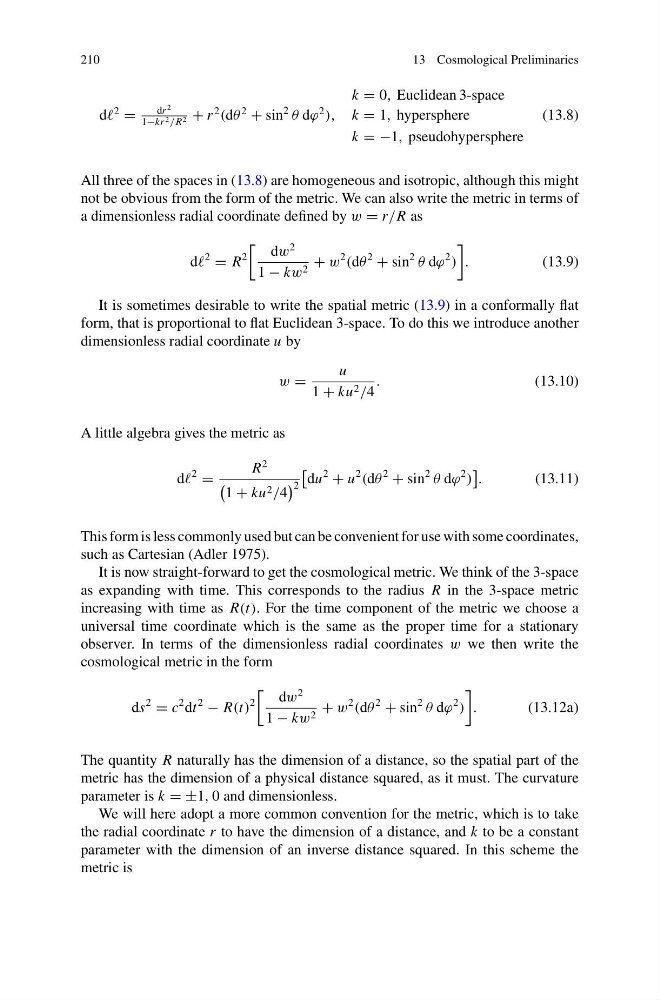
All three of the spaces in (13.8) are homogeneous and isotropic, although this might
not be obvious from the form of the metric. We can also write the metric in terms of
a dimensionless radial coordinate defined by w = r/R as
d
2
= R
2
dw
2
1 − kw 2 + w
2
(dθ
2
+ sin
2
θ dϕ
2
)
.
(13.9)
It is sometimes desirable to write the spatial metric (13.9) in a conformally flat
form, that is proportional to flat Euclidean 3-space. To do this we introduce another
dimensionless radial coordinate u by
w =
u
1 + ku 2 /4
.
(13.10)
A little algebra gives the metric as
d
2
=
R
2
1 + ku 2 /4
2
du
2
+ u
2
(dθ
2
+ sin
2
θ dϕ
2
)
.
(13.11)
This form is less commonly used but can be convenient for use with some coordinates,
such as Cartesian (Adler 1975).
It is now straight-forward to get the cosmological metric. We think of the 3-space
as expanding with time. This corresponds to the radius R in the 3-space metric
increasing with time as R(t). For the time component of the metric we choose a
universal time coordinate which is the same as the proper time for a stationary
observer. In terms of the dimensionless radial coordinates w we then write the
cosmological metric in the form
ds
2
= c
2 dt
2
− R(t)
2
dw
2
1 − kw 2 + w
2
(dθ
2
+ sin
2
θ dϕ
2
)
.
(13.12a)
The quantity R naturally has the dimension of a distance, so the spatial part of the
metric has the dimension of a physical distance squared, as it must. The curvature
parameter is k = ±1, 0 and dimensionless.
We will here adopt a more common convention for the metric, which is to take
the radial coordinate r to have the dimension of a distance, and k to be a constant
parameter with the dimension of an inverse distance squared. In this scheme the
metric is
13 Cosmological Preliminaries
k = 0, Euclidean 3-space
d
2
=
dr
2
1−kr 2 /R 2 + r
2
(dθ
2
+ sin
2
θ dϕ
2
), k = 1, hypersphere
k = −1, pseudohypersphere
(13.8)
All three of the spaces in (13.8) are homogeneous and isotropic, although this might
not be obvious from the form of the metric. We can also write the metric in terms of
a dimensionless radial coordinate defined by w = r/R as
d
2
= R
2
dw
2
1 − kw 2 + w
2
(dθ
2
+ sin
2
θ dϕ
2
)
.
(13.9)
It is sometimes desirable to write the spatial metric (13.9) in a conformally flat
form, that is proportional to flat Euclidean 3-space. To do this we introduce another
dimensionless radial coordinate u by
w =
u
1 + ku 2 /4
.
(13.10)
A little algebra gives the metric as
d
2
=
R
2
1 + ku 2 /4
2
du
2
+ u
2
(dθ
2
+ sin
2
θ dϕ
2
)
.
(13.11)
This form is less commonly used but can be convenient for use with some coordinates,
such as Cartesian (Adler 1975).
It is now straight-forward to get the cosmological metric. We think of the 3-space
as expanding with time. This corresponds to the radius R in the 3-space metric
increasing with time as R(t). For the time component of the metric we choose a
universal time coordinate which is the same as the proper time for a stationary
observer. In terms of the dimensionless radial coordinates w we then write the
cosmological metric in the form
ds
2
= c
2 dt
2
− R(t)
2
dw
2
1 − kw 2 + w
2
(dθ
2
+ sin
2
θ dϕ
2
)
.
(13.12a)
The quantity R naturally has the dimension of a distance, so the spatial part of the
metric has the dimension of a physical distance squared, as it must. The curvature
parameter is k = ±1, 0 and dimensionless.
We will here adopt a more common convention for the metric, which is to take
the radial coordinate r to have the dimension of a distance, and k to be a constant
parameter with the dimension of an inverse distance squared. In this scheme the
metric is