

11.5 Gravitational Wave Sources
179
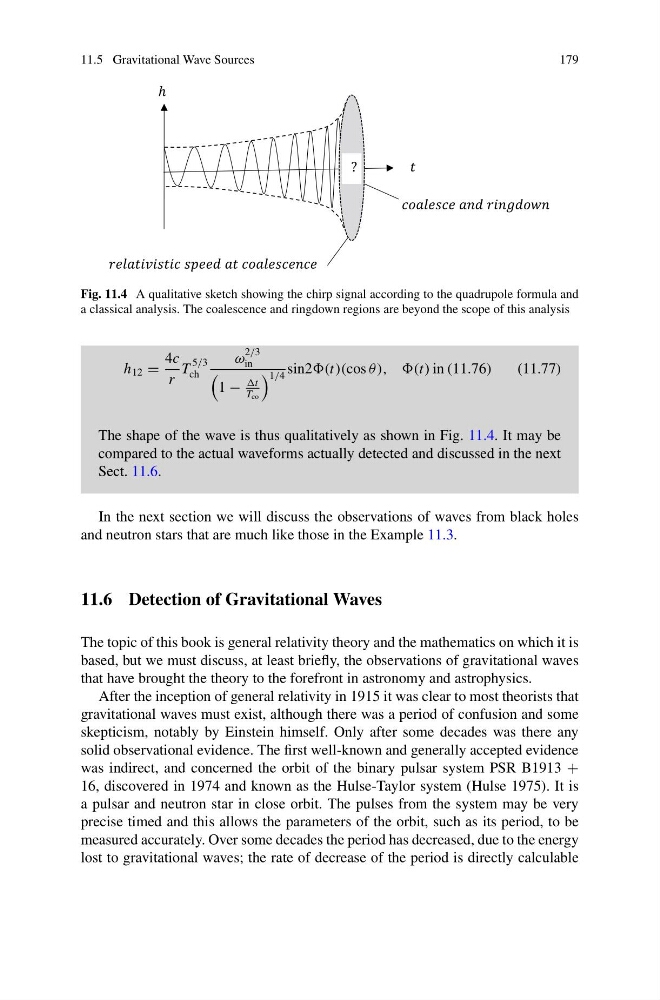
Fig. 11.4 A qualitative sketch showing the chirp signal according to the quadrupole formula and
a classical analysis. The coalescence and ringdown regions are beyond the scope of this analysis
h 12 =
4c
r
T
5/3
ch
ω
2/3
in
1 −
T co
1/4 sin2(t)(cos θ ), ,(t) in (11.76)
(11.77)
The shape of the wave is thus qualitatively as shown in Fig. 11.4. It may be
compared to the actual waveforms actually detected and discussed in the next
Sect. 11.6.
In the next section we will discuss the observations of waves from black holes
and neutron stars that are much like those in the Example 11.3.
11.6 Detection of Gravitational Waves
The topic of this book is general relativity theory and the mathematics on which it is
based, but we must discuss, at least briefly, the observations of gravitational waves
that have brought the theory to the forefront in astronomy and astrophysics.
After the inception of general relativity in 1915 it was clear to most theorists that
gravitational waves must exist, although there was a period of confusion and some
skepticism, notably by Einstein himself. Only after some decades was there any
solid observational evidence. The first well-known and generally accepted evidence
was indirect, and concerned the orbit of the binary pulsar system PSR B1913 +
16, discovered in 1974 and known as the Hulse-Taylor system (Hulse 1975). It is
a pulsar and neutron star in close orbit. The pulses from the system may be very
precise timed and this allows the parameters of the orbit, such as its period, to be
measured accurately. Over some decades the period has decreased, due to the energy
lost to gravitational waves; the rate of decrease of the period is directly calculable
179
Fig. 11.4 A qualitative sketch showing the chirp signal according to the quadrupole formula and
a classical analysis. The coalescence and ringdown regions are beyond the scope of this analysis
h 12 =
4c
r
T
5/3
ch
ω
2/3
in
1 −
T co
1/4 sin2(t)(cos θ ), ,(t) in (11.76)
(11.77)
The shape of the wave is thus qualitatively as shown in Fig. 11.4. It may be
compared to the actual waveforms actually detected and discussed in the next
Sect. 11.6.
In the next section we will discuss the observations of waves from black holes
and neutron stars that are much like those in the Example 11.3.
11.6 Detection of Gravitational Waves
The topic of this book is general relativity theory and the mathematics on which it is
based, but we must discuss, at least briefly, the observations of gravitational waves
that have brought the theory to the forefront in astronomy and astrophysics.
After the inception of general relativity in 1915 it was clear to most theorists that
gravitational waves must exist, although there was a period of confusion and some
skepticism, notably by Einstein himself. Only after some decades was there any
solid observational evidence. The first well-known and generally accepted evidence
was indirect, and concerned the orbit of the binary pulsar system PSR B1913 +
16, discovered in 1974 and known as the Hulse-Taylor system (Hulse 1975). It is
a pulsar and neutron star in close orbit. The pulses from the system may be very
precise timed and this allows the parameters of the orbit, such as its period, to be
measured accurately. Over some decades the period has decreased, due to the energy
lost to gravitational waves; the rate of decrease of the period is directly calculable