

180
11 Linearized General Relativity and Gravitational Waves
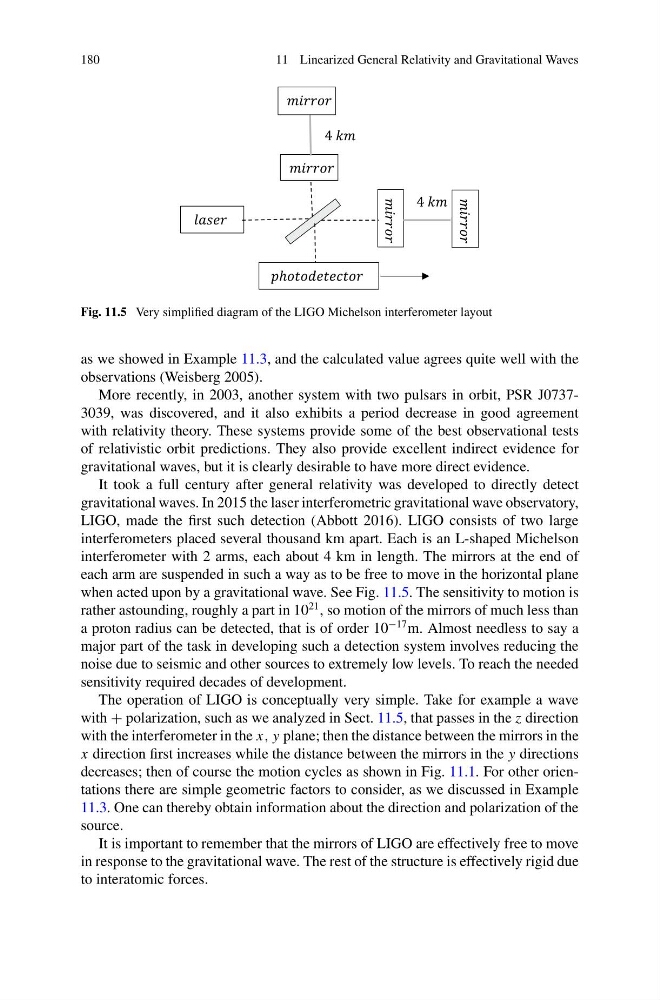
Fig. 11.5 Very simplified diagram of the LIGO Michelson interferometer layout
as we showed in Example 11.3, and the calculated value agrees quite well with the
observations (Weisberg 2005).
More recently, in 2003, another system with two pulsars in orbit, PSR J07373039, was discovered, and it also exhibits a period decrease in good agreement
with relativity theory. These systems provide some of the best observational tests
of relativistic orbit predictions. They also provide excellent indirect evidence for
gravitational waves, but it is clearly desirable to have more direct evidence.
It took a full century after general relativity was developed to directly detect
gravitational waves. In 2015 the laser interferometric gravitational wave observatory,
LIGO, made the first such detection (Abbott 2016). LIGO consists of two large
interferometers placed several thousand km apart. Each is an L-shaped Michelson
interferometer with 2 arms, each about 4 km in length. The mirrors at the end of
each arm are suspended in such a way as to be free to move in the horizontal plane
when acted upon by a gravitational wave. See Fig. 11.5. The sensitivity to motion is
rather astounding, roughly a part in 10
21 , so motion of the mirrors of much less than
a proton radius can be detected, that is of order 10
−17 m. Almost needless to say a
major part of the task in developing such a detection system involves reducing the
noise due to seismic and other sources to extremely low levels. To reach the needed
sensitivity required decades of development.
The operation of LIGO is conceptually very simple. Take for example a wave
with + polarization, such as we analyzed in Sect. 11.5, that passes in the z direction
with the interferometer in the x, y plane; then the distance between the mirrors in the
x direction first increases while the distance between the mirrors in the y directions
decreases; then of course the motion cycles as shown in Fig. 11.1. For other orientations there are simple geometric factors to consider, as we discussed in Example
11.3. One can thereby obtain information about the direction and polarization of the
source.
It is important to remember that the mirrors of LIGO are effectively free to move
in response to the gravitational wave. The rest of the structure is effectively rigid due
to interatomic forces.
11 Linearized General Relativity and Gravitational Waves
Fig. 11.5 Very simplified diagram of the LIGO Michelson interferometer layout
as we showed in Example 11.3, and the calculated value agrees quite well with the
observations (Weisberg 2005).
More recently, in 2003, another system with two pulsars in orbit, PSR J07373039, was discovered, and it also exhibits a period decrease in good agreement
with relativity theory. These systems provide some of the best observational tests
of relativistic orbit predictions. They also provide excellent indirect evidence for
gravitational waves, but it is clearly desirable to have more direct evidence.
It took a full century after general relativity was developed to directly detect
gravitational waves. In 2015 the laser interferometric gravitational wave observatory,
LIGO, made the first such detection (Abbott 2016). LIGO consists of two large
interferometers placed several thousand km apart. Each is an L-shaped Michelson
interferometer with 2 arms, each about 4 km in length. The mirrors at the end of
each arm are suspended in such a way as to be free to move in the horizontal plane
when acted upon by a gravitational wave. See Fig. 11.5. The sensitivity to motion is
rather astounding, roughly a part in 10
21 , so motion of the mirrors of much less than
a proton radius can be detected, that is of order 10
−17 m. Almost needless to say a
major part of the task in developing such a detection system involves reducing the
noise due to seismic and other sources to extremely low levels. To reach the needed
sensitivity required decades of development.
The operation of LIGO is conceptually very simple. Take for example a wave
with + polarization, such as we analyzed in Sect. 11.5, that passes in the z direction
with the interferometer in the x, y plane; then the distance between the mirrors in the
x direction first increases while the distance between the mirrors in the y directions
decreases; then of course the motion cycles as shown in Fig. 11.1. For other orientations there are simple geometric factors to consider, as we discussed in Example
11.3. One can thereby obtain information about the direction and polarization of the
source.
It is important to remember that the mirrors of LIGO are effectively free to move
in response to the gravitational wave. The rest of the structure is effectively rigid due
to interatomic forces.