

178
11 Linearized General Relativity and Gravitational Waves
ω = ω in
1 −
t
T co
−3/8
, ω in = initial freqency at t = 0,
1
T co
=
256
5
ω
8/3
in T
5/3
ch , coalescence time.
(11.74)
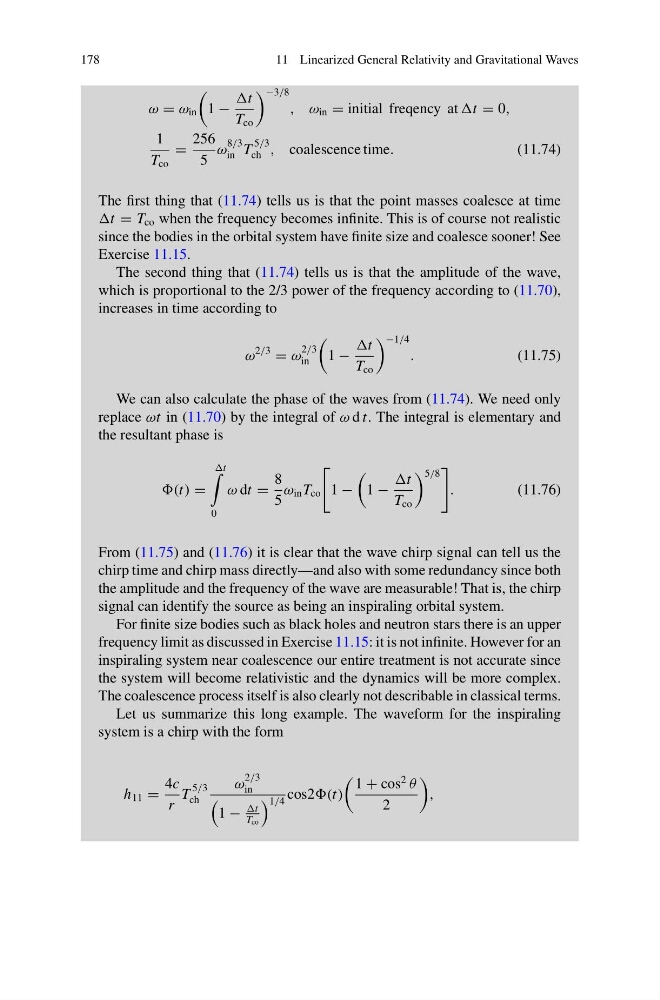
The first thing that (11.74) tells us is that the point masses coalesce at time
t = T co when the frequency becomes infinite. This is of course not realistic
since the bodies in the orbital system have finite size and coalesce sooner! See
Exercise 11.15.
The second thing that (11.74) tells us is that the amplitude of the wave,
which is proportional to the 2/3 power of the frequency according to (11.70),
increases in time according to
ω
2/3
= ω
2/3
in
1 −
t
T co
−1/4
.
(11.75)
We can also calculate the phase of the waves from (11.74). We need only
replace ωt in (11.70) by the integral of ω d t. The integral is elementary and
the resultant phase is
(t) =
t
0
ω dt =
8
5
ω in T co
1 −
1 −
t
T co
5/8
.
(11.76)
From (11.75) and (11.76) it is clear that the wave chirp signal can tell us the
chirp time and chirp mass directly—and also with some redundancy since both
the amplitude and the frequency of the wave are measurable! That is, the chirp
signal can identify the source as being an inspiraling orbital system.
For finite size bodies such as black holes and neutron stars there is an upper
frequency limit as discussed in Exercise 11.15: it is not infinite. However for an
inspiraling system near coalescence our entire treatment is not accurate since
the system will become relativistic and the dynamics will be more complex.
The coalescence process itself is also clearly not describable in classical terms.
Let us summarize this long example. The waveform for the inspiraling
system is a chirp with the form
h 11 =
4c
r
T
5/3
ch
ω
2/3
in
1 −
t
T co
1/4 cos2(t)
1 + cos
2
θ
2
,
11 Linearized General Relativity and Gravitational Waves
ω = ω in
1 −
t
T co
−3/8
, ω in = initial freqency at t = 0,
1
T co
=
256
5
ω
8/3
in T
5/3
ch , coalescence time.
(11.74)
The first thing that (11.74) tells us is that the point masses coalesce at time
t = T co when the frequency becomes infinite. This is of course not realistic
since the bodies in the orbital system have finite size and coalesce sooner! See
Exercise 11.15.
The second thing that (11.74) tells us is that the amplitude of the wave,
which is proportional to the 2/3 power of the frequency according to (11.70),
increases in time according to
ω
2/3
= ω
2/3
in
1 −
t
T co
−1/4
.
(11.75)
We can also calculate the phase of the waves from (11.74). We need only
replace ωt in (11.70) by the integral of ω d t. The integral is elementary and
the resultant phase is
(t) =
t
0
ω dt =
8
5
ω in T co
1 −
1 −
t
T co
5/8
.
(11.76)
From (11.75) and (11.76) it is clear that the wave chirp signal can tell us the
chirp time and chirp mass directly—and also with some redundancy since both
the amplitude and the frequency of the wave are measurable! That is, the chirp
signal can identify the source as being an inspiraling orbital system.
For finite size bodies such as black holes and neutron stars there is an upper
frequency limit as discussed in Exercise 11.15: it is not infinite. However for an
inspiraling system near coalescence our entire treatment is not accurate since
the system will become relativistic and the dynamics will be more complex.
The coalescence process itself is also clearly not describable in classical terms.
Let us summarize this long example. The waveform for the inspiraling
system is a chirp with the form
h 11 =
4c
r
T
5/3
ch
ω
2/3
in
1 −
t
T co
1/4 cos2(t)
1 + cos
2
θ
2
,