

11.5 Gravitational Wave Sources
177
h 11 =
4c
r
T
5/3
ch ω
2/3 cos 2ωt
1 + cos
2
θ
2
h 12 =
4c
r
T
5/3
ch ω
2/3 sin 2ωt(cos θ ), T ch =
G M ch
c 3
.
(11.70)
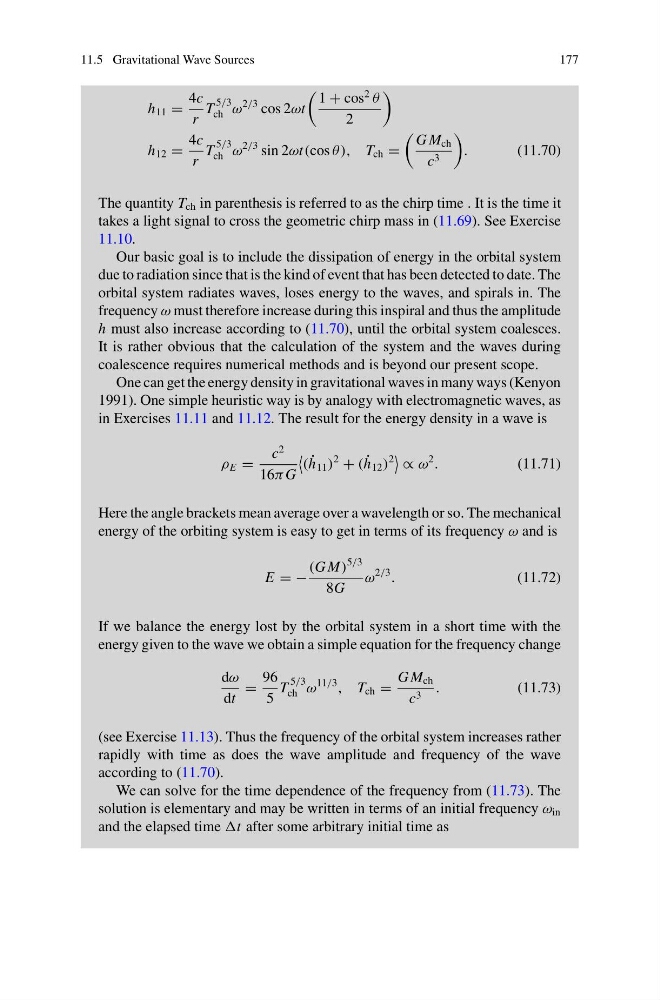
The quantity T ch in parenthesis is referred to as the chirp time . It is the time it
takes a light signal to cross the geometric chirp mass in (11.69). See Exercise
11.10.
Our basic goal is to include the dissipation of energy in the orbital system
due to radiation since that is the kind of event that has been detected to date. The
orbital system radiates waves, loses energy to the waves, and spirals in. The
frequency ω must therefore increase during this inspiral and thus the amplitude
h must also increase according to (11.70), until the orbital system coalesces.
It is rather obvious that the calculation of the system and the waves during
coalescence requires numerical methods and is beyond our present scope.
One can get the energy density in gravitational waves in many ways (Kenyon
1991). One simple heuristic way is by analogy with electromagnetic waves, as
in Exercises 11.11 and 11.12. The result for the energy density in a wave is
ρ E =
c
2
16π G
( ˙
h 11 )
2
+ ( ˙
h 12 )
2
∝ ω
2
.
(11.71)
Here the angle brackets mean average over a wavelength or so. The mechanical
energy of the orbiting system is easy to get in terms of its frequency ω and is
E = −
(G M)
5/3
8G
ω
2/3
.
(11.72)
If we balance the energy lost by the orbital system in a short time with the
energy given to the wave we obtain a simple equation for the frequency change
dω
dt
=
96
5
T
5/3
ch ω
11/3
, T ch =
G M ch
c 3 .
(11.73)
(see Exercise 11.13). Thus the frequency of the orbital system increases rather
rapidly with time as does the wave amplitude and frequency of the wave
according to (11.70).
We can solve for the time dependence of the frequency from (11.73). The
solution is elementary and may be written in terms of an initial frequency ω in
and the elapsed time t after some arbitrary initial time as
177
h 11 =
4c
r
T
5/3
ch ω
2/3 cos 2ωt
1 + cos
2
θ
2
h 12 =
4c
r
T
5/3
ch ω
2/3 sin 2ωt(cos θ ), T ch =
G M ch
c 3
.
(11.70)
The quantity T ch in parenthesis is referred to as the chirp time . It is the time it
takes a light signal to cross the geometric chirp mass in (11.69). See Exercise
11.10.
Our basic goal is to include the dissipation of energy in the orbital system
due to radiation since that is the kind of event that has been detected to date. The
orbital system radiates waves, loses energy to the waves, and spirals in. The
frequency ω must therefore increase during this inspiral and thus the amplitude
h must also increase according to (11.70), until the orbital system coalesces.
It is rather obvious that the calculation of the system and the waves during
coalescence requires numerical methods and is beyond our present scope.
One can get the energy density in gravitational waves in many ways (Kenyon
1991). One simple heuristic way is by analogy with electromagnetic waves, as
in Exercises 11.11 and 11.12. The result for the energy density in a wave is
ρ E =
c
2
16π G
( ˙
h 11 )
2
+ ( ˙
h 12 )
2
∝ ω
2
.
(11.71)
Here the angle brackets mean average over a wavelength or so. The mechanical
energy of the orbiting system is easy to get in terms of its frequency ω and is
E = −
(G M)
5/3
8G
ω
2/3
.
(11.72)
If we balance the energy lost by the orbital system in a short time with the
energy given to the wave we obtain a simple equation for the frequency change
dω
dt
=
96
5
T
5/3
ch ω
11/3
, T ch =
G M ch
c 3 .
(11.73)
(see Exercise 11.13). Thus the frequency of the orbital system increases rather
rapidly with time as does the wave amplitude and frequency of the wave
according to (11.70).
We can solve for the time dependence of the frequency from (11.73). The
solution is elementary and may be written in terms of an initial frequency ω in
and the elapsed time t after some arbitrary initial time as