

10.5 Spinning Black Holes and the Kerr Metric
151
is the generalization of the Schwarzschild black hole. The solution for such an object
was discovered by Kerr in 1963, many years after the Schwarzschild solution (Kerr
1963; Schiffer 1973; Adler 1975). The solution of the field equations is sufficiently
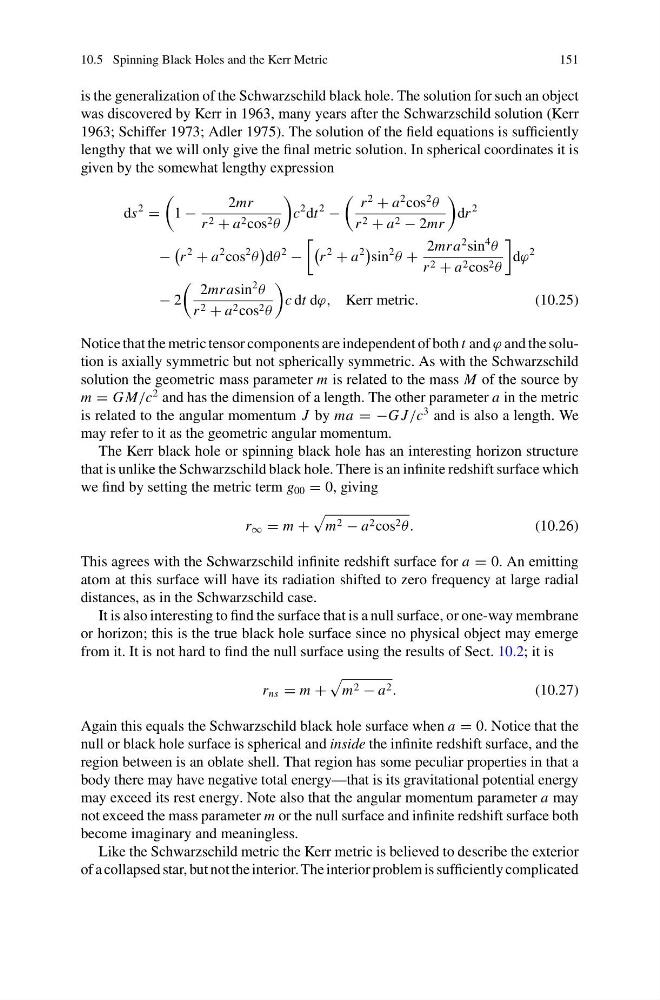
lengthy that we will only give the final metric solution. In spherical coordinates it is
given by the somewhat lengthy expression
ds
2
=
1 −
2mr
r 2 + a 2 cos 2 θ
c
2 dt
2
−
r
2
+ a
2 cos
2
θ
r 2 + a 2 − 2mr
dr
2
−
r
2
+ a
2 cos
2
θ
dθ
2
−
r
2
+ a
2
sin
2
θ +
2mra
2 sin
4
θ
r 2 + a 2 cos 2 θ
dϕ
2
− 2
2mrasin
2
θ
r 2 + a 2 cos 2 θ
c dt dϕ, Kerr metric.
(10.25)
Notice that the metric tensor components are independent of both t and ϕ and the solution is axially symmetric but not spherically symmetric. As with the Schwarzschild
solution the geometric mass parameter m is related to the mass M of the source by
m = G M/c
2 and has the dimension of a length. The other parameter a in the metric
is related to the angular momentum J by ma = −G J/c
3 and is also a length. We
may refer to it as the geometric angular momentum.
The Kerr black hole or spinning black hole has an interesting horizon structure
that is unlike the Schwarzschild black hole. There is an infinite redshift surface which
we find by setting the metric term g 00 = 0, giving
r ∞ = m +
m 2 − a 2 cos 2 θ.
(10.26)
This agrees with the Schwarzschild infinite redshift surface for a = 0. An emitting
atom at this surface will have its radiation shifted to zero frequency at large radial
distances, as in the Schwarzschild case.
It is also interesting to find the surface that is a null surface, or one-way membrane
or horizon; this is the true black hole surface since no physical object may emerge
from it. It is not hard to find the null surface using the results of Sect. 10.2; it is
r ns = m +
m 2 − a 2 .
(10.27)
Again this equals the Schwarzschild black hole surface when a = 0. Notice that the
null or black hole surface is spherical and inside the infinite redshift surface, and the
region between is an oblate shell. That region has some peculiar properties in that a
body there may have negative total energy—that is its gravitational potential energy
may exceed its rest energy. Note also that the angular momentum parameter a may
not exceed the mass parameter m or the null surface and infinite redshift surface both
become imaginary and meaningless.
Like the Schwarzschild metric the Kerr metric is believed to describe the exterior
of a collapsed star, but not the interior. The interior problem is sufficiently complicated
151
is the generalization of the Schwarzschild black hole. The solution for such an object
was discovered by Kerr in 1963, many years after the Schwarzschild solution (Kerr
1963; Schiffer 1973; Adler 1975). The solution of the field equations is sufficiently
lengthy that we will only give the final metric solution. In spherical coordinates it is
given by the somewhat lengthy expression
ds
2
=
1 −
2mr
r 2 + a 2 cos 2 θ
c
2 dt
2
−
r
2
+ a
2 cos
2
θ
r 2 + a 2 − 2mr
dr
2
−
r
2
+ a
2 cos
2
θ
dθ
2
−
r
2
+ a
2
sin
2
θ +
2mra
2 sin
4
θ
r 2 + a 2 cos 2 θ
dϕ
2
− 2
2mrasin
2
θ
r 2 + a 2 cos 2 θ
c dt dϕ, Kerr metric.
(10.25)
Notice that the metric tensor components are independent of both t and ϕ and the solution is axially symmetric but not spherically symmetric. As with the Schwarzschild
solution the geometric mass parameter m is related to the mass M of the source by
m = G M/c
2 and has the dimension of a length. The other parameter a in the metric
is related to the angular momentum J by ma = −G J/c
3 and is also a length. We
may refer to it as the geometric angular momentum.
The Kerr black hole or spinning black hole has an interesting horizon structure
that is unlike the Schwarzschild black hole. There is an infinite redshift surface which
we find by setting the metric term g 00 = 0, giving
r ∞ = m +
m 2 − a 2 cos 2 θ.
(10.26)
This agrees with the Schwarzschild infinite redshift surface for a = 0. An emitting
atom at this surface will have its radiation shifted to zero frequency at large radial
distances, as in the Schwarzschild case.
It is also interesting to find the surface that is a null surface, or one-way membrane
or horizon; this is the true black hole surface since no physical object may emerge
from it. It is not hard to find the null surface using the results of Sect. 10.2; it is
r ns = m +
m 2 − a 2 .
(10.27)
Again this equals the Schwarzschild black hole surface when a = 0. Notice that the
null or black hole surface is spherical and inside the infinite redshift surface, and the
region between is an oblate shell. That region has some peculiar properties in that a
body there may have negative total energy—that is its gravitational potential energy
may exceed its rest energy. Note also that the angular momentum parameter a may
not exceed the mass parameter m or the null surface and infinite redshift surface both
become imaginary and meaningless.
Like the Schwarzschild metric the Kerr metric is believed to describe the exterior
of a collapsed star, but not the interior. The interior problem is sufficiently complicated