

152
10 Black Holes and Gravitational Collapse
that there is no known analog of the dust ball collapse model to describe the collapse
of a spinning model star.
It is worth noting that if the black hole is slowly spinning, so that a is small, then
the Kerr metric is well approximated by the first order expansion
ds
2
=
1 −
2G M
c 2 r
c
2 dt
2
−
1 −
2G M
c 2 r
−1
dr
2
− r
2
dθ
2
+ sin
2
θ dϕ
2
−
4ma
r
sin
2
θ cdt dϕ Kerr metric to first order in a,
(10.28)
which we recognize as the Schwarzschild metric plus a cross term. This metric was
discovered by Lense and Thirring only a few years after the advent of general relativity (Thirring 1918). It is very simple and convenient for astrophysical applications
since it describes the exterior of slowly spinning roughly spherical bodies rather well.
10.6 Black Holes in the Real Universe
A few brief comments are in order on actual black holes in nature. Theorists generally
agree that a non-radiating condensed stellar-type object with a mass greater than the
TOV limit cannot be a neutron star; by default it must be a black hole (Misner 1973).
A number of high energy flickering X-ray sources are thus likely to be black holes.
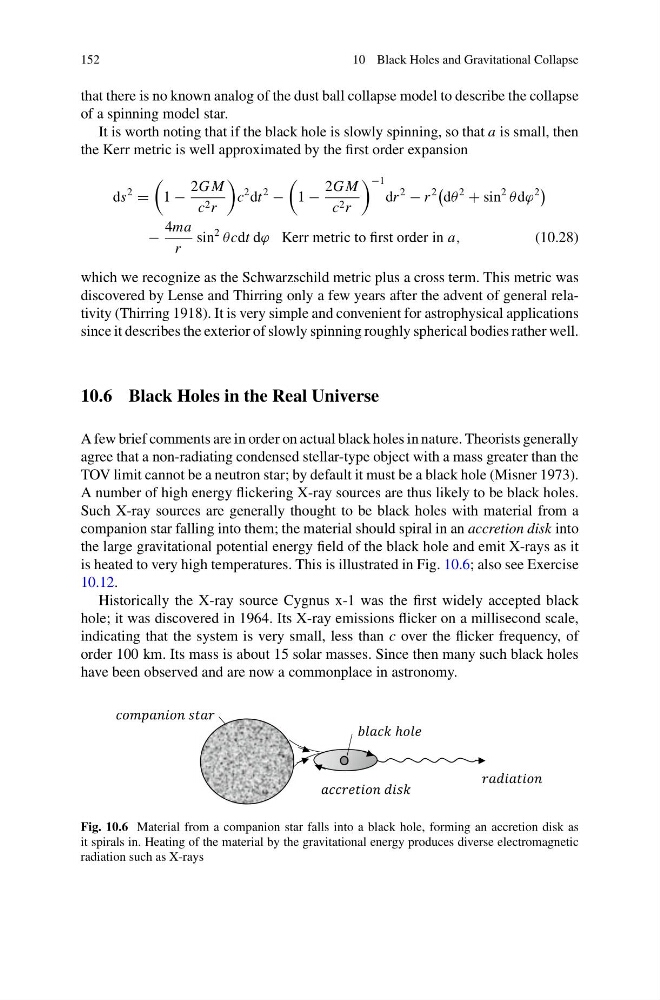
Such X-ray sources are generally thought to be black holes with material from a
companion star falling into them; the material should spiral in an accretion disk into
the large gravitational potential energy field of the black hole and emit X-rays as it
is heated to very high temperatures. This is illustrated in Fig. 10.6; also see Exercise
10.12.
Historically the X-ray source Cygnus x-1 was the first widely accepted black
hole; it was discovered in 1964. Its X-ray emissions flicker on a millisecond scale,
indicating that the system is very small, less than c over the flicker frequency, of
order 100 km. Its mass is about 15 solar masses. Since then many such black holes
have been observed and are now a commonplace in astronomy.
Fig. 10.6 Material from a companion star falls into a black hole, forming an accretion disk as
it spirals in. Heating of the material by the gravitational energy produces diverse electromagnetic
radiation such as X-rays
10 Black Holes and Gravitational Collapse
that there is no known analog of the dust ball collapse model to describe the collapse
of a spinning model star.
It is worth noting that if the black hole is slowly spinning, so that a is small, then
the Kerr metric is well approximated by the first order expansion
ds
2
=
1 −
2G M
c 2 r
c
2 dt
2
−
1 −
2G M
c 2 r
−1
dr
2
− r
2
dθ
2
+ sin
2
θ dϕ
2
−
4ma
r
sin
2
θ cdt dϕ Kerr metric to first order in a,
(10.28)
which we recognize as the Schwarzschild metric plus a cross term. This metric was
discovered by Lense and Thirring only a few years after the advent of general relativity (Thirring 1918). It is very simple and convenient for astrophysical applications
since it describes the exterior of slowly spinning roughly spherical bodies rather well.
10.6 Black Holes in the Real Universe
A few brief comments are in order on actual black holes in nature. Theorists generally
agree that a non-radiating condensed stellar-type object with a mass greater than the
TOV limit cannot be a neutron star; by default it must be a black hole (Misner 1973).
A number of high energy flickering X-ray sources are thus likely to be black holes.
Such X-ray sources are generally thought to be black holes with material from a
companion star falling into them; the material should spiral in an accretion disk into
the large gravitational potential energy field of the black hole and emit X-rays as it
is heated to very high temperatures. This is illustrated in Fig. 10.6; also see Exercise
10.12.
Historically the X-ray source Cygnus x-1 was the first widely accepted black
hole; it was discovered in 1964. Its X-ray emissions flicker on a millisecond scale,
indicating that the system is very small, less than c over the flicker frequency, of
order 100 km. Its mass is about 15 solar masses. Since then many such black holes
have been observed and are now a commonplace in astronomy.
Fig. 10.6 Material from a companion star falls into a black hole, forming an accretion disk as
it spirals in. Heating of the material by the gravitational energy produces diverse electromagnetic
radiation such as X-rays