

150
10 Black Holes and Gravitational Collapse
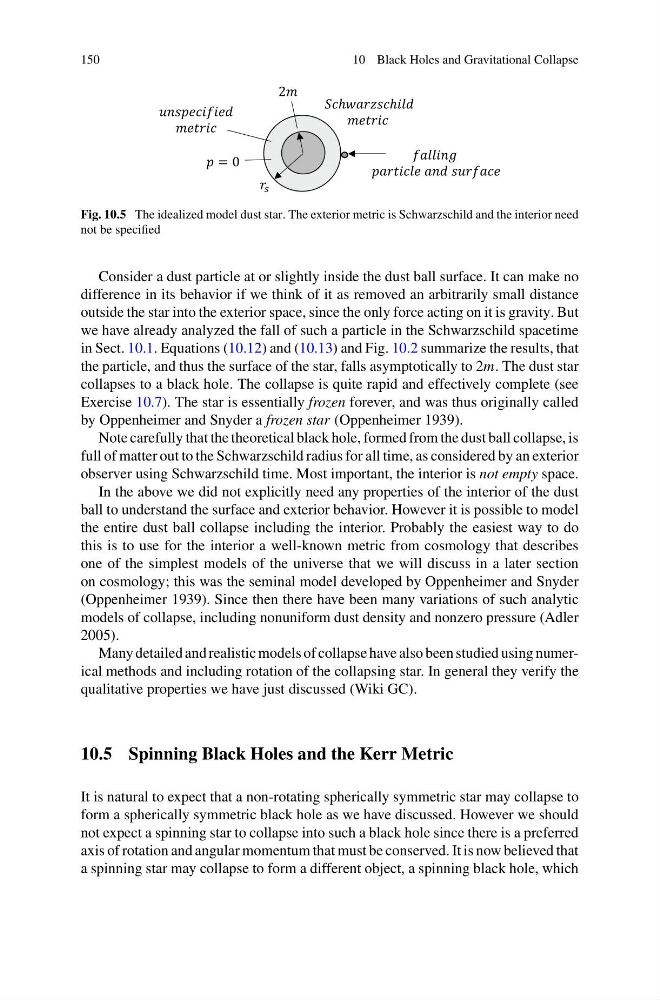
Fig. 10.5 The idealized model dust star. The exterior metric is Schwarzschild and the interior need
not be specified
Consider a dust particle at or slightly inside the dust ball surface. It can make no
difference in its behavior if we think of it as removed an arbitrarily small distance
outside the star into the exterior space, since the only force acting on it is gravity. But
we have already analyzed the fall of such a particle in the Schwarzschild spacetime
in Sect. 10.1. Equations (10.12) and (10.13) and Fig. 10.2 summarize the results, that
the particle, and thus the surface of the star, falls asymptotically to 2m. The dust star
collapses to a black hole. The collapse is quite rapid and effectively complete (see
Exercise 10.7). The star is essentially frozen forever, and was thus originally called
by Oppenheimer and Snyder a frozen star (Oppenheimer 1939).
Note carefully that the theoretical black hole, formed from the dust ball collapse, is
full of matter out to the Schwarzschild radius for all time, as considered by an exterior
observer using Schwarzschild time. Most important, the interior is not empty space.
In the above we did not explicitly need any properties of the interior of the dust
ball to understand the surface and exterior behavior. However it is possible to model
the entire dust ball collapse including the interior. Probably the easiest way to do
this is to use for the interior a well-known metric from cosmology that describes
one of the simplest models of the universe that we will discuss in a later section
on cosmology; this was the seminal model developed by Oppenheimer and Snyder
(Oppenheimer 1939). Since then there have been many variations of such analytic
models of collapse, including nonuniform dust density and nonzero pressure (Adler
2005).
Many detailed and realistic models of collapse have also been studied using numerical methods and including rotation of the collapsing star. In general they verify the
qualitative properties we have just discussed (Wiki GC).
10.5 Spinning Black Holes and the Kerr Metric
It is natural to expect that a non-rotating spherically symmetric star may collapse to
form a spherically symmetric black hole as we have discussed. However we should
not expect a spinning star to collapse into such a black hole since there is a preferred
axis of rotation and angular momentum that must be conserved. It is now believed that
a spinning star may collapse to form a different object, a spinning black hole, which
10 Black Holes and Gravitational Collapse
Fig. 10.5 The idealized model dust star. The exterior metric is Schwarzschild and the interior need
not be specified
Consider a dust particle at or slightly inside the dust ball surface. It can make no
difference in its behavior if we think of it as removed an arbitrarily small distance
outside the star into the exterior space, since the only force acting on it is gravity. But
we have already analyzed the fall of such a particle in the Schwarzschild spacetime
in Sect. 10.1. Equations (10.12) and (10.13) and Fig. 10.2 summarize the results, that
the particle, and thus the surface of the star, falls asymptotically to 2m. The dust star
collapses to a black hole. The collapse is quite rapid and effectively complete (see
Exercise 10.7). The star is essentially frozen forever, and was thus originally called
by Oppenheimer and Snyder a frozen star (Oppenheimer 1939).
Note carefully that the theoretical black hole, formed from the dust ball collapse, is
full of matter out to the Schwarzschild radius for all time, as considered by an exterior
observer using Schwarzschild time. Most important, the interior is not empty space.
In the above we did not explicitly need any properties of the interior of the dust
ball to understand the surface and exterior behavior. However it is possible to model
the entire dust ball collapse including the interior. Probably the easiest way to do
this is to use for the interior a well-known metric from cosmology that describes
one of the simplest models of the universe that we will discuss in a later section
on cosmology; this was the seminal model developed by Oppenheimer and Snyder
(Oppenheimer 1939). Since then there have been many variations of such analytic
models of collapse, including nonuniform dust density and nonzero pressure (Adler
2005).
Many detailed and realistic models of collapse have also been studied using numerical methods and including rotation of the collapsing star. In general they verify the
qualitative properties we have just discussed (Wiki GC).
10.5 Spinning Black Holes and the Kerr Metric
It is natural to expect that a non-rotating spherically symmetric star may collapse to
form a spherically symmetric black hole as we have discussed. However we should
not expect a spinning star to collapse into such a black hole since there is a preferred
axis of rotation and angular momentum that must be conserved. It is now believed that
a spinning star may collapse to form a different object, a spinning black hole, which