

10.1 Schwarzschild Black Hole
143
As expected the photon takes an infinite time to reach the black hole surface where
r n = 2m. It is easy to show from (10.5) that when all the distances are near 2m the
photon approaches the black hole asymptotically as
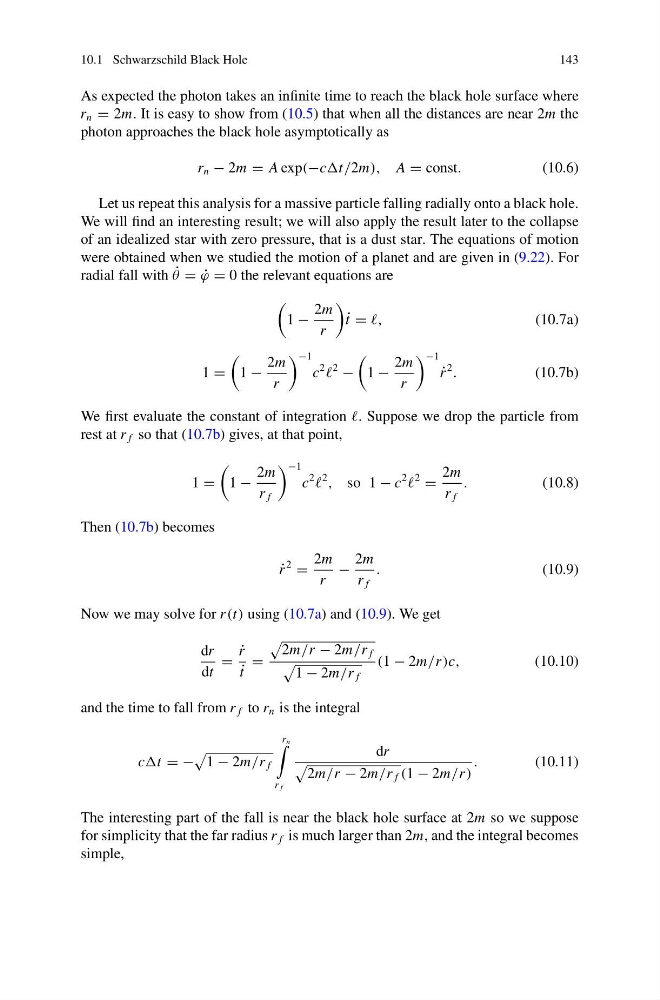
r n − 2m = A exp(−ct/2m), A = const.
(10.6)
Let us repeat this analysis for a massive particle falling radially onto a black hole.
We will find an interesting result; we will also apply the result later to the collapse
of an idealized star with zero pressure, that is a dust star. The equations of motion
were obtained when we studied the motion of a planet and are given in (9.22). For
radial fall with ˙
θ = ˙
ϕ = 0 the relevant equations are
1 −
2m
r
˙
t = ,
(10.7a)
1 =
1 −
2m
r
−1
c
2
2
−
1 −
2m
r
−1
˙
r
2
.
(10.7b)
We first evaluate the constant of integration . Suppose we drop the particle from
rest at r f so that (10.7b) gives, at that point,
1 =
1 −
2m
r f
−1
c
2
2
, so 1 − c
2
2
=
2m
r f
.
(10.8)
Then (10.7b) becomes
˙
r
2
=
2m
r
−
2m
r f
.
(10.9)
Now we may solve for r (t) using (10.7a) and (10.9). We get
dr
dt
=
˙
r
˙
t
=
2m/r − 2m/r f
1 − 2m/r f
(1 − 2m/r)c,
(10.10)
and the time to fall from r f to r n is the integral
ct = −
1 − 2m/r f
r n
r f
dr
2m/r − 2m/r f (1 − 2m/r )
.
(10.11)
The interesting part of the fall is near the black hole surface at 2m so we suppose
for simplicity that the far radius r f is much larger than 2m, and the integral becomes
simple,
143
As expected the photon takes an infinite time to reach the black hole surface where
r n = 2m. It is easy to show from (10.5) that when all the distances are near 2m the
photon approaches the black hole asymptotically as
r n − 2m = A exp(−ct/2m), A = const.
(10.6)
Let us repeat this analysis for a massive particle falling radially onto a black hole.
We will find an interesting result; we will also apply the result later to the collapse
of an idealized star with zero pressure, that is a dust star. The equations of motion
were obtained when we studied the motion of a planet and are given in (9.22). For
radial fall with ˙
θ = ˙
ϕ = 0 the relevant equations are
1 −
2m
r
˙
t = ,
(10.7a)
1 =
1 −
2m
r
−1
c
2
2
−
1 −
2m
r
−1
˙
r
2
.
(10.7b)
We first evaluate the constant of integration . Suppose we drop the particle from
rest at r f so that (10.7b) gives, at that point,
1 =
1 −
2m
r f
−1
c
2
2
, so 1 − c
2
2
=
2m
r f
.
(10.8)
Then (10.7b) becomes
˙
r
2
=
2m
r
−
2m
r f
.
(10.9)
Now we may solve for r (t) using (10.7a) and (10.9). We get
dr
dt
=
˙
r
˙
t
=
2m/r − 2m/r f
1 − 2m/r f
(1 − 2m/r)c,
(10.10)
and the time to fall from r f to r n is the integral
ct = −
1 − 2m/r f
r n
r f
dr
2m/r − 2m/r f (1 − 2m/r )
.
(10.11)
The interesting part of the fall is near the black hole surface at 2m so we suppose
for simplicity that the far radius r f is much larger than 2m, and the integral becomes
simple,