

142
10 Black Holes and Gravitational Collapse
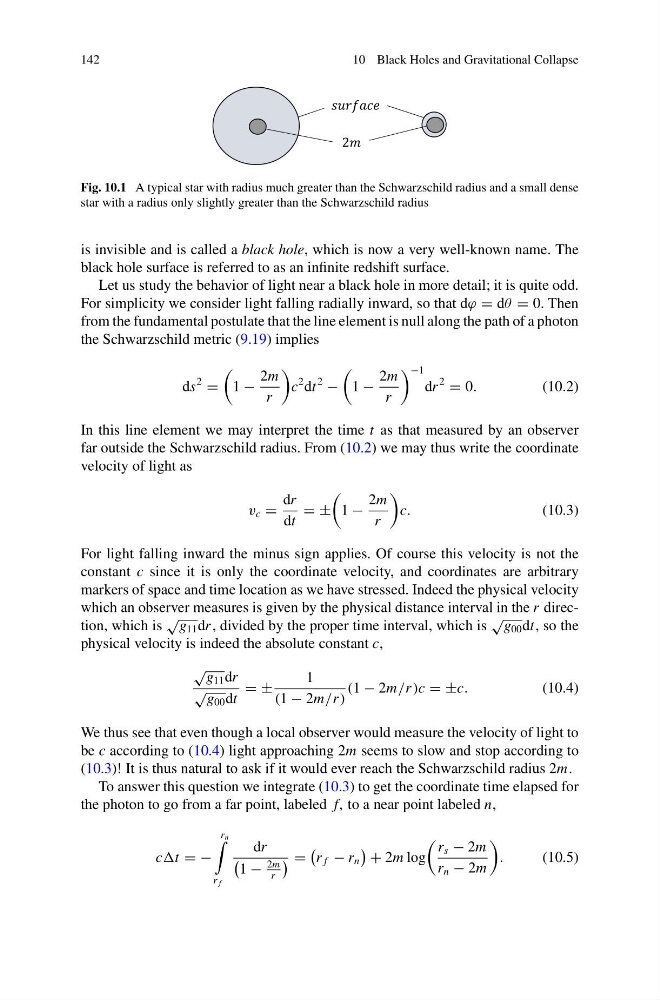
Fig. 10.1 A typical star with radius much greater than the Schwarzschild radius and a small dense
star with a radius only slightly greater than the Schwarzschild radius
is invisible and is called a black hole, which is now a very well-known name. The
black hole surface is referred to as an infinite redshift surface.
Let us study the behavior of light near a black hole in more detail; it is quite odd.
For simplicity we consider light falling radially inward, so that dϕ = dθ = 0. Then
from the fundamental postulate that the line element is null along the path of a photon
the Schwarzschild metric (9.19) implies
ds
2
=
1 −
2m
r
c
2 dt
2
−
1 −
2m
r
−1
dr
2
= 0.
(10.2)
In this line element we may interpret the time t as that measured by an observer
far outside the Schwarzschild radius. From (10.2) we may thus write the coordinate
velocity of light as
v c =
dr
dt
= ±
1 −
2m
r
c.
(10.3)
For light falling inward the minus sign applies. Of course this velocity is not the
constant c since it is only the coordinate velocity, and coordinates are arbitrary
markers of space and time location as we have stressed. Indeed the physical velocity
which an observer measures is given by the physical distance interval in the r direction, which is
√ g 11 dr , divided by the proper time interval, which is
√ g 00 dt, so the
physical velocity is indeed the absolute constant c,
√ g 11 dr
√ g 00 dt
= ±
1
(1 − 2m/r )
(1 − 2m/r )c = ±c.
(10.4)
We thus see that even though a local observer would measure the velocity of light to
be c according to (10.4) light approaching 2m seems to slow and stop according to
(10.3)! It is thus natural to ask if it would ever reach the Schwarzschild radius 2m.
To answer this question we integrate (10.3) to get the coordinate time elapsed for
the photon to go from a far point, labeled f, to a near point labeled n,
c = −
r n
r f
dr
1 −
2m
r
=
r f − r n
+ 2m log
r s − 2m
r n − 2m
.
(10.5)
10 Black Holes and Gravitational Collapse
Fig. 10.1 A typical star with radius much greater than the Schwarzschild radius and a small dense
star with a radius only slightly greater than the Schwarzschild radius
is invisible and is called a black hole, which is now a very well-known name. The
black hole surface is referred to as an infinite redshift surface.
Let us study the behavior of light near a black hole in more detail; it is quite odd.
For simplicity we consider light falling radially inward, so that dϕ = dθ = 0. Then
from the fundamental postulate that the line element is null along the path of a photon
the Schwarzschild metric (9.19) implies
ds
2
=
1 −
2m
r
c
2 dt
2
−
1 −
2m
r
−1
dr
2
= 0.
(10.2)
In this line element we may interpret the time t as that measured by an observer
far outside the Schwarzschild radius. From (10.2) we may thus write the coordinate
velocity of light as
v c =
dr
dt
= ±
1 −
2m
r
c.
(10.3)
For light falling inward the minus sign applies. Of course this velocity is not the
constant c since it is only the coordinate velocity, and coordinates are arbitrary
markers of space and time location as we have stressed. Indeed the physical velocity
which an observer measures is given by the physical distance interval in the r direction, which is
√ g 11 dr , divided by the proper time interval, which is
√ g 00 dt, so the
physical velocity is indeed the absolute constant c,
√ g 11 dr
√ g 00 dt
= ±
1
(1 − 2m/r )
(1 − 2m/r )c = ±c.
(10.4)
We thus see that even though a local observer would measure the velocity of light to
be c according to (10.4) light approaching 2m seems to slow and stop according to
(10.3)! It is thus natural to ask if it would ever reach the Schwarzschild radius 2m.
To answer this question we integrate (10.3) to get the coordinate time elapsed for
the photon to go from a far point, labeled f, to a near point labeled n,
c = −
r n
r f
dr
1 −
2m
r
=
r f − r n
+ 2m log
r s − 2m
r n − 2m
.
(10.5)