

144
10 Black Holes and Gravitational Collapse
c =
2
3
√
2m
r
3/2
f − r
3/2
n + 6m
√
r f −
√
r n
+ 2m log
⎡
⎣
√
r f −
√
2m
√
r n +
√
2m
√
r f +
√
2m
√
r n −
√
2m
⎤
⎦ .
(10.12)
We see that as r n → 2m the time required becomes infinite, just as for the photon.
The particle never reaches the black hole surface. It is easy to show from (10.12) that
the particle approaches the black hole asymptotically exactly like a photon, or
r n − 2m = A exp(−c A = const.
(10.13)
Both the photon and the particle fall onto the black hole surface exponentially, and
never quite reach it. (However see Exercise 10.7 and Sect. 19.6 on very small distances
in physics!)
The above analysis gives the motion of the particle in terms of the coordinate time,
r (t). This is appropriate from the point of view of an observer far outside the black
hole whose proper time is approximately equal to the Schwarzschild coordinate time.
We may also analyze the motion in terms of the proper time of an observer falling
with the particle towards the black hole, whose proper time is the arc length divided
by c. For this we need only integrate (10.9) for r (s),
dr
ds
= −
2m
r
, ,s =
2
3
√
2m
r
3/2
f − r
3/2
n
.
(10.14)
As before we have taken the far point r f to be much greater than 2m. This time is
totally different from the previous result (10.12). From the viewpoint of the observer
falling with the particle it falls onto the black hole surface in a finite time
BH =
2
3
√
2m
r
3/2
f − (2m)
3/2
.
(10.15)
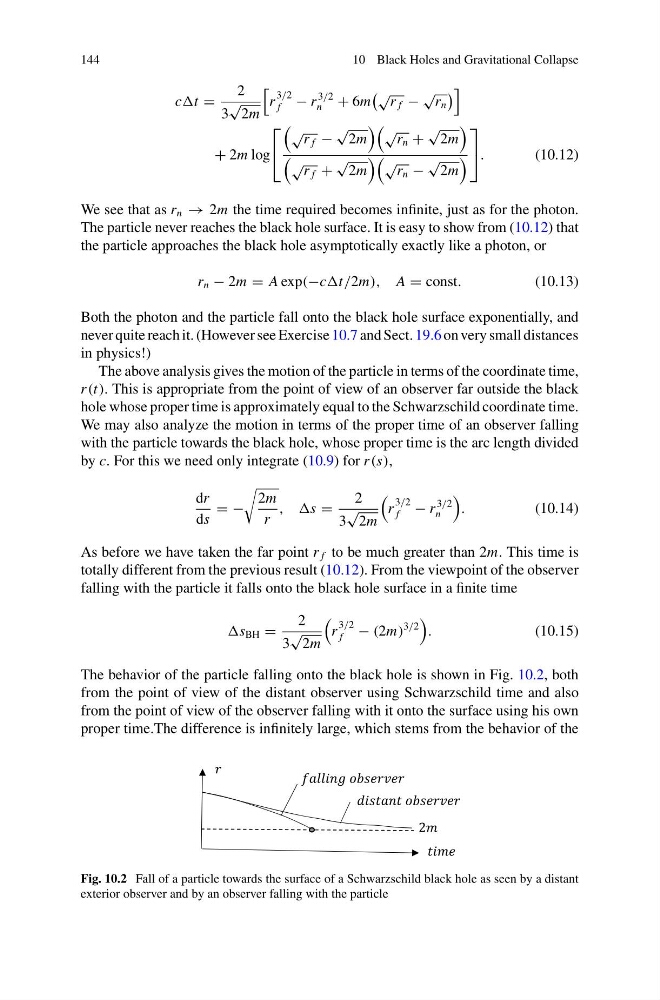
The behavior of the particle falling onto the black hole is shown in Fig. 10.2, both
from the point of view of the distant observer using Schwarzschild time and also
from the point of view of the observer falling with it onto the surface using his own
proper time.The difference is infinitely large, which stems from the behavior of the
Fig. 10.2 Fall of a particle towards the surface of a Schwarzschild black hole as seen by a distant
exterior observer and by an observer falling with the particle
10 Black Holes and Gravitational Collapse
c =
2
3
√
2m
r
3/2
f − r
3/2
n + 6m
√
r f −
√
r n
+ 2m log
⎡
⎣
√
r f −
√
2m
√
r n +
√
2m
√
r f +
√
2m
√
r n −
√
2m
⎤
⎦ .
(10.12)
We see that as r n → 2m the time required becomes infinite, just as for the photon.
The particle never reaches the black hole surface. It is easy to show from (10.12) that
the particle approaches the black hole asymptotically exactly like a photon, or
r n − 2m = A exp(−c A = const.
(10.13)
Both the photon and the particle fall onto the black hole surface exponentially, and
never quite reach it. (However see Exercise 10.7 and Sect. 19.6 on very small distances
in physics!)
The above analysis gives the motion of the particle in terms of the coordinate time,
r (t). This is appropriate from the point of view of an observer far outside the black
hole whose proper time is approximately equal to the Schwarzschild coordinate time.
We may also analyze the motion in terms of the proper time of an observer falling
with the particle towards the black hole, whose proper time is the arc length divided
by c. For this we need only integrate (10.9) for r (s),
dr
ds
= −
2m
r
, ,s =
2
3
√
2m
r
3/2
f − r
3/2
n
.
(10.14)
As before we have taken the far point r f to be much greater than 2m. This time is
totally different from the previous result (10.12). From the viewpoint of the observer
falling with the particle it falls onto the black hole surface in a finite time
BH =
2
3
√
2m
r
3/2
f − (2m)
3/2
.
(10.15)
The behavior of the particle falling onto the black hole is shown in Fig. 10.2, both
from the point of view of the distant observer using Schwarzschild time and also
from the point of view of the observer falling with it onto the surface using his own
proper time.The difference is infinitely large, which stems from the behavior of the
Fig. 10.2 Fall of a particle towards the surface of a Schwarzschild black hole as seen by a distant
exterior observer and by an observer falling with the particle