

41
Queen. He says that some of the best-known songs of the group occurred to
him precisely when he was working at Teide Observatory. Years later, I asked
why I had never seen him with a guitar in his hand and he replied, ‘Well, I hid
it because I didn't want you to think that I was wasting time!’
This young doctoral student had to build everything from scratch, including assembling the prefabricated tin hut in which he was to reside and setting
up his measuring instruments. We gave him all the help we could, and I
assigned Carlos Sánchez Magro, who was also doing his thesis on the zodiacal
light, to take care of him. I remember the Brian May of those days as a gangling, long-haired, but clever, very friendly, and courteous youth. At the time
there were a lot of long-haired young men at the Observatory. To his credit,
Brian May, in spite of all his success in the music world, has never lost his love
for astronomy. He not only brilliantly concluded his thesis in 2007 but is also
a driving force for astronomical research from his present prominent position.
He engages in outreach with notable distinction.
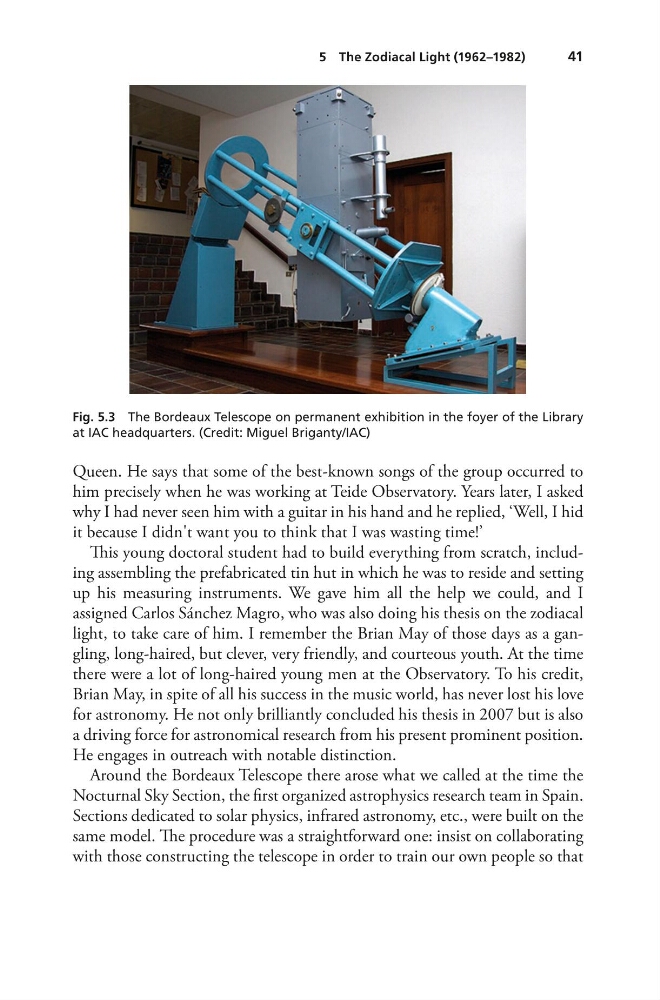
Around the Bordeaux Telescope there arose what we called at the time the
Nocturnal Sky Section, the first organized astrophysics research team in Spain.
Sections dedicated to solar physics, infrared astronomy, etc., were built on the
same model. The procedure was a straightforward one: insist on collaborating
with those constructing the telescope in order to train our own people so that
Fig. 5.3 The Bordeaux Telescope on permanent exhibition in the foyer of the Library
at IAC headquarters. (Credit: Miguel Briganty/IAC)
5 The Zodiacal Light (1962–1982)
Queen. He says that some of the best-known songs of the group occurred to
him precisely when he was working at Teide Observatory. Years later, I asked
why I had never seen him with a guitar in his hand and he replied, ‘Well, I hid
it because I didn't want you to think that I was wasting time!’
This young doctoral student had to build everything from scratch, including assembling the prefabricated tin hut in which he was to reside and setting
up his measuring instruments. We gave him all the help we could, and I
assigned Carlos Sánchez Magro, who was also doing his thesis on the zodiacal
light, to take care of him. I remember the Brian May of those days as a gangling, long-haired, but clever, very friendly, and courteous youth. At the time
there were a lot of long-haired young men at the Observatory. To his credit,
Brian May, in spite of all his success in the music world, has never lost his love
for astronomy. He not only brilliantly concluded his thesis in 2007 but is also
a driving force for astronomical research from his present prominent position.
He engages in outreach with notable distinction.
Around the Bordeaux Telescope there arose what we called at the time the
Nocturnal Sky Section, the first organized astrophysics research team in Spain.
Sections dedicated to solar physics, infrared astronomy, etc., were built on the
same model. The procedure was a straightforward one: insist on collaborating
with those constructing the telescope in order to train our own people so that
Fig. 5.3 The Bordeaux Telescope on permanent exhibition in the foyer of the Library
at IAC headquarters. (Credit: Miguel Briganty/IAC)
5 The Zodiacal Light (1962–1982)