

4 Catalyst Materials for Oxygen Reduction Reaction
91
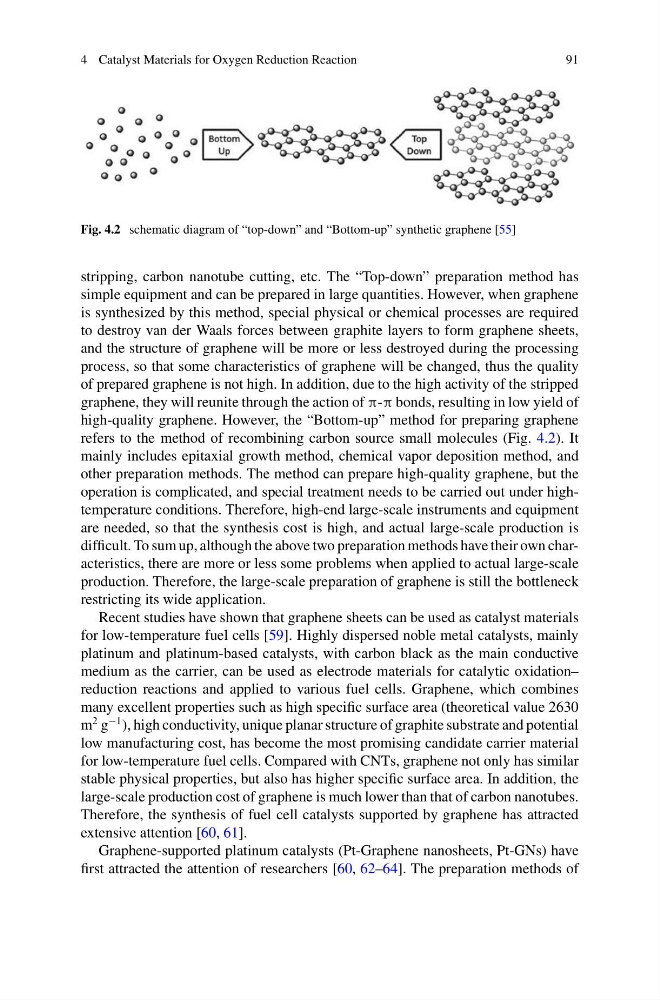
Fig. 4.2 schematic diagram of “top-down” and “Bottom-up” synthetic graphene [55]
stripping, carbon nanotube cutting, etc. The “Top-down” preparation method has
simple equipment and can be prepared in large quantities. However, when graphene
is synthesized by this method, special physical or chemical processes are required
to destroy van der Waals forces between graphite layers to form graphene sheets,
and the structure of graphene will be more or less destroyed during the processing
process, so that some characteristics of graphene will be changed, thus the quality
of prepared graphene is not high. In addition, due to the high activity of the stripped
graphene, they will reunite through the action of π-π bonds, resulting in low yield of
high-quality graphene. However, the “Bottom-up” method for preparing graphene
refers to the method of recombining carbon source small molecules (Fig. 4.2). It
mainly includes epitaxial growth method, chemical vapor deposition method, and
other preparation methods. The method can prepare high-quality graphene, but the
operation is complicated, and special treatment needs to be carried out under hightemperature conditions. Therefore, high-end large-scale instruments and equipment
are needed, so that the synthesis cost is high, and actual large-scale production is
difficult. To sum up, although the above two preparation methods have their own characteristics, there are more or less some problems when applied to actual large-scale
production. Therefore, the large-scale preparation of graphene is still the bottleneck
restricting its wide application.
Recent studies have shown that graphene sheets can be used as catalyst materials
for low-temperature fuel cells [59]. Highly dispersed noble metal catalysts, mainly
platinum and platinum-based catalysts, with carbon black as the main conductive
medium as the carrier, can be used as electrode materials for catalytic oxidation–
reduction reactions and applied to various fuel cells. Graphene, which combines
many excellent properties such as high specific surface area (theoretical value 2630
m
2 g
−1 ), high conductivity, unique planar structure of graphite substrate and potential
low manufacturing cost, has become the most promising candidate carrier material
for low-temperature fuel cells. Compared with CNTs, graphene not only has similar
stable physical properties, but also has higher specific surface area. In addition, the
large-scale production cost of graphene is much lower than that of carbon nanotubes.
Therefore, the synthesis of fuel cell catalysts supported by graphene has attracted
extensive attention [60, 61].
Graphene-supported platinum catalysts (Pt-Graphene nanosheets, Pt-GNs) have
first attracted the attention of researchers [60, 62–64]. The preparation methods of
91
Fig. 4.2 schematic diagram of “top-down” and “Bottom-up” synthetic graphene [55]
stripping, carbon nanotube cutting, etc. The “Top-down” preparation method has
simple equipment and can be prepared in large quantities. However, when graphene
is synthesized by this method, special physical or chemical processes are required
to destroy van der Waals forces between graphite layers to form graphene sheets,
and the structure of graphene will be more or less destroyed during the processing
process, so that some characteristics of graphene will be changed, thus the quality
of prepared graphene is not high. In addition, due to the high activity of the stripped
graphene, they will reunite through the action of π-π bonds, resulting in low yield of
high-quality graphene. However, the “Bottom-up” method for preparing graphene
refers to the method of recombining carbon source small molecules (Fig. 4.2). It
mainly includes epitaxial growth method, chemical vapor deposition method, and
other preparation methods. The method can prepare high-quality graphene, but the
operation is complicated, and special treatment needs to be carried out under hightemperature conditions. Therefore, high-end large-scale instruments and equipment
are needed, so that the synthesis cost is high, and actual large-scale production is
difficult. To sum up, although the above two preparation methods have their own characteristics, there are more or less some problems when applied to actual large-scale
production. Therefore, the large-scale preparation of graphene is still the bottleneck
restricting its wide application.
Recent studies have shown that graphene sheets can be used as catalyst materials
for low-temperature fuel cells [59]. Highly dispersed noble metal catalysts, mainly
platinum and platinum-based catalysts, with carbon black as the main conductive
medium as the carrier, can be used as electrode materials for catalytic oxidation–
reduction reactions and applied to various fuel cells. Graphene, which combines
many excellent properties such as high specific surface area (theoretical value 2630
m
2 g
−1 ), high conductivity, unique planar structure of graphite substrate and potential
low manufacturing cost, has become the most promising candidate carrier material
for low-temperature fuel cells. Compared with CNTs, graphene not only has similar
stable physical properties, but also has higher specific surface area. In addition, the
large-scale production cost of graphene is much lower than that of carbon nanotubes.
Therefore, the synthesis of fuel cell catalysts supported by graphene has attracted
extensive attention [60, 61].
Graphene-supported platinum catalysts (Pt-Graphene nanosheets, Pt-GNs) have
first attracted the attention of researchers [60, 62–64]. The preparation methods of