

92
Y. Li et al.
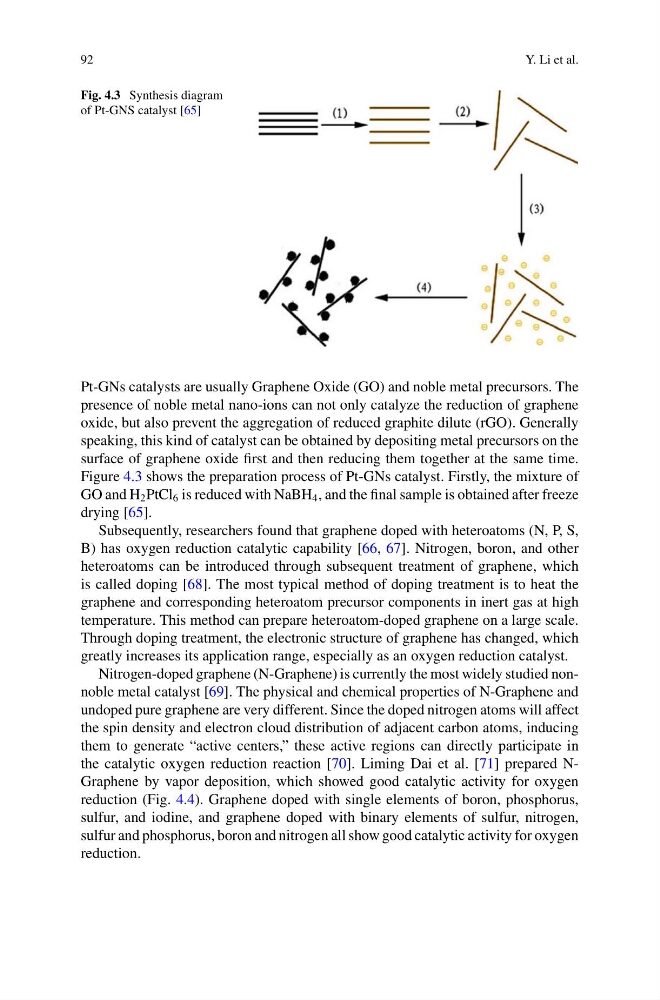
Fig. 4.3 Synthesis diagram
of Pt-GNS catalyst [65]
Pt-GNs catalysts are usually Graphene Oxide (GO) and noble metal precursors. The
presence of noble metal nano-ions can not only catalyze the reduction of graphene
oxide, but also prevent the aggregation of reduced graphite dilute (rGO). Generally
speaking, this kind of catalyst can be obtained by depositing metal precursors on the
surface of graphene oxide first and then reducing them together at the same time.
Figure 4.3 shows the preparation process of Pt-GNs catalyst. Firstly, the mixture of
GO and H 2 PtCl 6 is reduced with NaBH 4 , and the final sample is obtained after freeze
drying [65].
Subsequently, researchers found that graphene doped with heteroatoms (N, P, S,
B) has oxygen reduction catalytic capability [66, 67]. Nitrogen, boron, and other
heteroatoms can be introduced through subsequent treatment of graphene, which
is called doping [68]. The most typical method of doping treatment is to heat the
graphene and corresponding heteroatom precursor components in inert gas at high
temperature. This method can prepare heteroatom-doped graphene on a large scale.
Through doping treatment, the electronic structure of graphene has changed, which
greatly increases its application range, especially as an oxygen reduction catalyst.
Nitrogen-doped graphene (N-Graphene) is currently the most widely studied nonnoble metal catalyst [69]. The physical and chemical properties of N-Graphene and
undoped pure graphene are very different. Since the doped nitrogen atoms will affect
the spin density and electron cloud distribution of adjacent carbon atoms, inducing
them to generate “active centers,” these active regions can directly participate in
the catalytic oxygen reduction reaction [70]. Liming Dai et al. [71] prepared NGraphene by vapor deposition, which showed good catalytic activity for oxygen
reduction (Fig. 4.4). Graphene doped with single elements of boron, phosphorus,
sulfur, and iodine, and graphene doped with binary elements of sulfur, nitrogen,
sulfur and phosphorus, boron and nitrogen all show good catalytic activity for oxygen
reduction.
Y. Li et al.
Fig. 4.3 Synthesis diagram
of Pt-GNS catalyst [65]
Pt-GNs catalysts are usually Graphene Oxide (GO) and noble metal precursors. The
presence of noble metal nano-ions can not only catalyze the reduction of graphene
oxide, but also prevent the aggregation of reduced graphite dilute (rGO). Generally
speaking, this kind of catalyst can be obtained by depositing metal precursors on the
surface of graphene oxide first and then reducing them together at the same time.
Figure 4.3 shows the preparation process of Pt-GNs catalyst. Firstly, the mixture of
GO and H 2 PtCl 6 is reduced with NaBH 4 , and the final sample is obtained after freeze
drying [65].
Subsequently, researchers found that graphene doped with heteroatoms (N, P, S,
B) has oxygen reduction catalytic capability [66, 67]. Nitrogen, boron, and other
heteroatoms can be introduced through subsequent treatment of graphene, which
is called doping [68]. The most typical method of doping treatment is to heat the
graphene and corresponding heteroatom precursor components in inert gas at high
temperature. This method can prepare heteroatom-doped graphene on a large scale.
Through doping treatment, the electronic structure of graphene has changed, which
greatly increases its application range, especially as an oxygen reduction catalyst.
Nitrogen-doped graphene (N-Graphene) is currently the most widely studied nonnoble metal catalyst [69]. The physical and chemical properties of N-Graphene and
undoped pure graphene are very different. Since the doped nitrogen atoms will affect
the spin density and electron cloud distribution of adjacent carbon atoms, inducing
them to generate “active centers,” these active regions can directly participate in
the catalytic oxygen reduction reaction [70]. Liming Dai et al. [71] prepared NGraphene by vapor deposition, which showed good catalytic activity for oxygen
reduction (Fig. 4.4). Graphene doped with single elements of boron, phosphorus,
sulfur, and iodine, and graphene doped with binary elements of sulfur, nitrogen,
sulfur and phosphorus, boron and nitrogen all show good catalytic activity for oxygen
reduction.