

3 The Measurements of the Oxygen Reduction Reaction
71
Where i, j, k are unit vectors, and u x , u y , and u z are the flow rates of the solution
in the x, y, and z directions, respectively. In order to solve the convection–diffusion
equation of the material on the rotating disk electrode and obtain the concentration
distribution of the substance on the surface of the electrode, it is necessary to discuss
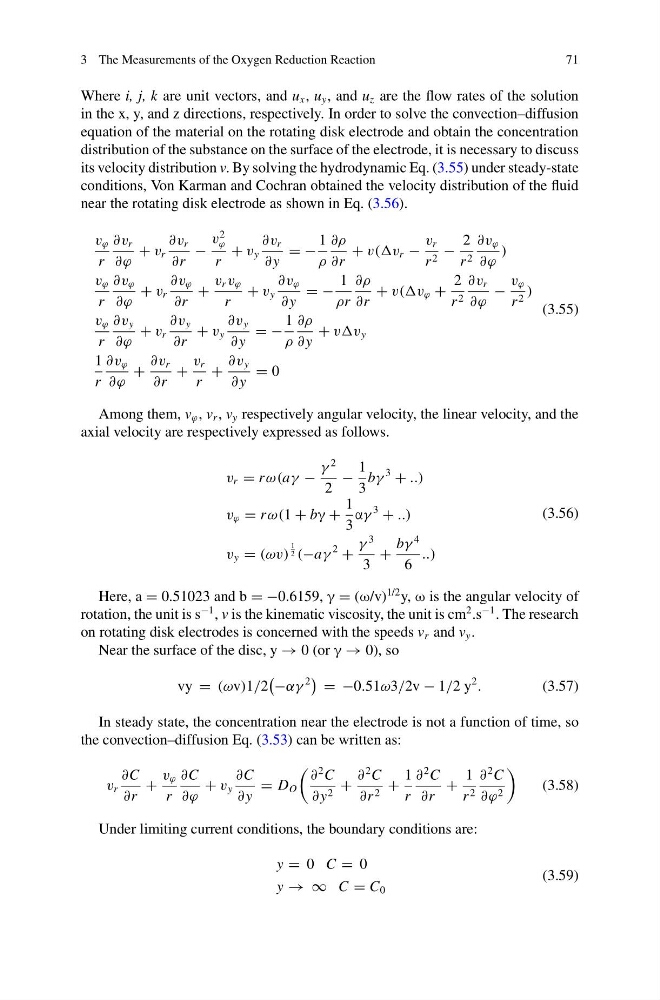
its velocity distribution v. By solving the hydrodynamic Eq. (3.55) under steady-state
conditions, Von Karman and Cochran obtained the velocity distribution of the fluid
near the rotating disk electrode as shown in Eq. (3.56).
v ϕ
r
∂v r
∂ϕ
+ v r
∂v r
∂r
−
v
2
ϕ
r
+ v y
∂v r
∂ y
= −
1
ρ
∂ρ
∂r
+ v((v r −
v r
r 2 −
2
r 2
∂v ϕ
∂ϕ
)
v ϕ
r
∂v ϕ
∂ϕ
+ v r
∂v ϕ
∂r
+
v r v ϕ
r
+ v y
∂v ϕ
∂ y
= −
1
ρr
∂ρ
∂r
+ v((v ϕ +
2
r 2
∂v r
∂ϕ
−
v ϕ
r 2 )
v ϕ
r
∂v y
∂ϕ
+ v r
∂v y
∂r
+ v y
∂v y
∂ y
= −
1
ρ
∂ρ
∂ y
+ vvv y
1
r
∂v ϕ
∂ϕ
+
∂v r
∂r
+
v r
r
+
∂v y
∂ y
= 0
(3.55)
Among them, v ϕ , v r , v y respectively angular velocity, the linear velocity, and the
axial velocity are respectively expressed as follows.
v r = r ω(aγ −
γ
2
2
−
1
3
bγ
3
+ ..)
v ϕ = r ω(1 + bγ +
1
3
αγ
3
+ ..)
v y = (ωv)
1
2 (−aγ
2
+
γ
3
3
+
bγ
4
6
..)
(3.56)
Here, a = 0.51023 and b = −0.6159, γ = (ω/v)
1/2 y, ω is the angular velocity of
rotation, the unit is s
−1 , v is the kinematic viscosity, the unit is cm
2 .s
−1 . The research
on rotating disk electrodes is concerned with the speeds v r and v y .
Near the surface of the disc, y → 0 (or γ → 0), so
vy = (ωv)1/2
−αγ
2
= −0.51ω3/2v − 1/2 y
2
.
(3.57)
In steady state, the concentration near the electrode is not a function of time, so
the convection–diffusion Eq. (3.53) can be written as:
v r
∂C
∂r
+
v ϕ
r
∂C
∂ϕ
+ v y
∂C
∂ y
= D O
∂
2 C
∂ y 2 +
∂
2 C
∂r 2 +
1
r
∂
2 C
∂r
+
1
r 2
∂
2 C
∂ϕ 2
(3.58)
Under limiting current conditions, the boundary conditions are:
y = 0 C = 0
y → ∞ C = C 0
(3.59)
71
Where i, j, k are unit vectors, and u x , u y , and u z are the flow rates of the solution
in the x, y, and z directions, respectively. In order to solve the convection–diffusion
equation of the material on the rotating disk electrode and obtain the concentration
distribution of the substance on the surface of the electrode, it is necessary to discuss
its velocity distribution v. By solving the hydrodynamic Eq. (3.55) under steady-state
conditions, Von Karman and Cochran obtained the velocity distribution of the fluid
near the rotating disk electrode as shown in Eq. (3.56).
v ϕ
r
∂v r
∂ϕ
+ v r
∂v r
∂r
−
v
2
ϕ
r
+ v y
∂v r
∂ y
= −
1
ρ
∂ρ
∂r
+ v((v r −
v r
r 2 −
2
r 2
∂v ϕ
∂ϕ
)
v ϕ
r
∂v ϕ
∂ϕ
+ v r
∂v ϕ
∂r
+
v r v ϕ
r
+ v y
∂v ϕ
∂ y
= −
1
ρr
∂ρ
∂r
+ v((v ϕ +
2
r 2
∂v r
∂ϕ
−
v ϕ
r 2 )
v ϕ
r
∂v y
∂ϕ
+ v r
∂v y
∂r
+ v y
∂v y
∂ y
= −
1
ρ
∂ρ
∂ y
+ vvv y
1
r
∂v ϕ
∂ϕ
+
∂v r
∂r
+
v r
r
+
∂v y
∂ y
= 0
(3.55)
Among them, v ϕ , v r , v y respectively angular velocity, the linear velocity, and the
axial velocity are respectively expressed as follows.
v r = r ω(aγ −
γ
2
2
−
1
3
bγ
3
+ ..)
v ϕ = r ω(1 + bγ +
1
3
αγ
3
+ ..)
v y = (ωv)
1
2 (−aγ
2
+
γ
3
3
+
bγ
4
6
..)
(3.56)
Here, a = 0.51023 and b = −0.6159, γ = (ω/v)
1/2 y, ω is the angular velocity of
rotation, the unit is s
−1 , v is the kinematic viscosity, the unit is cm
2 .s
−1 . The research
on rotating disk electrodes is concerned with the speeds v r and v y .
Near the surface of the disc, y → 0 (or γ → 0), so
vy = (ωv)1/2
−αγ
2
= −0.51ω3/2v − 1/2 y
2
.
(3.57)
In steady state, the concentration near the electrode is not a function of time, so
the convection–diffusion Eq. (3.53) can be written as:
v r
∂C
∂r
+
v ϕ
r
∂C
∂ϕ
+ v y
∂C
∂ y
= D O
∂
2 C
∂ y 2 +
∂
2 C
∂r 2 +
1
r
∂
2 C
∂r
+
1
r 2
∂
2 C
∂ϕ 2
(3.58)
Under limiting current conditions, the boundary conditions are:
y = 0 C = 0
y → ∞ C = C 0
(3.59)