

70
C. Juhong et al.
In summary, the limiting current can be used to detect whether the film is uniform,
whether the experimental conditions are properly set, and whether the solution is
pure.
From the oxygen reduction curve, in addition to the limit current i d , we can also
obtain oxygen reduction parameters such as half-wave potential and initial potential.
Thereby, the oxygen reduction performance of the catalyst can be roughly evaluated.
Of course, the steeper the oxygen reduction curve, the better the electrical properties
of the catalyst.
3.5.2 Mass Activity and Specific Activity
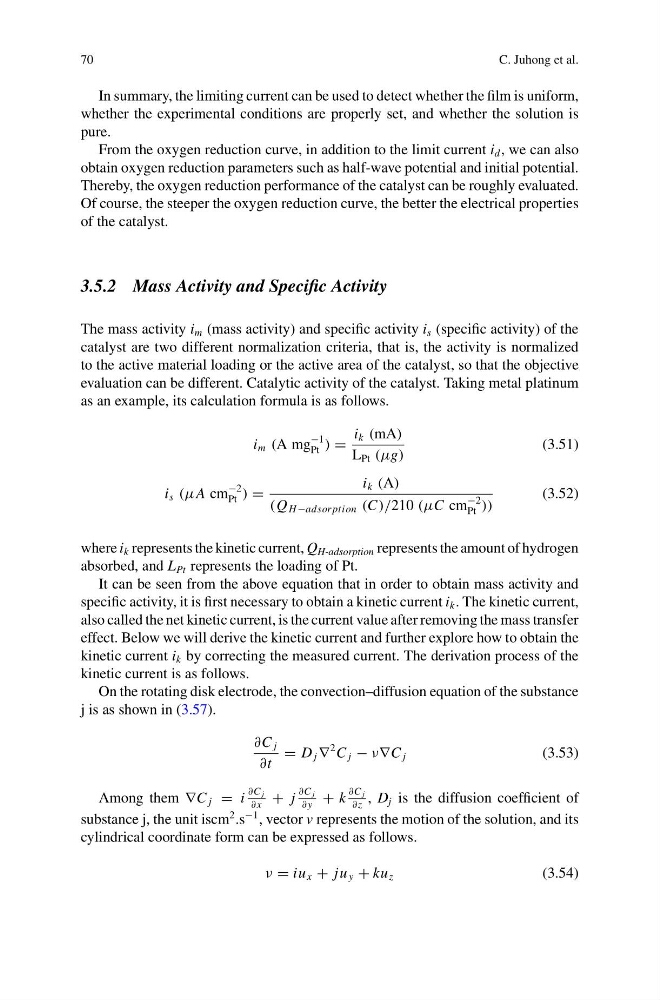
The mass activity i m (mass activity) and specific activity i s (specific activity) of the
catalyst are two different normalization criteria, that is, the activity is normalized
to the active material loading or the active area of the catalyst, so that the objective
evaluation can be different. Catalytic activity of the catalyst. Taking metal platinum
as an example, its calculation formula is as follows.
i m (A mg
−1
Pt ) =
i k (mA)
L Pt (μg)
(3.51)
i s (μA cm
−2
Pt ) =
i k (A)
(Q H −adsor ption (C)/210 (μC cm
−2
Pt ))
(3.52)
where i k represents the kinetic current, Q H-adsorption represents the amount of hydrogen
absorbed, and L Pt represents the loading of Pt.
It can be seen from the above equation that in order to obtain mass activity and
specific activity, it is first necessary to obtain a kinetic current i k . The kinetic current,
also called the net kinetic current, is the current value after removing the mass transfer
effect. Below we will derive the kinetic current and further explore how to obtain the
kinetic current i k by correcting the measured current. The derivation process of the
kinetic current is as follows.
On the rotating disk electrode, the convection–diffusion equation of the substance
j is as shown in (3.57).
∂C j
∂t
= D j ∇
2 C j − ν∇C j
(3.53)
Among them ∇C j = i
∂C j
∂ x
+ j
∂C j
∂ y
+ k
∂C j
∂z
, D j is the diffusion coefficient of
substance j, the unit iscm
2 .s
−1 , vector v represents the motion of the solution, and its
cylindrical coordinate form can be expressed as follows.
ν = iu x + ju y + ku z
(3.54)
C. Juhong et al.
In summary, the limiting current can be used to detect whether the film is uniform,
whether the experimental conditions are properly set, and whether the solution is
pure.
From the oxygen reduction curve, in addition to the limit current i d , we can also
obtain oxygen reduction parameters such as half-wave potential and initial potential.
Thereby, the oxygen reduction performance of the catalyst can be roughly evaluated.
Of course, the steeper the oxygen reduction curve, the better the electrical properties
of the catalyst.
3.5.2 Mass Activity and Specific Activity
The mass activity i m (mass activity) and specific activity i s (specific activity) of the
catalyst are two different normalization criteria, that is, the activity is normalized
to the active material loading or the active area of the catalyst, so that the objective
evaluation can be different. Catalytic activity of the catalyst. Taking metal platinum
as an example, its calculation formula is as follows.
i m (A mg
−1
Pt ) =
i k (mA)
L Pt (μg)
(3.51)
i s (μA cm
−2
Pt ) =
i k (A)
(Q H −adsor ption (C)/210 (μC cm
−2
Pt ))
(3.52)
where i k represents the kinetic current, Q H-adsorption represents the amount of hydrogen
absorbed, and L Pt represents the loading of Pt.
It can be seen from the above equation that in order to obtain mass activity and
specific activity, it is first necessary to obtain a kinetic current i k . The kinetic current,
also called the net kinetic current, is the current value after removing the mass transfer
effect. Below we will derive the kinetic current and further explore how to obtain the
kinetic current i k by correcting the measured current. The derivation process of the
kinetic current is as follows.
On the rotating disk electrode, the convection–diffusion equation of the substance
j is as shown in (3.57).
∂C j
∂t
= D j ∇
2 C j − ν∇C j
(3.53)
Among them ∇C j = i
∂C j
∂ x
+ j
∂C j
∂ y
+ k
∂C j
∂z
, D j is the diffusion coefficient of
substance j, the unit iscm
2 .s
−1 , vector v represents the motion of the solution, and its
cylindrical coordinate form can be expressed as follows.
ν = iu x + ju y + ku z
(3.54)