

3 The Measurements of the Oxygen Reduction Reaction
69
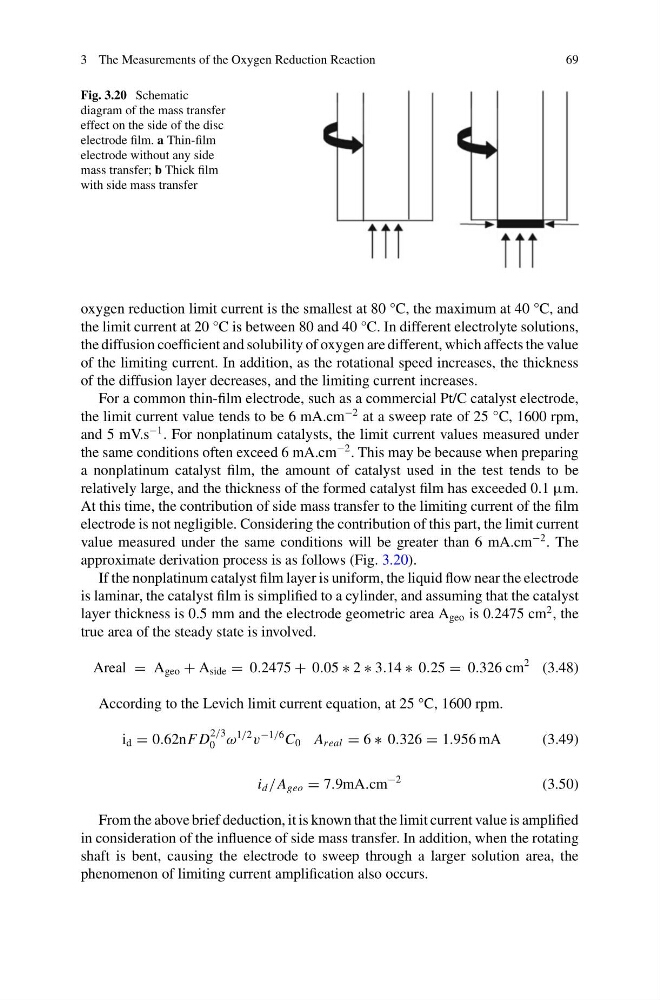
Fig. 3.20 Schematic
diagram of the mass transfer
effect on the side of the disc
electrode film. a Thin-film
electrode without any side
mass transfer; b Thick film
with side mass transfer
oxygen reduction limit current is the smallest at 80 °C, the maximum at 40 °C, and
the limit current at 20 °C is between 80 and 40 °C. In different electrolyte solutions,
the diffusion coefficient and solubility of oxygen are different, which affects the value
of the limiting current. In addition, as the rotational speed increases, the thickness
of the diffusion layer decreases, and the limiting current increases.
For a common thin-film electrode, such as a commercial Pt/C catalyst electrode,
the limit current value tends to be 6 mA.cm
−2 at a sweep rate of 25 °C, 1600 rpm,
and 5 mV.s
−1 . For nonplatinum catalysts, the limit current values measured under
the same conditions often exceed 6 mA.cm
−2 . This may be because when preparing
a nonplatinum catalyst film, the amount of catalyst used in the test tends to be
relatively large, and the thickness of the formed catalyst film has exceeded 0.1 μm.
At this time, the contribution of side mass transfer to the limiting current of the film
electrode is not negligible. Considering the contribution of this part, the limit current
value measured under the same conditions will be greater than 6 mA.cm
−2 . The
approximate derivation process is as follows (Fig. 3.20).
If the nonplatinum catalyst film layer is uniform, the liquid flow near the electrode
is laminar, the catalyst film is simplified to a cylinder, and assuming that the catalyst
layer thickness is 0.5 mm and the electrode geometric area A geo is 0.2475 cm
2 , the
true area of the steady state is involved.
Areal = A geo + A side = 0.2475 + 0.05 ∗ 2 ∗ 3.14 ∗ 0.25 = 0.326 cm
2 (3.48)
According to the Levich limit current equation, at 25 °C, 1600 rpm.
i d = 0.62nF D
2/3
0 ω
1/2
v
−1/6 C 0 A real = 6 ∗ 0.326 = 1.956 mA
(3.49)
i d /A geo = 7.9mA.cm
−2
(3.50)
From the above brief deduction, it is known that the limit current value is amplified
in consideration of the influence of side mass transfer. In addition, when the rotating
shaft is bent, causing the electrode to sweep through a larger solution area, the
phenomenon of limiting current amplification also occurs.
69
Fig. 3.20 Schematic
diagram of the mass transfer
effect on the side of the disc
electrode film. a Thin-film
electrode without any side
mass transfer; b Thick film
with side mass transfer
oxygen reduction limit current is the smallest at 80 °C, the maximum at 40 °C, and
the limit current at 20 °C is between 80 and 40 °C. In different electrolyte solutions,
the diffusion coefficient and solubility of oxygen are different, which affects the value
of the limiting current. In addition, as the rotational speed increases, the thickness
of the diffusion layer decreases, and the limiting current increases.
For a common thin-film electrode, such as a commercial Pt/C catalyst electrode,
the limit current value tends to be 6 mA.cm
−2 at a sweep rate of 25 °C, 1600 rpm,
and 5 mV.s
−1 . For nonplatinum catalysts, the limit current values measured under
the same conditions often exceed 6 mA.cm
−2 . This may be because when preparing
a nonplatinum catalyst film, the amount of catalyst used in the test tends to be
relatively large, and the thickness of the formed catalyst film has exceeded 0.1 μm.
At this time, the contribution of side mass transfer to the limiting current of the film
electrode is not negligible. Considering the contribution of this part, the limit current
value measured under the same conditions will be greater than 6 mA.cm
−2 . The
approximate derivation process is as follows (Fig. 3.20).
If the nonplatinum catalyst film layer is uniform, the liquid flow near the electrode
is laminar, the catalyst film is simplified to a cylinder, and assuming that the catalyst
layer thickness is 0.5 mm and the electrode geometric area A geo is 0.2475 cm
2 , the
true area of the steady state is involved.
Areal = A geo + A side = 0.2475 + 0.05 ∗ 2 ∗ 3.14 ∗ 0.25 = 0.326 cm
2 (3.48)
According to the Levich limit current equation, at 25 °C, 1600 rpm.
i d = 0.62nF D
2/3
0 ω
1/2
v
−1/6 C 0 A real = 6 ∗ 0.326 = 1.956 mA
(3.49)
i d /A geo = 7.9mA.cm
−2
(3.50)
From the above brief deduction, it is known that the limit current value is amplified
in consideration of the influence of side mass transfer. In addition, when the rotating
shaft is bent, causing the electrode to sweep through a larger solution area, the
phenomenon of limiting current amplification also occurs.