

68
C. Juhong et al.
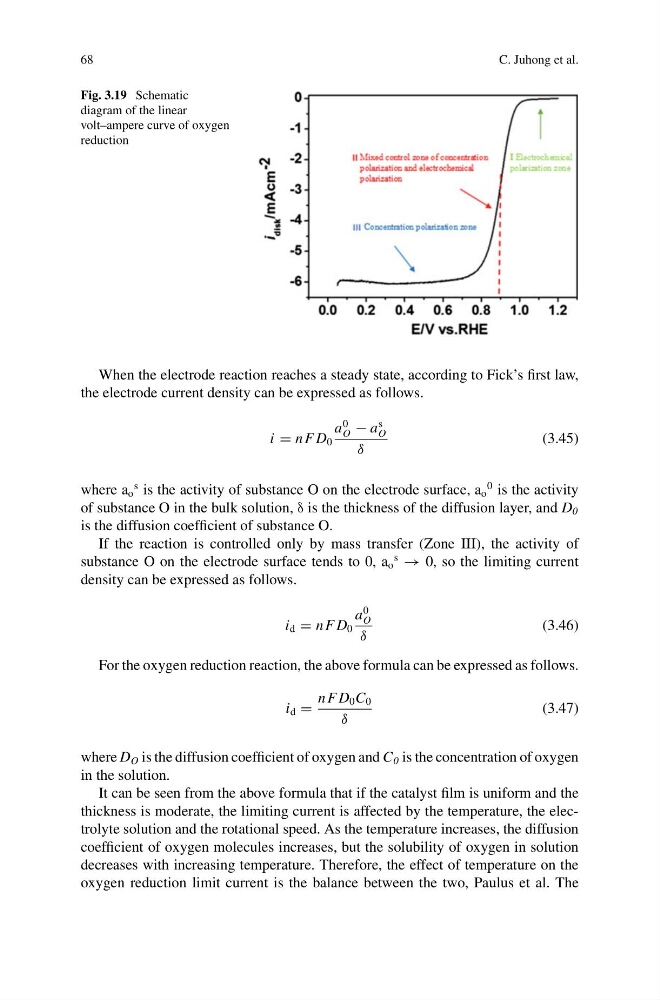
Fig. 3.19 Schematic
diagram of the linear
volt–ampere curve of oxygen
reduction
When the electrode reaction reaches a steady state, according to Fick’s first law,
the electrode current density can be expressed as follows.
i = n F D 0
a
0
O − a
s
O
δ
(3.45)
where a o
s is the activity of substance O on the electrode surface, a o
0 is the activity
of substance O in the bulk solution, δ is the thickness of the diffusion layer, and D 0
is the diffusion coefficient of substance O.
If the reaction is controlled only by mass transfer (Zone III), the activity of
substance O on the electrode surface tends to 0, a o
s
→ 0, so the limiting current
density can be expressed as follows.
i d = n F D 0
a
0
O
δ
(3.46)
For the oxygen reduction reaction, the above formula can be expressed as follows.
i d =
n F D 0 C 0
δ
(3.47)
where D O is the diffusion coefficient of oxygen and C 0 is the concentration of oxygen
in the solution.
It can be seen from the above formula that if the catalyst film is uniform and the
thickness is moderate, the limiting current is affected by the temperature, the electrolyte solution and the rotational speed. As the temperature increases, the diffusion
coefficient of oxygen molecules increases, but the solubility of oxygen in solution
decreases with increasing temperature. Therefore, the effect of temperature on the
oxygen reduction limit current is the balance between the two, Paulus et al. The
C. Juhong et al.
Fig. 3.19 Schematic
diagram of the linear
volt–ampere curve of oxygen
reduction
When the electrode reaction reaches a steady state, according to Fick’s first law,
the electrode current density can be expressed as follows.
i = n F D 0
a
0
O − a
s
O
δ
(3.45)
where a o
s is the activity of substance O on the electrode surface, a o
0 is the activity
of substance O in the bulk solution, δ is the thickness of the diffusion layer, and D 0
is the diffusion coefficient of substance O.
If the reaction is controlled only by mass transfer (Zone III), the activity of
substance O on the electrode surface tends to 0, a o
s
→ 0, so the limiting current
density can be expressed as follows.
i d = n F D 0
a
0
O
δ
(3.46)
For the oxygen reduction reaction, the above formula can be expressed as follows.
i d =
n F D 0 C 0
δ
(3.47)
where D O is the diffusion coefficient of oxygen and C 0 is the concentration of oxygen
in the solution.
It can be seen from the above formula that if the catalyst film is uniform and the
thickness is moderate, the limiting current is affected by the temperature, the electrolyte solution and the rotational speed. As the temperature increases, the diffusion
coefficient of oxygen molecules increases, but the solubility of oxygen in solution
decreases with increasing temperature. Therefore, the effect of temperature on the
oxygen reduction limit current is the balance between the two, Paulus et al. The