

72
C. Juhong et al.
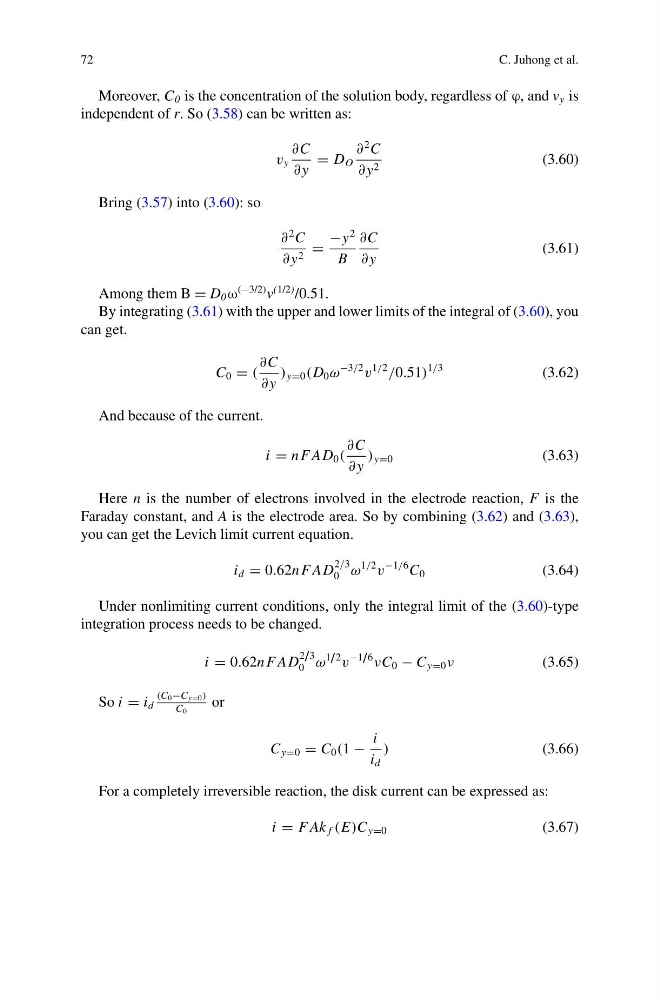
Moreover, C 0 is the concentration of the solution body, regardless of ϕ, and v y is
independent of r. So (3.58) can be written as:
v y
∂C
∂ y
= D O
∂
2 C
∂ y 2
(3.60)
Bring (3.57) into (3.60): so
∂
2 C
∂ y 2 =
−y
2
B
∂C
∂ y
(3.61)
Among them B = D 0 ω
(−3/2) v
(1/2) /0.51.
By integrating (3.61) with the upper and lower limits of the integral of (3.60), you
can get.
C 0 = (
∂C
∂ y
) y=0 (D 0 ω
−3/2
v
1/2
/0.51)
1/3
(3.62)
And because of the current.
i = n F AD 0 (
∂C
∂ y
) y=0
(3.63)
Here n is the number of electrons involved in the electrode reaction, F is the
Faraday constant, and A is the electrode area. So by combining (3.62) and (3.63),
you can get the Levich limit current equation.
i d = 0.62n F AD
2/3
0 ω
1/2
v
−1/6 C 0
(3.64)
Under nonlimiting current conditions, only the integral limit of the (3.60)-type
integration process needs to be changed.
i = 0.62n F AD
2 / 3
0 ω
1 / 2 v
−1 / 6 νC 0 − C y=0 ν
(3.65)
So i = i d
(C 0 −C y=0 )
C 0
or
C y=0 = C 0 (1 −
i
i d
)
(3.66)
For a completely irreversible reaction, the disk current can be expressed as:
i = F Ak f (E)C y=0
(3.67)
C. Juhong et al.
Moreover, C 0 is the concentration of the solution body, regardless of ϕ, and v y is
independent of r. So (3.58) can be written as:
v y
∂C
∂ y
= D O
∂
2 C
∂ y 2
(3.60)
Bring (3.57) into (3.60): so
∂
2 C
∂ y 2 =
−y
2
B
∂C
∂ y
(3.61)
Among them B = D 0 ω
(−3/2) v
(1/2) /0.51.
By integrating (3.61) with the upper and lower limits of the integral of (3.60), you
can get.
C 0 = (
∂C
∂ y
) y=0 (D 0 ω
−3/2
v
1/2
/0.51)
1/3
(3.62)
And because of the current.
i = n F AD 0 (
∂C
∂ y
) y=0
(3.63)
Here n is the number of electrons involved in the electrode reaction, F is the
Faraday constant, and A is the electrode area. So by combining (3.62) and (3.63),
you can get the Levich limit current equation.
i d = 0.62n F AD
2/3
0 ω
1/2
v
−1/6 C 0
(3.64)
Under nonlimiting current conditions, only the integral limit of the (3.60)-type
integration process needs to be changed.
i = 0.62n F AD
2 / 3
0 ω
1 / 2 v
−1 / 6 νC 0 − C y=0 ν
(3.65)
So i = i d
(C 0 −C y=0 )
C 0
or
C y=0 = C 0 (1 −
i
i d
)
(3.66)
For a completely irreversible reaction, the disk current can be expressed as:
i = F Ak f (E)C y=0
(3.67)