

3 The Measurements of the Oxygen Reduction Reaction
65
is the use of perchloric acid or sulfuric acid, there is basically no impact on the test.
As for the catalyst containing ruthenium, since ruthenium catalyzes the reduction
of perchloric acid to form a large amount of strongly adsorbed chloride ions, the
electrolyte solution is not suitable for the perchloric acid solution for the oxygen
reduction test of the catalyst.
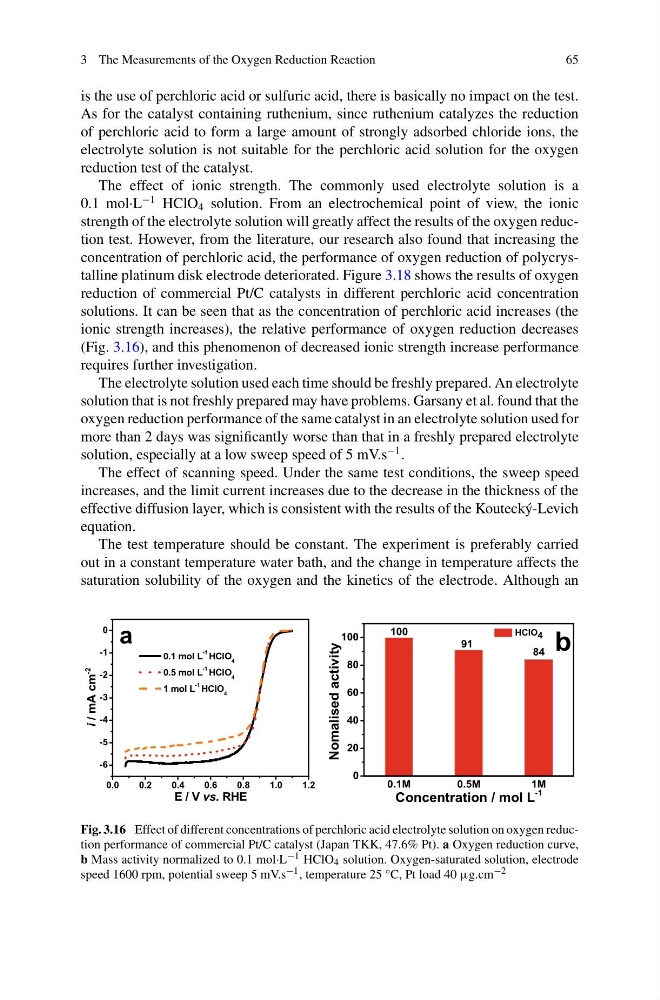
The effect of ionic strength. The commonly used electrolyte solution is a
0.1 mol·L
−1 HClO 4 solution. From an electrochemical point of view, the ionic
strength of the electrolyte solution will greatly affect the results of the oxygen reduction test. However, from the literature, our research also found that increasing the
concentration of perchloric acid, the performance of oxygen reduction of polycrystalline platinum disk electrode deteriorated. Figure 3.18 shows the results of oxygen
reduction of commercial Pt/C catalysts in different perchloric acid concentration
solutions. It can be seen that as the concentration of perchloric acid increases (the
ionic strength increases), the relative performance of oxygen reduction decreases
(Fig. 3.16), and this phenomenon of decreased ionic strength increase performance
requires further investigation.
The electrolyte solution used each time should be freshly prepared. An electrolyte
solution that is not freshly prepared may have problems. Garsany et al. found that the
oxygen reduction performance of the same catalyst in an electrolyte solution used for
more than 2 days was significantly worse than that in a freshly prepared electrolyte
solution, especially at a low sweep speed of 5 mV.s
−1 .
The effect of scanning speed. Under the same test conditions, the sweep speed
increases, and the limit current increases due to the decrease in the thickness of the
effective diffusion layer, which is consistent with the results of the Koutecký-Levich
equation.
The test temperature should be constant. The experiment is preferably carried
out in a constant temperature water bath, and the change in temperature affects the
saturation solubility of the oxygen and the kinetics of the electrode. Although an
0.0
0.2
0.4
0.6
0.8
1.0
1.2
-6
-5
-4
-3
-2
-1
0
0.1 mol L
-1 HClO 4
0.5 mol L
-1 HClO 4
1 mol L
-1 HClO 4
i / mA cm
-2
E / V vs. RHE
a
0.1M
0.5M
1M
0
20
40
60
80
100
91
84
Nomalised activity
Concentration / mol L
-1
HClO 4 b
100
Fig. 3.16 Effect of different concentrations of perchloric acid electrolyte solution on oxygen reduction performance of commercial Pt/C catalyst (Japan TKK, 47.6% Pt). a Oxygen reduction curve,
b Mass activity normalized to 0.1 mol·L −1 HClO 4 solution. Oxygen-saturated solution, electrode
speed 1600 rpm, potential sweep 5 mV.s −1 , temperature 25 °C, Pt load 40 μg.cm −2
65
is the use of perchloric acid or sulfuric acid, there is basically no impact on the test.
As for the catalyst containing ruthenium, since ruthenium catalyzes the reduction
of perchloric acid to form a large amount of strongly adsorbed chloride ions, the
electrolyte solution is not suitable for the perchloric acid solution for the oxygen
reduction test of the catalyst.
The effect of ionic strength. The commonly used electrolyte solution is a
0.1 mol·L
−1 HClO 4 solution. From an electrochemical point of view, the ionic
strength of the electrolyte solution will greatly affect the results of the oxygen reduction test. However, from the literature, our research also found that increasing the
concentration of perchloric acid, the performance of oxygen reduction of polycrystalline platinum disk electrode deteriorated. Figure 3.18 shows the results of oxygen
reduction of commercial Pt/C catalysts in different perchloric acid concentration
solutions. It can be seen that as the concentration of perchloric acid increases (the
ionic strength increases), the relative performance of oxygen reduction decreases
(Fig. 3.16), and this phenomenon of decreased ionic strength increase performance
requires further investigation.
The electrolyte solution used each time should be freshly prepared. An electrolyte
solution that is not freshly prepared may have problems. Garsany et al. found that the
oxygen reduction performance of the same catalyst in an electrolyte solution used for
more than 2 days was significantly worse than that in a freshly prepared electrolyte
solution, especially at a low sweep speed of 5 mV.s
−1 .
The effect of scanning speed. Under the same test conditions, the sweep speed
increases, and the limit current increases due to the decrease in the thickness of the
effective diffusion layer, which is consistent with the results of the Koutecký-Levich
equation.
The test temperature should be constant. The experiment is preferably carried
out in a constant temperature water bath, and the change in temperature affects the
saturation solubility of the oxygen and the kinetics of the electrode. Although an
0.0
0.2
0.4
0.6
0.8
1.0
1.2
-6
-5
-4
-3
-2
-1
0
0.1 mol L
-1 HClO 4
0.5 mol L
-1 HClO 4
1 mol L
-1 HClO 4
i / mA cm
-2
E / V vs. RHE
a
0.1M
0.5M
1M
0
20
40
60
80
100
91
84
Nomalised activity
Concentration / mol L
-1
HClO 4 b
100
Fig. 3.16 Effect of different concentrations of perchloric acid electrolyte solution on oxygen reduction performance of commercial Pt/C catalyst (Japan TKK, 47.6% Pt). a Oxygen reduction curve,
b Mass activity normalized to 0.1 mol·L −1 HClO 4 solution. Oxygen-saturated solution, electrode
speed 1600 rpm, potential sweep 5 mV.s −1 , temperature 25 °C, Pt load 40 μg.cm −2