

66
C. Juhong et al.
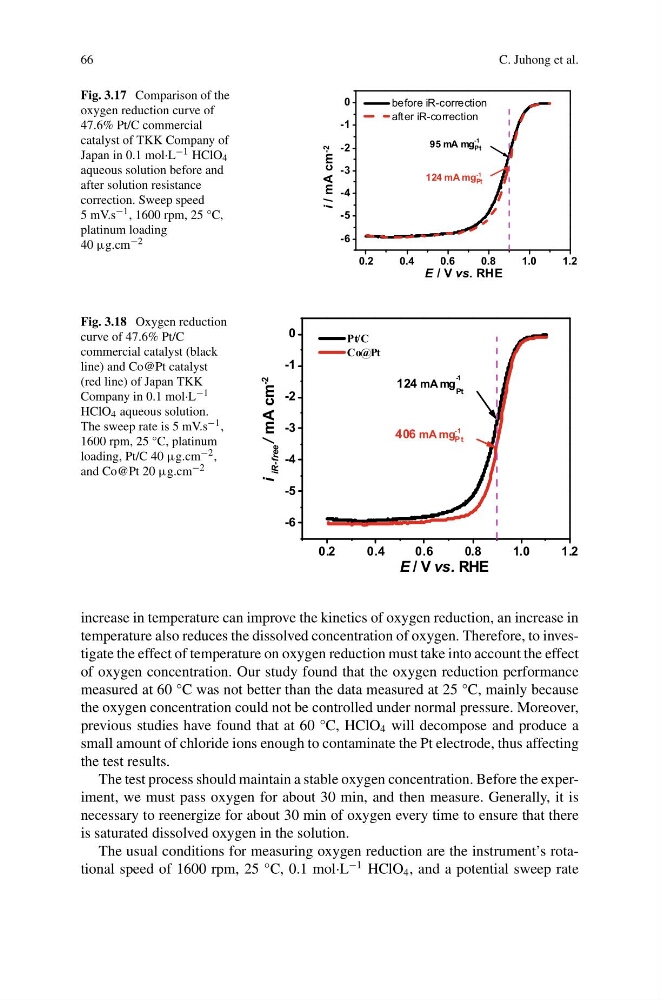
Fig. 3.17 Comparison of the
oxygen reduction curve of
47.6% Pt/C commercial
catalyst of TKK Company of
Japan in 0.1 mol·L −1 HClO 4
aqueous solution before and
after solution resistance
correction. Sweep speed
5 mV.s −1 , 1600 rpm, 25 °C,
platinum loading
40 μg.cm −2
0.2
0.4
0.6
0.8
1.0
1.2
-6
-5
-4
-3
-2
-1
0
E / V vs. RHE
i / mA cm -2
before iR-correction
after iR-correction
95 mA mg
-1
Pt
124 mA mg
-1
Pt
Fig. 3.18 Oxygen reduction
curve of 47.6% Pt/C
commercial catalyst (black
line) and Co@Pt catalyst
(red line) of Japan TKK
Company in 0.1 mol·L −1
HClO 4 aqueous solution.
The sweep rate is 5 mV.s −1 ,
1600 rpm, 25 °C, platinum
loading, Pt/C 40 μg.cm −2 ,
and Co@Pt 20 μg.cm −2
0.2
0.4
0.6
0.8
1.0
1.2
-6
-5
-4
-3
-2
-1
0
E / V vs. RHE
124 mA mg
-1
Pt
i
iR-free / mA cm
-2
Pt/C
Co@Pt
406 mA mg
-1
Pt
increase in temperature can improve the kinetics of oxygen reduction, an increase in
temperature also reduces the dissolved concentration of oxygen. Therefore, to investigate the effect of temperature on oxygen reduction must take into account the effect
of oxygen concentration. Our study found that the oxygen reduction performance
measured at 60 °C was not better than the data measured at 25 °C, mainly because
the oxygen concentration could not be controlled under normal pressure. Moreover,
previous studies have found that at 60 °C, HClO 4 will decompose and produce a
small amount of chloride ions enough to contaminate the Pt electrode, thus affecting
the test results.
The test process should maintain a stable oxygen concentration. Before the experiment, we must pass oxygen for about 30 min, and then measure. Generally, it is
necessary to reenergize for about 30 min of oxygen every time to ensure that there
is saturated dissolved oxygen in the solution.
The usual conditions for measuring oxygen reduction are the instrument’s rotational speed of 1600 rpm, 25 °C, 0.1 mol·L
−1 HClO 4 , and a potential sweep rate
C. Juhong et al.
Fig. 3.17 Comparison of the
oxygen reduction curve of
47.6% Pt/C commercial
catalyst of TKK Company of
Japan in 0.1 mol·L −1 HClO 4
aqueous solution before and
after solution resistance
correction. Sweep speed
5 mV.s −1 , 1600 rpm, 25 °C,
platinum loading
40 μg.cm −2
0.2
0.4
0.6
0.8
1.0
1.2
-6
-5
-4
-3
-2
-1
0
E / V vs. RHE
i / mA cm -2
before iR-correction
after iR-correction
95 mA mg
-1
Pt
124 mA mg
-1
Pt
Fig. 3.18 Oxygen reduction
curve of 47.6% Pt/C
commercial catalyst (black
line) and Co@Pt catalyst
(red line) of Japan TKK
Company in 0.1 mol·L −1
HClO 4 aqueous solution.
The sweep rate is 5 mV.s −1 ,
1600 rpm, 25 °C, platinum
loading, Pt/C 40 μg.cm −2 ,
and Co@Pt 20 μg.cm −2
0.2
0.4
0.6
0.8
1.0
1.2
-6
-5
-4
-3
-2
-1
0
E / V vs. RHE
124 mA mg
-1
Pt
i
iR-free / mA cm
-2
Pt/C
Co@Pt
406 mA mg
-1
Pt
increase in temperature can improve the kinetics of oxygen reduction, an increase in
temperature also reduces the dissolved concentration of oxygen. Therefore, to investigate the effect of temperature on oxygen reduction must take into account the effect
of oxygen concentration. Our study found that the oxygen reduction performance
measured at 60 °C was not better than the data measured at 25 °C, mainly because
the oxygen concentration could not be controlled under normal pressure. Moreover,
previous studies have found that at 60 °C, HClO 4 will decompose and produce a
small amount of chloride ions enough to contaminate the Pt electrode, thus affecting
the test results.
The test process should maintain a stable oxygen concentration. Before the experiment, we must pass oxygen for about 30 min, and then measure. Generally, it is
necessary to reenergize for about 30 min of oxygen every time to ensure that there
is saturated dissolved oxygen in the solution.
The usual conditions for measuring oxygen reduction are the instrument’s rotational speed of 1600 rpm, 25 °C, 0.1 mol·L
−1 HClO 4 , and a potential sweep rate