

50
C. Juhong et al.
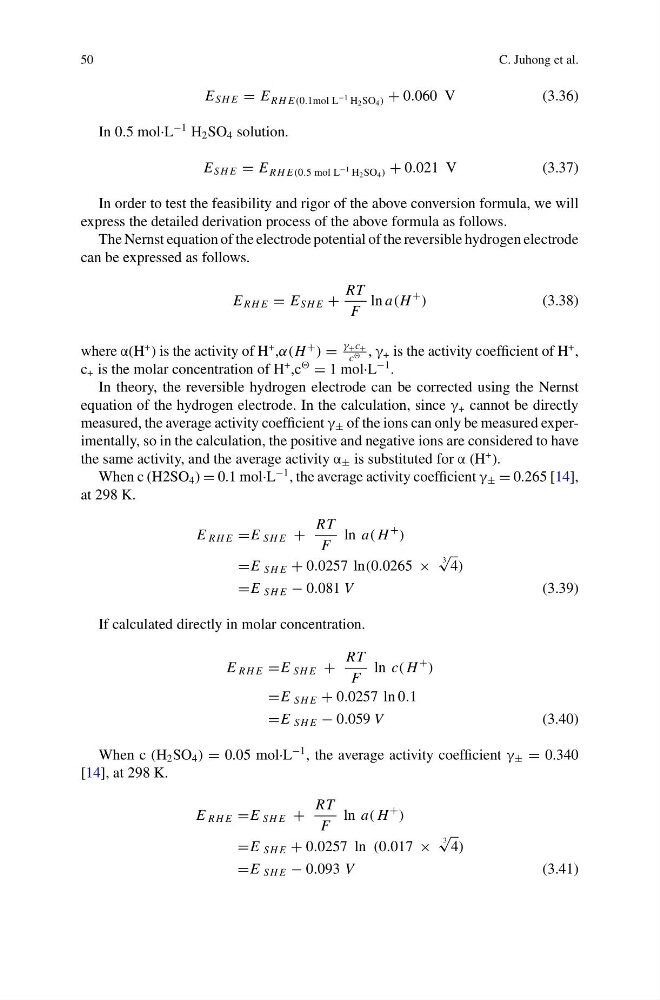
E S H E = E R H E(0.1mol L
−1 H 2 SO 4 ) + 0.060 V
(3.36)
In 0.5 mol·L
−1 H 2 SO 4 solution.
E S H E = E R H E(0.5 mol L
−1 H 2 SO 4 ) + 0.021 V
(3.37)
In order to test the feasibility and rigor of the above conversion formula, we will
express the detailed derivation process of the above formula as follows.
The Nernst equation of the electrode potential of the reversible hydrogen electrode
can be expressed as follows.
E R H E = E S H E +
RT
F
ln a(H
+
)
(3.38)
where α(H
+ ) is the activity of H
+ ,α(H
+
) =
γ + c +
c , γ + is the activity coefficient of H
+ ,
c + is the molar concentration of H
+ ,c
= 1 mol·L
−1 .
In theory, the reversible hydrogen electrode can be corrected using the Nernst
equation of the hydrogen electrode. In the calculation, since γ + cannot be directly
measured, the average activity coefficient γ ± of the ions can only be measured experimentally, so in the calculation, the positive and negative ions are considered to have
the same activity, and the average activity α ± is substituted for α (H
+ ).
When c (H2SO 4 ) = 0.1 mol·L
−1 , the average activity coefficient γ ± = 0.265 [14],
at 298 K.
E R H E =E S H E +
RT
F
ln a( H
+
)
=E S H E + 0.0257 ln(0.0265 ×
3
√
4)
=E S H E − 0.081 V
(3.39)
If calculated directly in molar concentration.
E R H E =E S H E +
RT
F
ln c( H
+
)
=E S H E + 0.0257 ln 0.1
=E S H E − 0.059 V
(3.40)
When c (H 2 SO 4 ) = 0.05 mol·L
−1 , the average activity coefficient γ ± = 0.340
[14], at 298 K.
E R H E =E S H E +
RT
F
ln a( H
+
)
=E S H E + 0.0257 ln (0.017 ×
3
√
4)
=E S H E − 0.093 V
(3.41)
C. Juhong et al.
E S H E = E R H E(0.1mol L
−1 H 2 SO 4 ) + 0.060 V
(3.36)
In 0.5 mol·L
−1 H 2 SO 4 solution.
E S H E = E R H E(0.5 mol L
−1 H 2 SO 4 ) + 0.021 V
(3.37)
In order to test the feasibility and rigor of the above conversion formula, we will
express the detailed derivation process of the above formula as follows.
The Nernst equation of the electrode potential of the reversible hydrogen electrode
can be expressed as follows.
E R H E = E S H E +
RT
F
ln a(H
+
)
(3.38)
where α(H
+ ) is the activity of H
+ ,α(H
+
) =
γ + c +
c , γ + is the activity coefficient of H
+ ,
c + is the molar concentration of H
+ ,c
= 1 mol·L
−1 .
In theory, the reversible hydrogen electrode can be corrected using the Nernst
equation of the hydrogen electrode. In the calculation, since γ + cannot be directly
measured, the average activity coefficient γ ± of the ions can only be measured experimentally, so in the calculation, the positive and negative ions are considered to have
the same activity, and the average activity α ± is substituted for α (H
+ ).
When c (H2SO 4 ) = 0.1 mol·L
−1 , the average activity coefficient γ ± = 0.265 [14],
at 298 K.
E R H E =E S H E +
RT
F
ln a( H
+
)
=E S H E + 0.0257 ln(0.0265 ×
3
√
4)
=E S H E − 0.081 V
(3.39)
If calculated directly in molar concentration.
E R H E =E S H E +
RT
F
ln c( H
+
)
=E S H E + 0.0257 ln 0.1
=E S H E − 0.059 V
(3.40)
When c (H 2 SO 4 ) = 0.05 mol·L
−1 , the average activity coefficient γ ± = 0.340
[14], at 298 K.
E R H E =E S H E +
RT
F
ln a( H
+
)
=E S H E + 0.0257 ln (0.017 ×
3
√
4)
=E S H E − 0.093 V
(3.41)