

3 The Measurements of the Oxygen Reduction Reaction
51
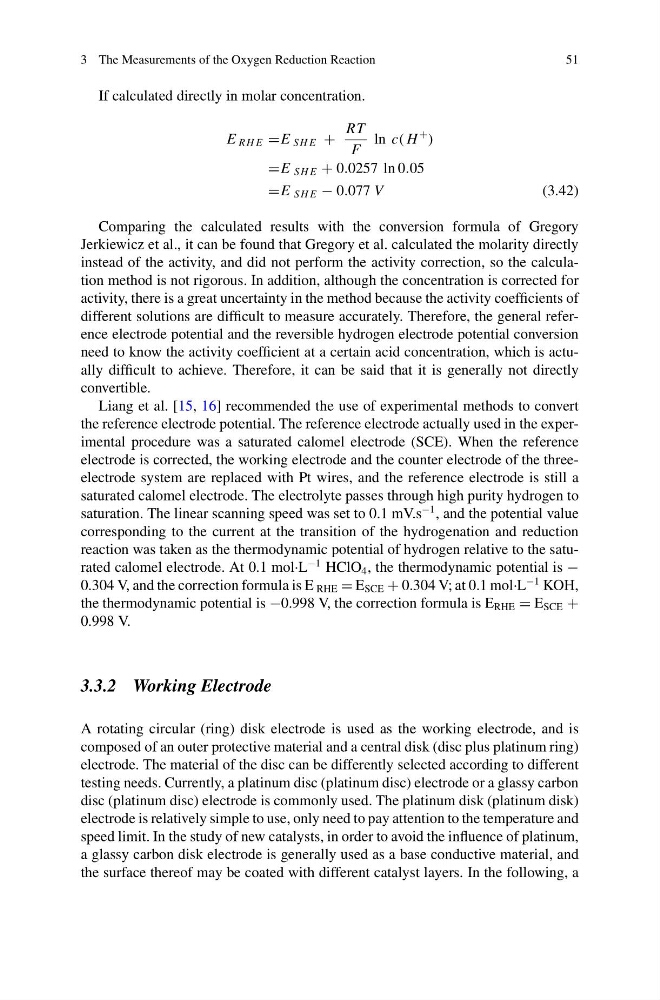
If calculated directly in molar concentration.
E R H E =E S H E +
RT
F
ln c( H
+
)
=E S H E + 0.0257 ln 0.05
=E S H E − 0.077 V
(3.42)
Comparing the calculated results with the conversion formula of Gregory
Jerkiewicz et al., it can be found that Gregory et al. calculated the molarity directly
instead of the activity, and did not perform the activity correction, so the calculation method is not rigorous. In addition, although the concentration is corrected for
activity, there is a great uncertainty in the method because the activity coefficients of
different solutions are difficult to measure accurately. Therefore, the general reference electrode potential and the reversible hydrogen electrode potential conversion
need to know the activity coefficient at a certain acid concentration, which is actually difficult to achieve. Therefore, it can be said that it is generally not directly
convertible.
Liang et al. [15, 16] recommended the use of experimental methods to convert
the reference electrode potential. The reference electrode actually used in the experimental procedure was a saturated calomel electrode (SCE). When the reference
electrode is corrected, the working electrode and the counter electrode of the threeelectrode system are replaced with Pt wires, and the reference electrode is still a
saturated calomel electrode. The electrolyte passes through high purity hydrogen to
saturation. The linear scanning speed was set to 0.1 mV.s
−1 , and the potential value
corresponding to the current at the transition of the hydrogenation and reduction
reaction was taken as the thermodynamic potential of hydrogen relative to the saturated calomel electrode. At 0.1 mol·L
−1 HClO 4 , the thermodynamic potential is −
0.304 V, and the correction formula is E RHE = E SCE + 0.304 V; at 0.1 mol·L
−1 KOH,
the thermodynamic potential is −0.998 V, the correction formula is E RHE = E SCE +
0.998 V.
3.3.2 Working Electrode
A rotating circular (ring) disk electrode is used as the working electrode, and is
composed of an outer protective material and a central disk (disc plus platinum ring)
electrode. The material of the disc can be differently selected according to different
testing needs. Currently, a platinum disc (platinum disc) electrode or a glassy carbon
disc (platinum disc) electrode is commonly used. The platinum disk (platinum disk)
electrode is relatively simple to use, only need to pay attention to the temperature and
speed limit. In the study of new catalysts, in order to avoid the influence of platinum,
a glassy carbon disk electrode is generally used as a base conductive material, and
the surface thereof may be coated with different catalyst layers. In the following, a
51
If calculated directly in molar concentration.
E R H E =E S H E +
RT
F
ln c( H
+
)
=E S H E + 0.0257 ln 0.05
=E S H E − 0.077 V
(3.42)
Comparing the calculated results with the conversion formula of Gregory
Jerkiewicz et al., it can be found that Gregory et al. calculated the molarity directly
instead of the activity, and did not perform the activity correction, so the calculation method is not rigorous. In addition, although the concentration is corrected for
activity, there is a great uncertainty in the method because the activity coefficients of
different solutions are difficult to measure accurately. Therefore, the general reference electrode potential and the reversible hydrogen electrode potential conversion
need to know the activity coefficient at a certain acid concentration, which is actually difficult to achieve. Therefore, it can be said that it is generally not directly
convertible.
Liang et al. [15, 16] recommended the use of experimental methods to convert
the reference electrode potential. The reference electrode actually used in the experimental procedure was a saturated calomel electrode (SCE). When the reference
electrode is corrected, the working electrode and the counter electrode of the threeelectrode system are replaced with Pt wires, and the reference electrode is still a
saturated calomel electrode. The electrolyte passes through high purity hydrogen to
saturation. The linear scanning speed was set to 0.1 mV.s
−1 , and the potential value
corresponding to the current at the transition of the hydrogenation and reduction
reaction was taken as the thermodynamic potential of hydrogen relative to the saturated calomel electrode. At 0.1 mol·L
−1 HClO 4 , the thermodynamic potential is −
0.304 V, and the correction formula is E RHE = E SCE + 0.304 V; at 0.1 mol·L
−1 KOH,
the thermodynamic potential is −0.998 V, the correction formula is E RHE = E SCE +
0.998 V.
3.3.2 Working Electrode
A rotating circular (ring) disk electrode is used as the working electrode, and is
composed of an outer protective material and a central disk (disc plus platinum ring)
electrode. The material of the disc can be differently selected according to different
testing needs. Currently, a platinum disc (platinum disc) electrode or a glassy carbon
disc (platinum disc) electrode is commonly used. The platinum disk (platinum disk)
electrode is relatively simple to use, only need to pay attention to the temperature and
speed limit. In the study of new catalysts, in order to avoid the influence of platinum,
a glassy carbon disk electrode is generally used as a base conductive material, and
the surface thereof may be coated with different catalyst layers. In the following, a