

48
C. Juhong et al.
prevent the chloride ions on the reference electrode from diffusing to the test electrode. Mayrhofer et al. used an ion-conducting membrane (Nafion
® ) instead of a salt
bridge to study the effect of a saturated calomel electrode on the oxygen reduction
of a platinum electrode after using an ion-conducting membrane. The results show
that the oxygen reduction test is stable for up to 290 min using a system of three
conductive films, independent of free chloride ions. The Nafion
® ion-conducting
membrane consists of a polytetrafluoroethylene skeleton and a side chain containing
a sulfonate group. The sulfonate group is hydrophilic, and the polytetrafluoroethylene skeleton is hydrophobic, and the membrane allows water and cations to diffuse
through. It rejects negative ions that are electrically equivalent to sulfate groups, such
as chlorine, thereby preventing the passage of chloride ions.
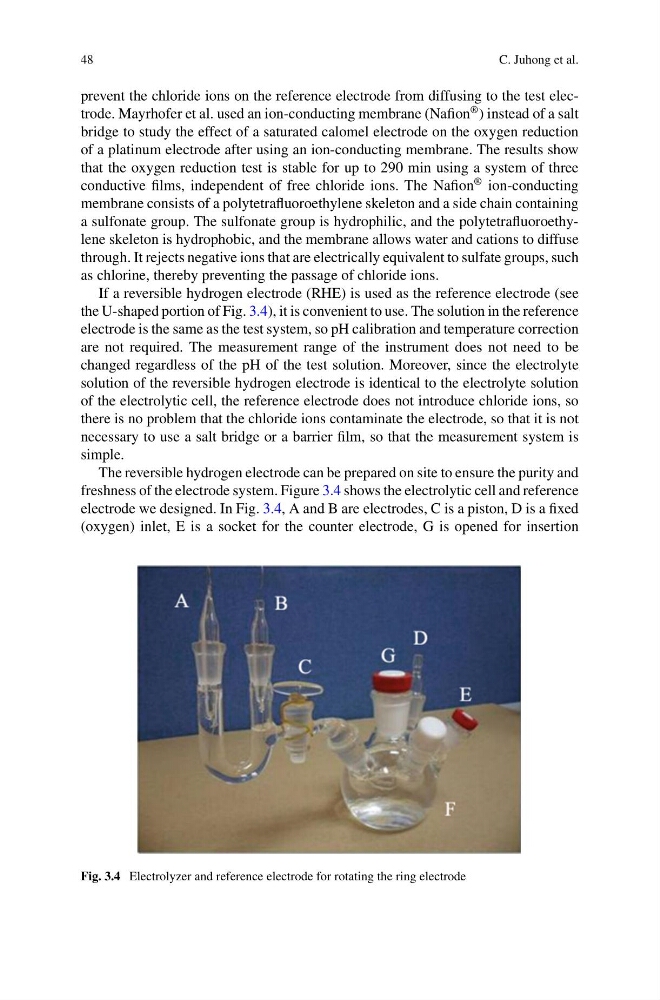
If a reversible hydrogen electrode (RHE) is used as the reference electrode (see
the U-shaped portion of Fig. 3.4), it is convenient to use. The solution in the reference
electrode is the same as the test system, so pH calibration and temperature correction
are not required. The measurement range of the instrument does not need to be
changed regardless of the pH of the test solution. Moreover, since the electrolyte
solution of the reversible hydrogen electrode is identical to the electrolyte solution
of the electrolytic cell, the reference electrode does not introduce chloride ions, so
there is no problem that the chloride ions contaminate the electrode, so that it is not
necessary to use a salt bridge or a barrier film, so that the measurement system is
simple.
The reversible hydrogen electrode can be prepared on site to ensure the purity and
freshness of the electrode system. Figure 3.4 shows the electrolytic cell and reference
electrode we designed. In Fig. 3.4, A and B are electrodes, C is a piston, D is a fixed
(oxygen) inlet, E is a socket for the counter electrode, G is opened for insertion
Fig. 3.4 Electrolyzer and reference electrode for rotating the ring electrode
C. Juhong et al.
prevent the chloride ions on the reference electrode from diffusing to the test electrode. Mayrhofer et al. used an ion-conducting membrane (Nafion
® ) instead of a salt
bridge to study the effect of a saturated calomel electrode on the oxygen reduction
of a platinum electrode after using an ion-conducting membrane. The results show
that the oxygen reduction test is stable for up to 290 min using a system of three
conductive films, independent of free chloride ions. The Nafion
® ion-conducting
membrane consists of a polytetrafluoroethylene skeleton and a side chain containing
a sulfonate group. The sulfonate group is hydrophilic, and the polytetrafluoroethylene skeleton is hydrophobic, and the membrane allows water and cations to diffuse
through. It rejects negative ions that are electrically equivalent to sulfate groups, such
as chlorine, thereby preventing the passage of chloride ions.
If a reversible hydrogen electrode (RHE) is used as the reference electrode (see
the U-shaped portion of Fig. 3.4), it is convenient to use. The solution in the reference
electrode is the same as the test system, so pH calibration and temperature correction
are not required. The measurement range of the instrument does not need to be
changed regardless of the pH of the test solution. Moreover, since the electrolyte
solution of the reversible hydrogen electrode is identical to the electrolyte solution
of the electrolytic cell, the reference electrode does not introduce chloride ions, so
there is no problem that the chloride ions contaminate the electrode, so that it is not
necessary to use a salt bridge or a barrier film, so that the measurement system is
simple.
The reversible hydrogen electrode can be prepared on site to ensure the purity and
freshness of the electrode system. Figure 3.4 shows the electrolytic cell and reference
electrode we designed. In Fig. 3.4, A and B are electrodes, C is a piston, D is a fixed
(oxygen) inlet, E is a socket for the counter electrode, G is opened for insertion
Fig. 3.4 Electrolyzer and reference electrode for rotating the ring electrode