

32
C. Juhong et al.
to have a chemical potential for the complete reduction of the intermediate species,
which can only be achieved on a few metal surfaces, such as the (100) crystal planes
of platinum, palladium, silver and gold. Most materials, including carbon, mercury,
other crystal faces of gold, and oxide-modified metals, are indirect two-electron reactions. The direct four-electron reaction and indirect two-electron reaction in acidic
and alkaline solutions are briefly described below.
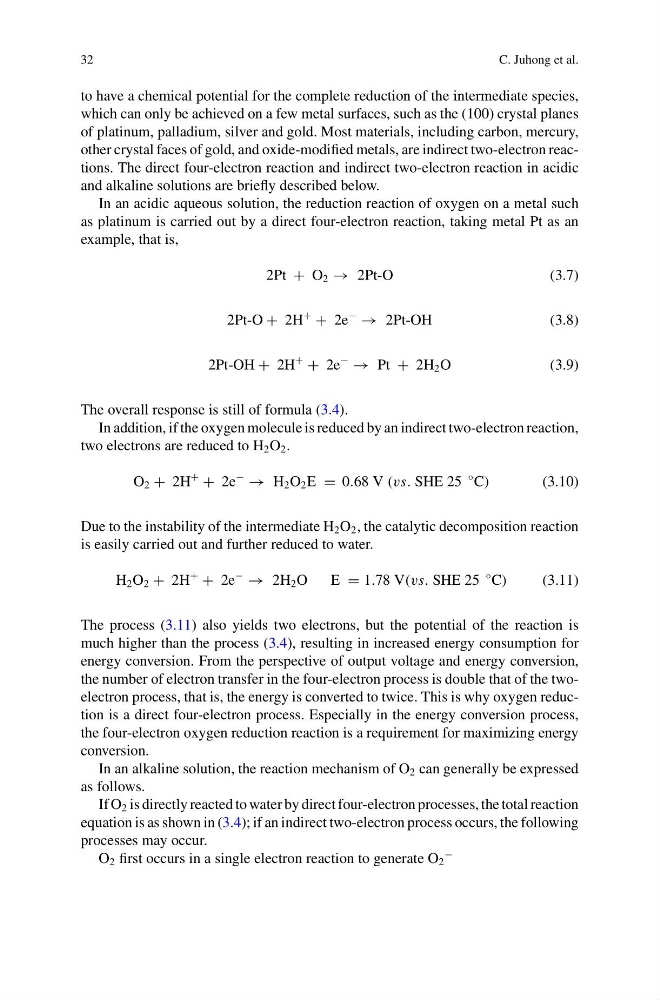
In an acidic aqueous solution, the reduction reaction of oxygen on a metal such
as platinum is carried out by a direct four-electron reaction, taking metal Pt as an
example, that is,
2Pt + O 2 → 2Pt-O
(3.7)
2Pt-O + 2H
+
+ 2e
−
→ 2Pt-OH
(3.8)
2Pt-OH + 2H
+
+ 2e
−
→ Pt + 2H 2 O
(3.9)
The overall response is still of formula (3.4).
In addition, if the oxygen molecule is reduced by an indirect two-electron reaction,
two electrons are reduced to H 2 O 2 .
O 2 + 2H
+
+ 2e
−
→ H 2 O 2 E = 0.68 V (vs. SHE 25
◦ C)
(3.10)
Due to the instability of the intermediate H 2 O 2 , the catalytic decomposition reaction
is easily carried out and further reduced to water.
H 2 O 2 + 2H
+
+ 2e
−
→ 2H 2 O
E = 1.78 V(vs. SHE 25
◦ C)
(3.11)
The process (3.11) also yields two electrons, but the potential of the reaction is
much higher than the process (3.4), resulting in increased energy consumption for
energy conversion. From the perspective of output voltage and energy conversion,
the number of electron transfer in the four-electron process is double that of the twoelectron process, that is, the energy is converted to twice. This is why oxygen reduction is a direct four-electron process. Especially in the energy conversion process,
the four-electron oxygen reduction reaction is a requirement for maximizing energy
conversion.
In an alkaline solution, the reaction mechanism of O 2 can generally be expressed
as follows.
If O 2 is directly reacted to water by direct four-electron processes, the total reaction
equation is as shown in (3.4); if an indirect two-electron process occurs, the following
processes may occur.
O 2 first occurs in a single electron reaction to generate O 2
−
C. Juhong et al.
to have a chemical potential for the complete reduction of the intermediate species,
which can only be achieved on a few metal surfaces, such as the (100) crystal planes
of platinum, palladium, silver and gold. Most materials, including carbon, mercury,
other crystal faces of gold, and oxide-modified metals, are indirect two-electron reactions. The direct four-electron reaction and indirect two-electron reaction in acidic
and alkaline solutions are briefly described below.
In an acidic aqueous solution, the reduction reaction of oxygen on a metal such
as platinum is carried out by a direct four-electron reaction, taking metal Pt as an
example, that is,
2Pt + O 2 → 2Pt-O
(3.7)
2Pt-O + 2H
+
+ 2e
−
→ 2Pt-OH
(3.8)
2Pt-OH + 2H
+
+ 2e
−
→ Pt + 2H 2 O
(3.9)
The overall response is still of formula (3.4).
In addition, if the oxygen molecule is reduced by an indirect two-electron reaction,
two electrons are reduced to H 2 O 2 .
O 2 + 2H
+
+ 2e
−
→ H 2 O 2 E = 0.68 V (vs. SHE 25
◦ C)
(3.10)
Due to the instability of the intermediate H 2 O 2 , the catalytic decomposition reaction
is easily carried out and further reduced to water.
H 2 O 2 + 2H
+
+ 2e
−
→ 2H 2 O
E = 1.78 V(vs. SHE 25
◦ C)
(3.11)
The process (3.11) also yields two electrons, but the potential of the reaction is
much higher than the process (3.4), resulting in increased energy consumption for
energy conversion. From the perspective of output voltage and energy conversion,
the number of electron transfer in the four-electron process is double that of the twoelectron process, that is, the energy is converted to twice. This is why oxygen reduction is a direct four-electron process. Especially in the energy conversion process,
the four-electron oxygen reduction reaction is a requirement for maximizing energy
conversion.
In an alkaline solution, the reaction mechanism of O 2 can generally be expressed
as follows.
If O 2 is directly reacted to water by direct four-electron processes, the total reaction
equation is as shown in (3.4); if an indirect two-electron process occurs, the following
processes may occur.
O 2 first occurs in a single electron reaction to generate O 2
−