

3 The Measurements of the Oxygen Reduction Reaction
31
The Gibbs free energy generated by the standard mole of 1 mol of liquid water is −
237.142 kJ mol
−1 , the Faraday constant is 96485 C mol
−1 , the number of transferred
electrons is 2, and the conversion formula of Gibbs free energy and electrode potential
is obtained.
E = −
G
nF
(3.6)
It can be calculated that the theoretical equilibrium potential for generating 1 mol
of liquid water at 298 K is 1.229 V. It can be seen from the Gibbs free energy of
this reaction that the reaction is thermodynamically spontaneous, but because the
reaction rate is extremely slow and limited by the reaction kinetics, an external
catalyst is needed to improve its kinetics performance.
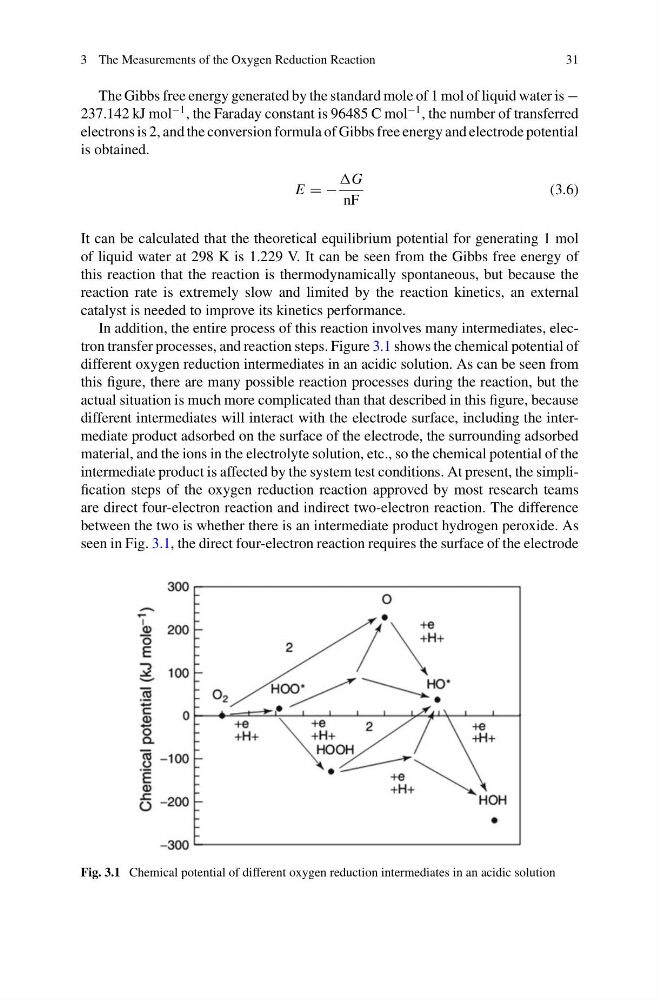
In addition, the entire process of this reaction involves many intermediates, electron transfer processes, and reaction steps. Figure 3.1 shows the chemical potential of
different oxygen reduction intermediates in an acidic solution. As can be seen from
this figure, there are many possible reaction processes during the reaction, but the
actual situation is much more complicated than that described in this figure, because
different intermediates will interact with the electrode surface, including the intermediate product adsorbed on the surface of the electrode, the surrounding adsorbed
material, and the ions in the electrolyte solution, etc., so the chemical potential of the
intermediate product is affected by the system test conditions. At present, the simplification steps of the oxygen reduction reaction approved by most research teams
are direct four-electron reaction and indirect two-electron reaction. The difference
between the two is whether there is an intermediate product hydrogen peroxide. As
seen in Fig. 3.1, the direct four-electron reaction requires the surface of the electrode
Fig. 3.1 Chemical potential of different oxygen reduction intermediates in an acidic solution
31
The Gibbs free energy generated by the standard mole of 1 mol of liquid water is −
237.142 kJ mol
−1 , the Faraday constant is 96485 C mol
−1 , the number of transferred
electrons is 2, and the conversion formula of Gibbs free energy and electrode potential
is obtained.
E = −
G
nF
(3.6)
It can be calculated that the theoretical equilibrium potential for generating 1 mol
of liquid water at 298 K is 1.229 V. It can be seen from the Gibbs free energy of
this reaction that the reaction is thermodynamically spontaneous, but because the
reaction rate is extremely slow and limited by the reaction kinetics, an external
catalyst is needed to improve its kinetics performance.
In addition, the entire process of this reaction involves many intermediates, electron transfer processes, and reaction steps. Figure 3.1 shows the chemical potential of
different oxygen reduction intermediates in an acidic solution. As can be seen from
this figure, there are many possible reaction processes during the reaction, but the
actual situation is much more complicated than that described in this figure, because
different intermediates will interact with the electrode surface, including the intermediate product adsorbed on the surface of the electrode, the surrounding adsorbed
material, and the ions in the electrolyte solution, etc., so the chemical potential of the
intermediate product is affected by the system test conditions. At present, the simplification steps of the oxygen reduction reaction approved by most research teams
are direct four-electron reaction and indirect two-electron reaction. The difference
between the two is whether there is an intermediate product hydrogen peroxide. As
seen in Fig. 3.1, the direct four-electron reaction requires the surface of the electrode
Fig. 3.1 Chemical potential of different oxygen reduction intermediates in an acidic solution