

3 The Measurements of the Oxygen Reduction Reaction
33
O 2 + e
−
→ O
−
2
(3.12)
O 2
− is protonated to HO 2
− by a water molecule, which is also a single electron
reaction.
O
−
2 + H 2 O → HO
−
2 + OH
(3.13)
OH + e
−
→ OH
−
(3.14)
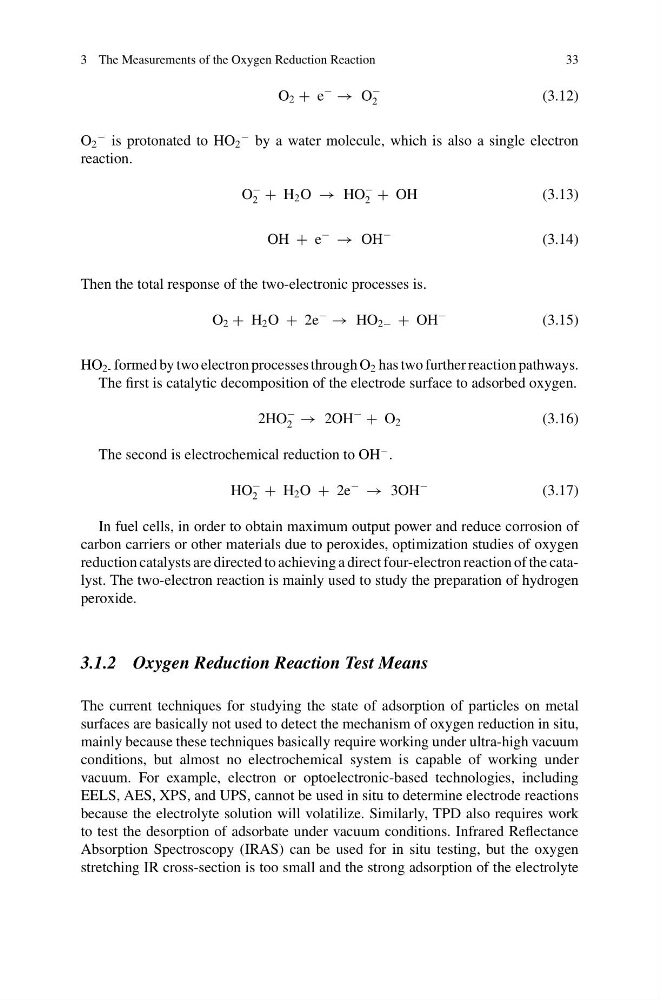
Then the total response of the two-electronic processes is.
O 2 + H 2 O + 2e
−
→ HO 2− + OH
−
(3.15)
HO 2- formed by two electron processes through O 2 has two further reaction pathways.
The first is catalytic decomposition of the electrode surface to adsorbed oxygen.
2HO
−
2 → 2OH
−
+ O 2
(3.16)
The second is electrochemical reduction to OH
− .
HO
−
2 + H 2 O + 2e
−
→ 3OH
−
(3.17)
In fuel cells, in order to obtain maximum output power and reduce corrosion of
carbon carriers or other materials due to peroxides, optimization studies of oxygen
reduction catalysts are directed to achieving a direct four-electron reaction of the catalyst. The two-electron reaction is mainly used to study the preparation of hydrogen
peroxide.
3.1.2 Oxygen Reduction Reaction Test Means
The current techniques for studying the state of adsorption of particles on metal
surfaces are basically not used to detect the mechanism of oxygen reduction in situ,
mainly because these techniques basically require working under ultra-high vacuum
conditions, but almost no electrochemical system is capable of working under
vacuum. For example, electron or optoelectronic-based technologies, including
EELS, AES, XPS, and UPS, cannot be used in situ to determine electrode reactions
because the electrolyte solution will volatilize. Similarly, TPD also requires work
to test the desorption of adsorbate under vacuum conditions. Infrared Reflectance
Absorption Spectroscopy (IRAS) can be used for in situ testing, but the oxygen
stretching IR cross-section is too small and the strong adsorption of the electrolyte
33
O 2 + e
−
→ O
−
2
(3.12)
O 2
− is protonated to HO 2
− by a water molecule, which is also a single electron
reaction.
O
−
2 + H 2 O → HO
−
2 + OH
(3.13)
OH + e
−
→ OH
−
(3.14)
Then the total response of the two-electronic processes is.
O 2 + H 2 O + 2e
−
→ HO 2− + OH
−
(3.15)
HO 2- formed by two electron processes through O 2 has two further reaction pathways.
The first is catalytic decomposition of the electrode surface to adsorbed oxygen.
2HO
−
2 → 2OH
−
+ O 2
(3.16)
The second is electrochemical reduction to OH
− .
HO
−
2 + H 2 O + 2e
−
→ 3OH
−
(3.17)
In fuel cells, in order to obtain maximum output power and reduce corrosion of
carbon carriers or other materials due to peroxides, optimization studies of oxygen
reduction catalysts are directed to achieving a direct four-electron reaction of the catalyst. The two-electron reaction is mainly used to study the preparation of hydrogen
peroxide.
3.1.2 Oxygen Reduction Reaction Test Means
The current techniques for studying the state of adsorption of particles on metal
surfaces are basically not used to detect the mechanism of oxygen reduction in situ,
mainly because these techniques basically require working under ultra-high vacuum
conditions, but almost no electrochemical system is capable of working under
vacuum. For example, electron or optoelectronic-based technologies, including
EELS, AES, XPS, and UPS, cannot be used in situ to determine electrode reactions
because the electrolyte solution will volatilize. Similarly, TPD also requires work
to test the desorption of adsorbate under vacuum conditions. Infrared Reflectance
Absorption Spectroscopy (IRAS) can be used for in situ testing, but the oxygen
stretching IR cross-section is too small and the strong adsorption of the electrolyte