

222
J. Zhu et al.
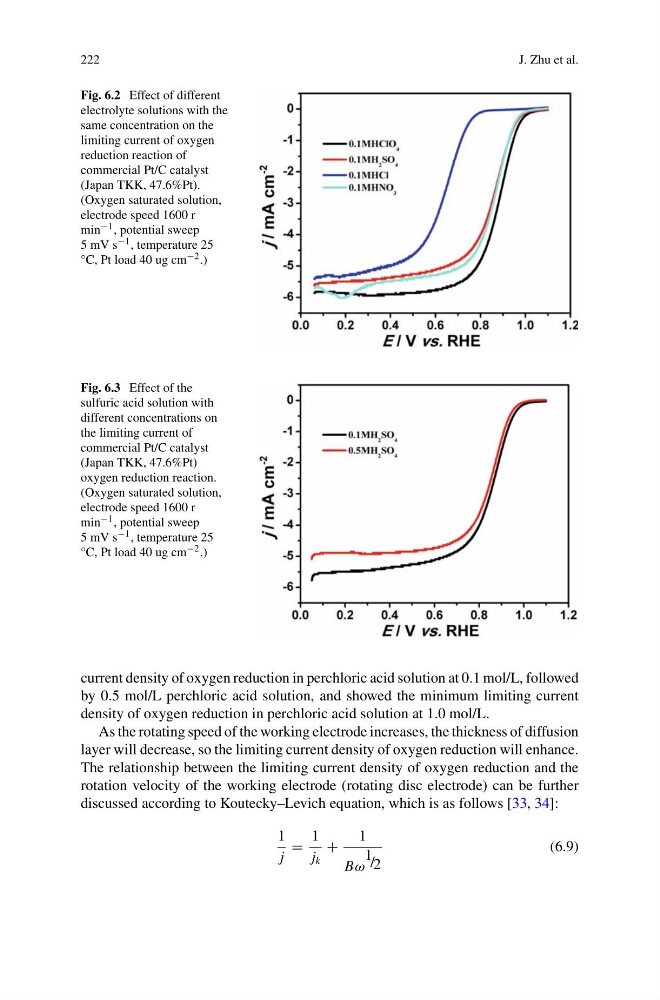
Fig. 6.2 Effect of different
electrolyte solutions with the
same concentration on the
limiting current of oxygen
reduction reaction of
commercial Pt/C catalyst
(Japan TKK, 47.6%Pt).
(Oxygen saturated solution,
electrode speed 1600 r
min −1 , potential sweep
5 mV s −1 , temperature 25
°C, Pt load 40 ug cm −2 .)
Fig. 6.3 Effect of the
sulfuric acid solution with
different concentrations on
the limiting current of
commercial Pt/C catalyst
(Japan TKK, 47.6%Pt)
oxygen reduction reaction.
(Oxygen saturated solution,
electrode speed 1600 r
min −1 , potential sweep
5 mV s −1 , temperature 25
°C, Pt load 40 ug cm −2 .)
current density of oxygen reduction in perchloric acid solution at 0.1 mol/L, followed
by 0.5 mol/L perchloric acid solution, and showed the minimum limiting current
density of oxygen reduction in perchloric acid solution at 1.0 mol/L.
As the rotating speed of the working electrode increases, the thickness of diffusion
layer will decrease, so the limiting current density of oxygen reduction will enhance.
The relationship between the limiting current density of oxygen reduction and the
rotation velocity of the working electrode (rotating disc electrode) can be further
discussed according to Koutecky–Levich equation, which is as follows [33, 34]:
1
j
=
1
j k
+
1
Bω
1 / 2
(6.9)
J. Zhu et al.
Fig. 6.2 Effect of different
electrolyte solutions with the
same concentration on the
limiting current of oxygen
reduction reaction of
commercial Pt/C catalyst
(Japan TKK, 47.6%Pt).
(Oxygen saturated solution,
electrode speed 1600 r
min −1 , potential sweep
5 mV s −1 , temperature 25
°C, Pt load 40 ug cm −2 .)
Fig. 6.3 Effect of the
sulfuric acid solution with
different concentrations on
the limiting current of
commercial Pt/C catalyst
(Japan TKK, 47.6%Pt)
oxygen reduction reaction.
(Oxygen saturated solution,
electrode speed 1600 r
min −1 , potential sweep
5 mV s −1 , temperature 25
°C, Pt load 40 ug cm −2 .)
current density of oxygen reduction in perchloric acid solution at 0.1 mol/L, followed
by 0.5 mol/L perchloric acid solution, and showed the minimum limiting current
density of oxygen reduction in perchloric acid solution at 1.0 mol/L.
As the rotating speed of the working electrode increases, the thickness of diffusion
layer will decrease, so the limiting current density of oxygen reduction will enhance.
The relationship between the limiting current density of oxygen reduction and the
rotation velocity of the working electrode (rotating disc electrode) can be further
discussed according to Koutecky–Levich equation, which is as follows [33, 34]:
1
j
=
1
j k
+
1
Bω
1 / 2
(6.9)