

6 Application of Oxygen Reduction Catalysts
221
i = n F D 0
a
0
O
δ
(6.6)
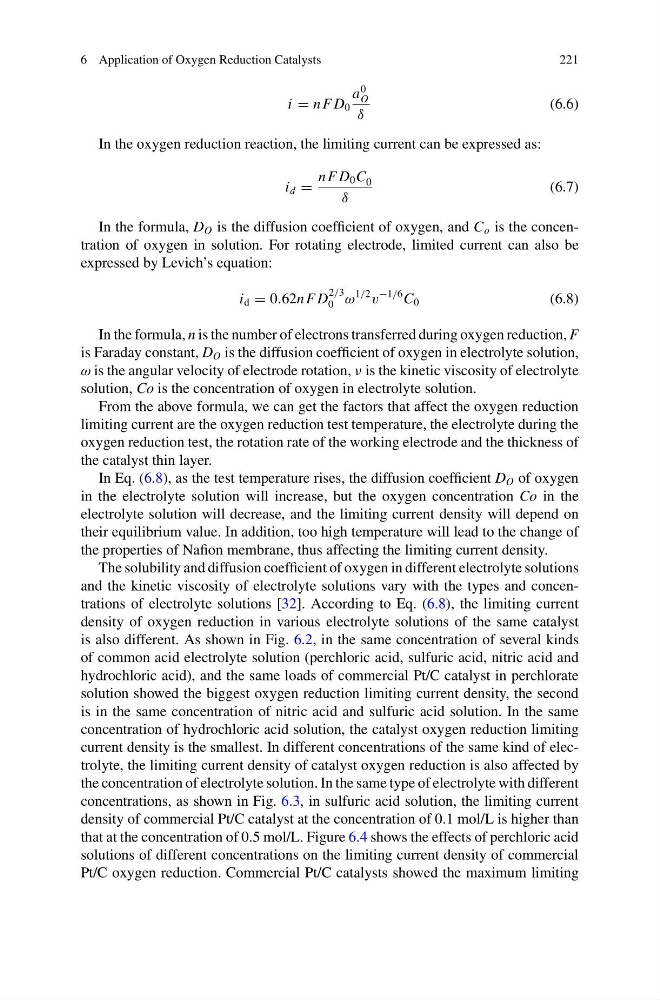
In the oxygen reduction reaction, the limiting current can be expressed as:
i d =
n F D 0 C 0
δ
(6.7)
In the formula, D O is the diffusion coefficient of oxygen, and C o is the concentration of oxygen in solution. For rotating electrode, limited current can also be
expressed by Levich’s equation:
i d = 0.62n F D
2/3
0 ω
1/2
v
−1/6 C 0
(6.8)
In the formula, n is the number of electrons transferred during oxygen reduction, F
is Faraday constant, D O is the diffusion coefficient of oxygen in electrolyte solution,
ω is the angular velocity of electrode rotation, ν is the kinetic viscosity of electrolyte
solution, Co is the concentration of oxygen in electrolyte solution.
From the above formula, we can get the factors that affect the oxygen reduction
limiting current are the oxygen reduction test temperature, the electrolyte during the
oxygen reduction test, the rotation rate of the working electrode and the thickness of
the catalyst thin layer.
In Eq. (6.8), as the test temperature rises, the diffusion coefficient D O of oxygen
in the electrolyte solution will increase, but the oxygen concentration Co in the
electrolyte solution will decrease, and the limiting current density will depend on
their equilibrium value. In addition, too high temperature will lead to the change of
the properties of Nafion membrane, thus affecting the limiting current density.
The solubility and diffusion coefficient of oxygen in different electrolyte solutions
and the kinetic viscosity of electrolyte solutions vary with the types and concentrations of electrolyte solutions [32]. According to Eq. (6.8), the limiting current
density of oxygen reduction in various electrolyte solutions of the same catalyst
is also different. As shown in Fig. 6.2, in the same concentration of several kinds
of common acid electrolyte solution (perchloric acid, sulfuric acid, nitric acid and
hydrochloric acid), and the same loads of commercial Pt/C catalyst in perchlorate
solution showed the biggest oxygen reduction limiting current density, the second
is in the same concentration of nitric acid and sulfuric acid solution. In the same
concentration of hydrochloric acid solution, the catalyst oxygen reduction limiting
current density is the smallest. In different concentrations of the same kind of electrolyte, the limiting current density of catalyst oxygen reduction is also affected by
the concentration of electrolyte solution. In the same type of electrolyte with different
concentrations, as shown in Fig. 6.3, in sulfuric acid solution, the limiting current
density of commercial Pt/C catalyst at the concentration of 0.1 mol/L is higher than
that at the concentration of 0.5 mol/L. Figure 6.4 shows the effects of perchloric acid
solutions of different concentrations on the limiting current density of commercial
Pt/C oxygen reduction. Commercial Pt/C catalysts showed the maximum limiting
221
i = n F D 0
a
0
O
δ
(6.6)
In the oxygen reduction reaction, the limiting current can be expressed as:
i d =
n F D 0 C 0
δ
(6.7)
In the formula, D O is the diffusion coefficient of oxygen, and C o is the concentration of oxygen in solution. For rotating electrode, limited current can also be
expressed by Levich’s equation:
i d = 0.62n F D
2/3
0 ω
1/2
v
−1/6 C 0
(6.8)
In the formula, n is the number of electrons transferred during oxygen reduction, F
is Faraday constant, D O is the diffusion coefficient of oxygen in electrolyte solution,
ω is the angular velocity of electrode rotation, ν is the kinetic viscosity of electrolyte
solution, Co is the concentration of oxygen in electrolyte solution.
From the above formula, we can get the factors that affect the oxygen reduction
limiting current are the oxygen reduction test temperature, the electrolyte during the
oxygen reduction test, the rotation rate of the working electrode and the thickness of
the catalyst thin layer.
In Eq. (6.8), as the test temperature rises, the diffusion coefficient D O of oxygen
in the electrolyte solution will increase, but the oxygen concentration Co in the
electrolyte solution will decrease, and the limiting current density will depend on
their equilibrium value. In addition, too high temperature will lead to the change of
the properties of Nafion membrane, thus affecting the limiting current density.
The solubility and diffusion coefficient of oxygen in different electrolyte solutions
and the kinetic viscosity of electrolyte solutions vary with the types and concentrations of electrolyte solutions [32]. According to Eq. (6.8), the limiting current
density of oxygen reduction in various electrolyte solutions of the same catalyst
is also different. As shown in Fig. 6.2, in the same concentration of several kinds
of common acid electrolyte solution (perchloric acid, sulfuric acid, nitric acid and
hydrochloric acid), and the same loads of commercial Pt/C catalyst in perchlorate
solution showed the biggest oxygen reduction limiting current density, the second
is in the same concentration of nitric acid and sulfuric acid solution. In the same
concentration of hydrochloric acid solution, the catalyst oxygen reduction limiting
current density is the smallest. In different concentrations of the same kind of electrolyte, the limiting current density of catalyst oxygen reduction is also affected by
the concentration of electrolyte solution. In the same type of electrolyte with different
concentrations, as shown in Fig. 6.3, in sulfuric acid solution, the limiting current
density of commercial Pt/C catalyst at the concentration of 0.1 mol/L is higher than
that at the concentration of 0.5 mol/L. Figure 6.4 shows the effects of perchloric acid
solutions of different concentrations on the limiting current density of commercial
Pt/C oxygen reduction. Commercial Pt/C catalysts showed the maximum limiting