

220
J. Zhu et al.
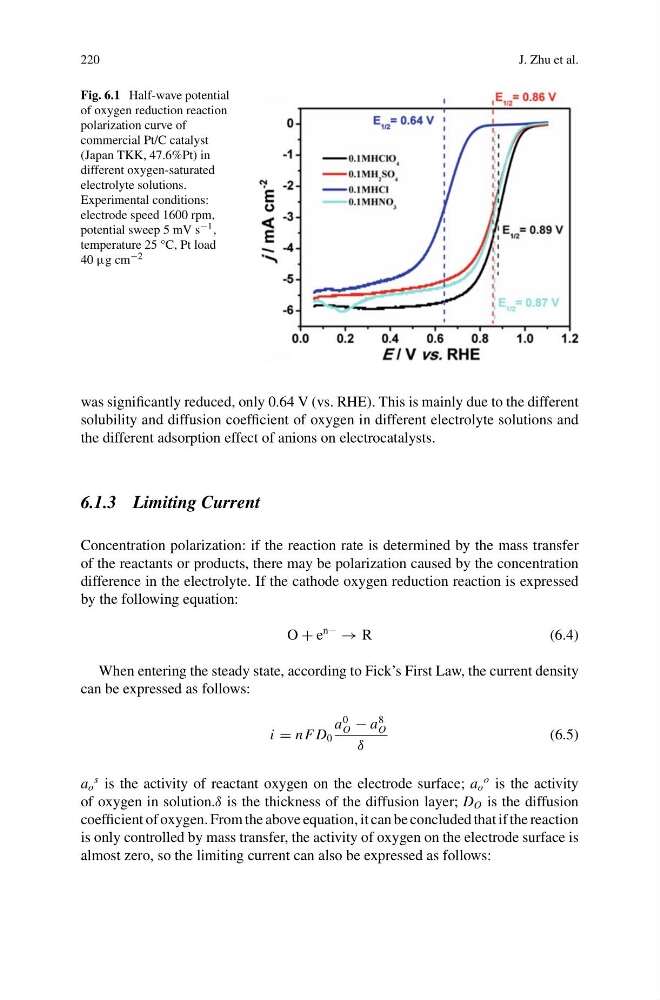
Fig. 6.1 Half-wave potential
of oxygen reduction reaction
polarization curve of
commercial Pt/C catalyst
(Japan TKK, 47.6%Pt) in
different oxygen-saturated
electrolyte solutions.
Experimental conditions:
electrode speed 1600 rpm,
potential sweep 5 mV s −1 ,
temperature 25 °C, Pt load
40 μg cm −2
was significantly reduced, only 0.64 V (vs. RHE). This is mainly due to the different
solubility and diffusion coefficient of oxygen in different electrolyte solutions and
the different adsorption effect of anions on electrocatalysts.
6.1.3 Limiting Current
Concentration polarization: if the reaction rate is determined by the mass transfer
of the reactants or products, there may be polarization caused by the concentration
difference in the electrolyte. If the cathode oxygen reduction reaction is expressed
by the following equation:
O + e
n−
→ R
( 6 . 4 )
When entering the steady state, according to Fick’s First Law, the current density
can be expressed as follows:
i = n F D 0
a
0
O − a
8
O
δ
(6.5)
a o
s is the activity of reactant oxygen on the electrode surface; a o
o is the activity
of oxygen in solution.δ is the thickness of the diffusion layer; D O is the diffusion
coefficient of oxygen. From the above equation, it can be concluded that if the reaction
is only controlled by mass transfer, the activity of oxygen on the electrode surface is
almost zero, so the limiting current can also be expressed as follows:
J. Zhu et al.
Fig. 6.1 Half-wave potential
of oxygen reduction reaction
polarization curve of
commercial Pt/C catalyst
(Japan TKK, 47.6%Pt) in
different oxygen-saturated
electrolyte solutions.
Experimental conditions:
electrode speed 1600 rpm,
potential sweep 5 mV s −1 ,
temperature 25 °C, Pt load
40 μg cm −2
was significantly reduced, only 0.64 V (vs. RHE). This is mainly due to the different
solubility and diffusion coefficient of oxygen in different electrolyte solutions and
the different adsorption effect of anions on electrocatalysts.
6.1.3 Limiting Current
Concentration polarization: if the reaction rate is determined by the mass transfer
of the reactants or products, there may be polarization caused by the concentration
difference in the electrolyte. If the cathode oxygen reduction reaction is expressed
by the following equation:
O + e
n−
→ R
( 6 . 4 )
When entering the steady state, according to Fick’s First Law, the current density
can be expressed as follows:
i = n F D 0
a
0
O − a
8
O
δ
(6.5)
a o
s is the activity of reactant oxygen on the electrode surface; a o
o is the activity
of oxygen in solution.δ is the thickness of the diffusion layer; D O is the diffusion
coefficient of oxygen. From the above equation, it can be concluded that if the reaction
is only controlled by mass transfer, the activity of oxygen on the electrode surface is
almost zero, so the limiting current can also be expressed as follows: