

208
S. Luo et al.
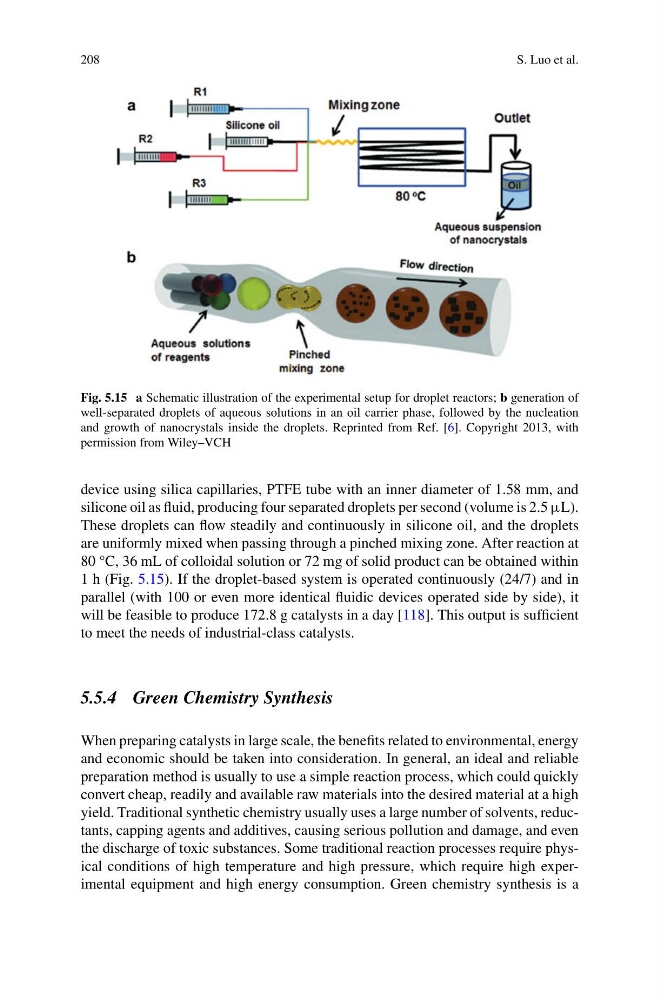
Fig. 5.15 a Schematic illustration of the experimental setup for droplet reactors; b generation of
well-separated droplets of aqueous solutions in an oil carrier phase, followed by the nucleation
and growth of nanocrystals inside the droplets. Reprinted from Ref. [6]. Copyright 2013, with
permission from Wiley–VCH
device using silica capillaries, PTFE tube with an inner diameter of 1.58 mm, and
silicone oil as fluid, producing four separated droplets per second (volume is 2.5 µL).
These droplets can flow steadily and continuously in silicone oil, and the droplets
are uniformly mixed when passing through a pinched mixing zone. After reaction at
80 °C, 36 mL of colloidal solution or 72 mg of solid product can be obtained within
1 h (Fig. 5.15). If the droplet-based system is operated continuously (24/7) and in
parallel (with 100 or even more identical fluidic devices operated side by side), it
will be feasible to produce 172.8 g catalysts in a day [118]. This output is sufficient
to meet the needs of industrial-class catalysts.
5.5.4 Green Chemistry Synthesis
When preparing catalysts in large scale, the benefits related to environmental, energy
and economic should be taken into consideration. In general, an ideal and reliable
preparation method is usually to use a simple reaction process, which could quickly
convert cheap, readily and available raw materials into the desired material at a high
yield. Traditional synthetic chemistry usually uses a large number of solvents, reductants, capping agents and additives, causing serious pollution and damage, and even
the discharge of toxic substances. Some traditional reaction processes require physical conditions of high temperature and high pressure, which require high experimental equipment and high energy consumption. Green chemistry synthesis is a
S. Luo et al.
Fig. 5.15 a Schematic illustration of the experimental setup for droplet reactors; b generation of
well-separated droplets of aqueous solutions in an oil carrier phase, followed by the nucleation
and growth of nanocrystals inside the droplets. Reprinted from Ref. [6]. Copyright 2013, with
permission from Wiley–VCH
device using silica capillaries, PTFE tube with an inner diameter of 1.58 mm, and
silicone oil as fluid, producing four separated droplets per second (volume is 2.5 µL).
These droplets can flow steadily and continuously in silicone oil, and the droplets
are uniformly mixed when passing through a pinched mixing zone. After reaction at
80 °C, 36 mL of colloidal solution or 72 mg of solid product can be obtained within
1 h (Fig. 5.15). If the droplet-based system is operated continuously (24/7) and in
parallel (with 100 or even more identical fluidic devices operated side by side), it
will be feasible to produce 172.8 g catalysts in a day [118]. This output is sufficient
to meet the needs of industrial-class catalysts.
5.5.4 Green Chemistry Synthesis
When preparing catalysts in large scale, the benefits related to environmental, energy
and economic should be taken into consideration. In general, an ideal and reliable
preparation method is usually to use a simple reaction process, which could quickly
convert cheap, readily and available raw materials into the desired material at a high
yield. Traditional synthetic chemistry usually uses a large number of solvents, reductants, capping agents and additives, causing serious pollution and damage, and even
the discharge of toxic substances. Some traditional reaction processes require physical conditions of high temperature and high pressure, which require high experimental equipment and high energy consumption. Green chemistry synthesis is a